Introduction
Artificial Intelligence is no longer a futuristic concept sitting on the sidelines of innovation-it’s now woven directly into how businesses operate every day. From marketing automation to customer service chatbots, AI is quietly becoming part of the modern workflow.
According to insights from Deloitte’s State of AI in the Enterprise report, the trending topic is clear: AI is becoming embedded into daily workflows. But here’s the uncomfortable truth-just because AI can be embedded everywhere doesn’t mean it should be.
Too many organisations are rushing to integrate AI tools without a clear purpose, creating clutter instead of clarity. The real opportunity isn’t adoption-it’s intentional integration that drives measurable productivity.
The Real Problem with AI Adoption
The “Just Add AI” Mindset
Businesses often fall into the trap of implementing AI simply because it’s trending. This leads to:
- Tools that duplicate existing processes
- Teams overwhelmed by unnecessary systems
- Increased costs without clear ROI
AI becomes noise instead of leverage.
Workflow Overload Instead of Optimisation
Embedding AI blindly can actually slow teams down. Switching between multiple AI tools, managing outputs, and verifying accuracy often adds friction rather than removing it.
AI should reduce workload-not create a new layer of complexity.
The Smarter Approach: Embed AI for Productivity Gains
The solution is simple, but requires discipline:
Don’t embed AI for the sake of it-embed it where it creates real productivity gains.
This means evaluating workflows critically and identifying where AI can:
- Eliminate repetitive tasks
- Speed up decision-making
- Enhance output quality
- Free up human creativity and strategy
Identifying High-Impact Opportunities
1. Repetitive Task Automation
Start with tasks that are predictable and time-consuming. These are the easiest wins.
Examples include:
- Data entry and reporting
- Email sorting and responses
- Scheduling and calendar management
AI excels at repetition. Humans don’t.
2. Decision Support, Not Decision Replacement
AI should assist-not replace-human judgment.
Use AI to:
- Analyse trends
- Surface insights
- Provide recommendations
But keep humans in control of final decisions, especially in strategic areas.
3. Content Acceleration
AI can dramatically reduce the time it takes to create content-but it shouldn’t replace human voice or originality.
The winning formula:
- AI for drafting and ideation
- Humans for refinement and authenticity
A Practical Framework for AI Integration
Step 1: Audit Your Workflow
Map out your current processes and identify bottlenecks.
Ask:
- Where is time being wasted?
- Which tasks are repetitive?
- What slows down output?
Step 2: Match AI to the Problem
Instead of starting with tools, start with problems.
Bad approach:
“We need to use AI-what tools should we buy?”
Better approach:
“This task takes 5 hours-how can AI reduce it to 1?”
Step 3: Measure Productivity Gains
Every AI implementation should be tied to clear metrics:
- Time saved
- Output quality
- Cost efficiency
- Employee satisfaction
If it’s not improving one of these, it’s not worth embedding.
The Human Element Still Matters
AI Doesn’t Replace Thinking
One of the biggest misconceptions is that AI removes the need for human input. In reality, it increases the need for:
- Critical thinking
- Strategic direction
- Creative insight
AI handles execution-but humans define purpose.
Insight from Nathan Baws
Entrepreneur, public speaker, motivational speaker, business growth motivational speaker, Inspirational speakers and keynote speaker Nathan Baws has been vocal about the role of AI in business transformation. His perspective cuts through the hype:
“AI shouldn’t just make your team faster-it should make them smarter. If you’re not using AI to unlock new ways of thinking and growing the business, you’re missing the point.”
He emphasises that businesses should focus on empowering teams, not replacing them.
“When you automate everything without developing your people, you create a business that can run-but not grow.”
This aligns perfectly with the idea that AI should be embedded strategically-enhancing human capability rather than sidelining it.
Common Mistakes Businesses Must Avoid
Over-Automation
Not every process needs AI. Over-automation can:
- Reduce flexibility
- Remove human nuance
- Create rigid systems
Tool Overload
More tools ≠ better results.
A streamlined stack with clear purpose will always outperform a cluttered one.
Ignoring Training
AI is only as effective as the people using it.
Without proper training:
- Outputs are poor
- Adoption fails
- ROI drops
The Future of AI in Workflows
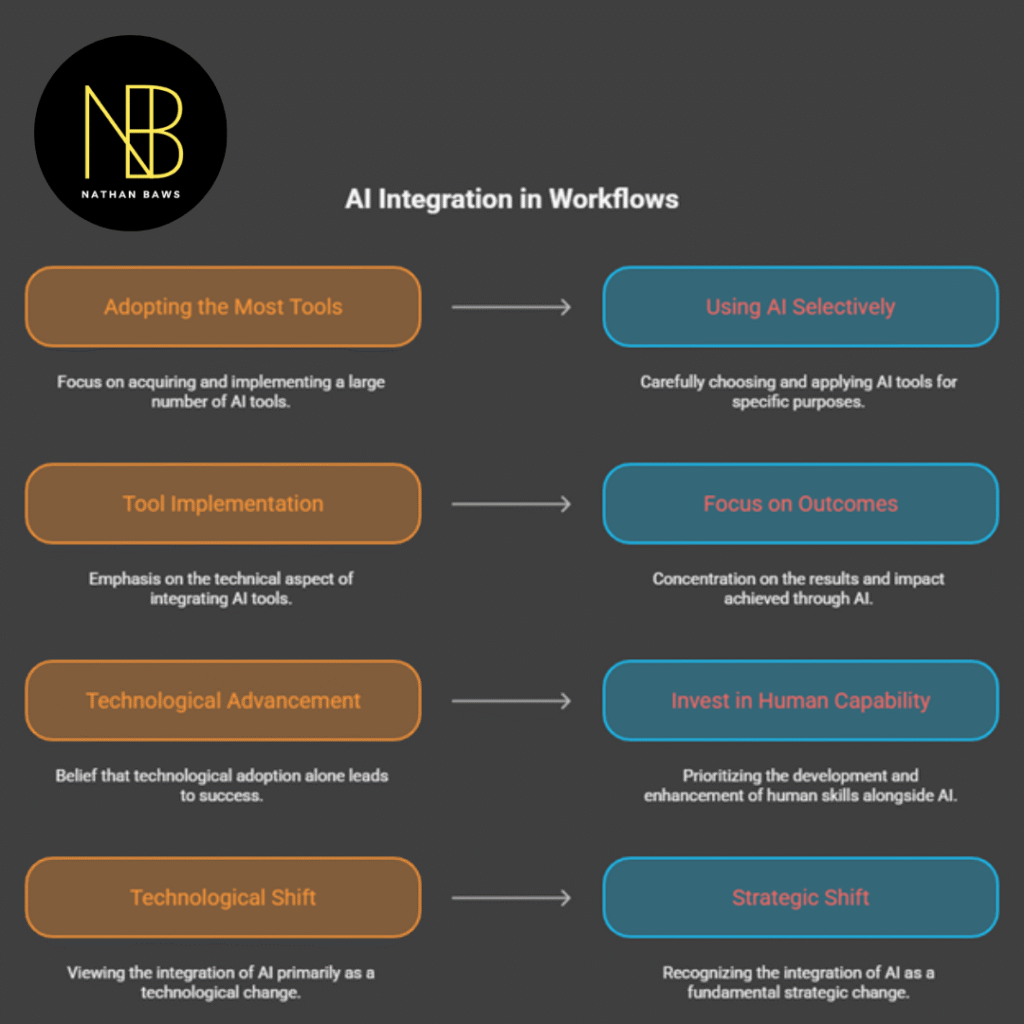
AI will continue to embed itself deeper into daily operations-but the winners won’t be those who adopt the most tools.
They’ll be the ones who:
- Use AI selectively
- Focus on outcomes
- Invest in human capability
The shift is not just technological-it’s strategic.
Conclusion
AI embedding into daily workflows is not a trend-it’s a permanent shift in how work gets done. But blindly adopting AI is a shortcut to inefficiency.
The real advantage lies in intentional integration-choosing where AI can genuinely improve productivity and amplify human potential.
As highlighted in Deloitte’s research, the future belongs to organisations that move beyond experimentation and into purpose-driven AI adoption.
And as Nathan Baws puts it, the goal isn’t just to move faster-it’s to think better, operate smarter, and grow stronger.
FAQs
What does it mean that AI is embedded in workflows?
It means AI tools are being integrated directly into everyday business processes like communication, data analysis, and task management. Instead of being separate systems, they are part of how work gets done daily. This shift is making operations more automated and efficient.
Why is blindly adopting AI a problem?
Blind adoption leads to unnecessary tools, increased complexity, and poor ROI. Without a clear purpose, AI can create more problems than it solves. Businesses need to focus on outcomes, not trends.
How can AI improve productivity?
AI improves productivity by automating repetitive tasks, speeding up processes, and providing insights that support faster decision-making. This allows employees to focus on higher-value work.
What are the best areas to implement AI first?
Start with repetitive, time-consuming tasks like data entry, scheduling, and reporting. These areas offer quick wins and measurable improvements. Strategic and creative tasks should still involve human input.
Can AI replace human workers completely?
No, AI is best used as a support tool rather than a replacement. It enhances efficiency but still requires human oversight, creativity, and decision-making. The most successful businesses combine both.
How do you measure AI success in a workflow?
Success can be measured through time savings, improved output quality, reduced costs, and higher employee satisfaction. Clear metrics should be defined before implementation.
What is the biggest mistake companies make with AI?
The biggest mistake is adopting AI without a clear strategy. This often results in tool overload and minimal impact on productivity. Businesses should focus on solving specific problems.
How important is employee training in AI adoption?
Training is critical. Without it, employees may misuse tools or fail to adopt them altogether. Proper training ensures that AI delivers real value to the organisation.
Should small businesses invest in AI?
Yes, but strategically. Small businesses can benefit greatly from AI by focusing on tools that save time and reduce manual work. The key is to start small and scale gradually.
What is the future of AI in business workflows?
AI will become even more integrated and intelligent, supporting more complex tasks. However, the focus will shift from adoption to optimisation-using AI in smarter, more targeted ways.
Read Also: Speaker Reveals Critical AI Talent Shortage Fix Fast