Introduction
There’s a growing narrative in the business world that artificial intelligence is the ultimate competitive advantage. That’s only half true.
The real advantage isn’t AI itself. It’s who knows how to use it well.
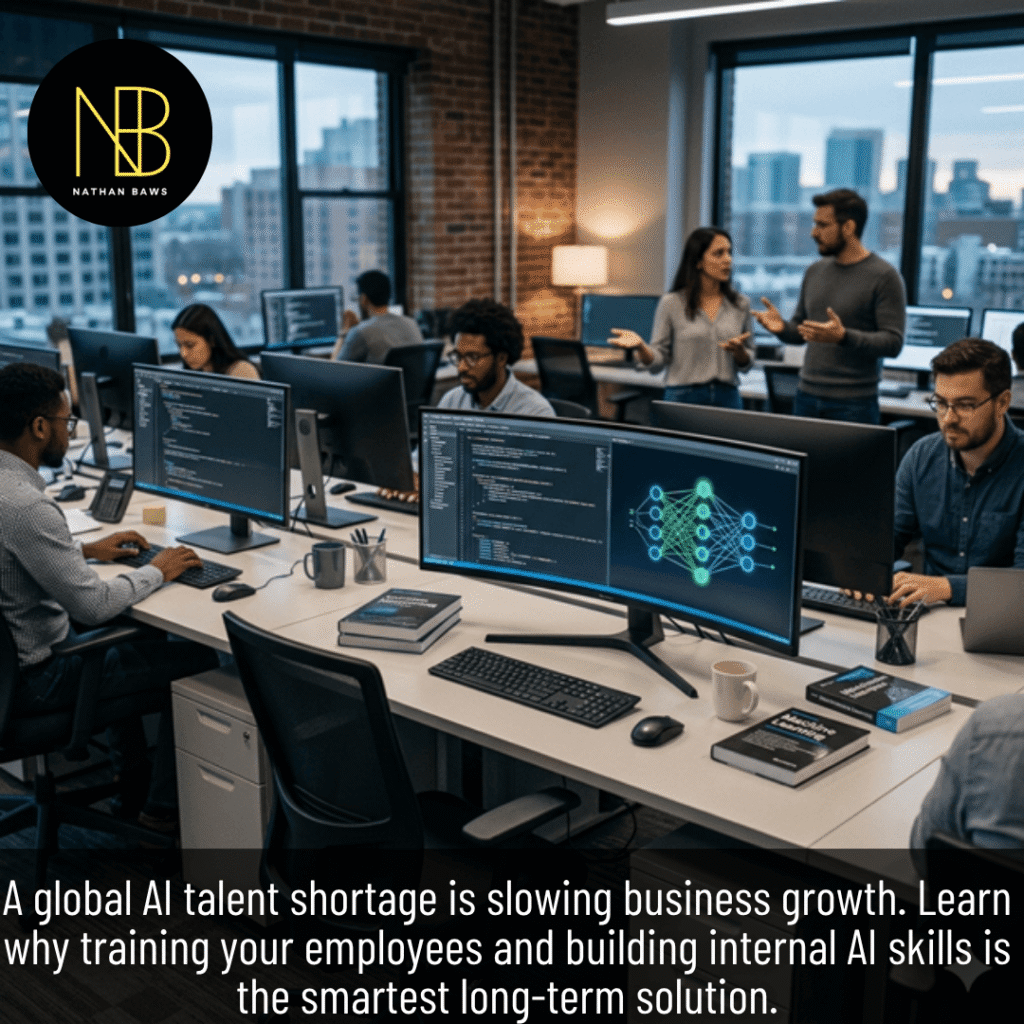
Right now, we’re facing a massive AI talent shortage, and it’s quickly becoming one of the biggest obstacles to growth across industries. A report covered by The Economic Times highlights that nearly 40% of AI and data-related roles remain unfilled. That’s not a small gap, it’s a structural weakness in how businesses are approaching transformation.
Companies are buying AI tools, subscribing to platforms, and investing in automation. But when it comes to execution, they hit a wall. Teams don’t fully understand the tools. Leaders don’t know how to integrate them into strategy. And as a result, AI ends up underutilised.
This is where most businesses go wrong. They assume the solution is to hire more talent. But in reality, the smarter and more sustainable path is to build that talent internally.
Training your employees is no longer optional. It’s the foundation of staying competitive.
The AI Talent Shortage Is a Business Problem, Not Just a Hiring Problem
It’s easy to treat the talent shortage as an HR issue. After all, if there aren’t enough skilled professionals, the natural reaction is to recruit more aggressively. But that approach only scratches the surface.
The deeper issue is that AI adoption is moving faster than workforce development. Businesses are evolving, but their people are not evolving at the same pace. This creates a disconnect between strategy and execution.
When a company invests in AI without investing in its people, it creates a situation where tools exist, but capability does not. The result is frustration, wasted resources, and stalled progress.
The shortage also exposes a more uncomfortable truth: relying on external talent makes businesses vulnerable. Skilled AI professionals are not only scarce but also highly mobile. They move where the opportunities are best, often leaving companies in a constant cycle of hiring and rehiring.
To break out of that cycle, businesses need to rethink their approach entirely.
Why Hiring More AI Experts Won’t Solve the Problem
At first glance, hiring seems like the logical solution. If you lack AI expertise, bring in people who have it. But this approach has clear limitations.
For one, the supply simply isn’t there. Every company is chasing the same pool of talent, which drives up salaries and makes hiring increasingly competitive. Even if you manage to secure top talent, integrating them into your organisation and scaling their knowledge across teams takes time.
More importantly, a handful of experts cannot transform an entire organisation. AI is not a single function. It touches marketing, sales, operations, finance, and leadership. Expecting a small group of specialists to drive that level of change is unrealistic.
There’s also a cultural barrier. When AI knowledge is concentrated in a few individuals, it creates silos. Other employees may feel disconnected from the technology, seeing it as something “technical” rather than something relevant to their daily work.
This is why hiring alone cannot close the gap. It may provide short-term relief, but it doesn’t build long-term capability.
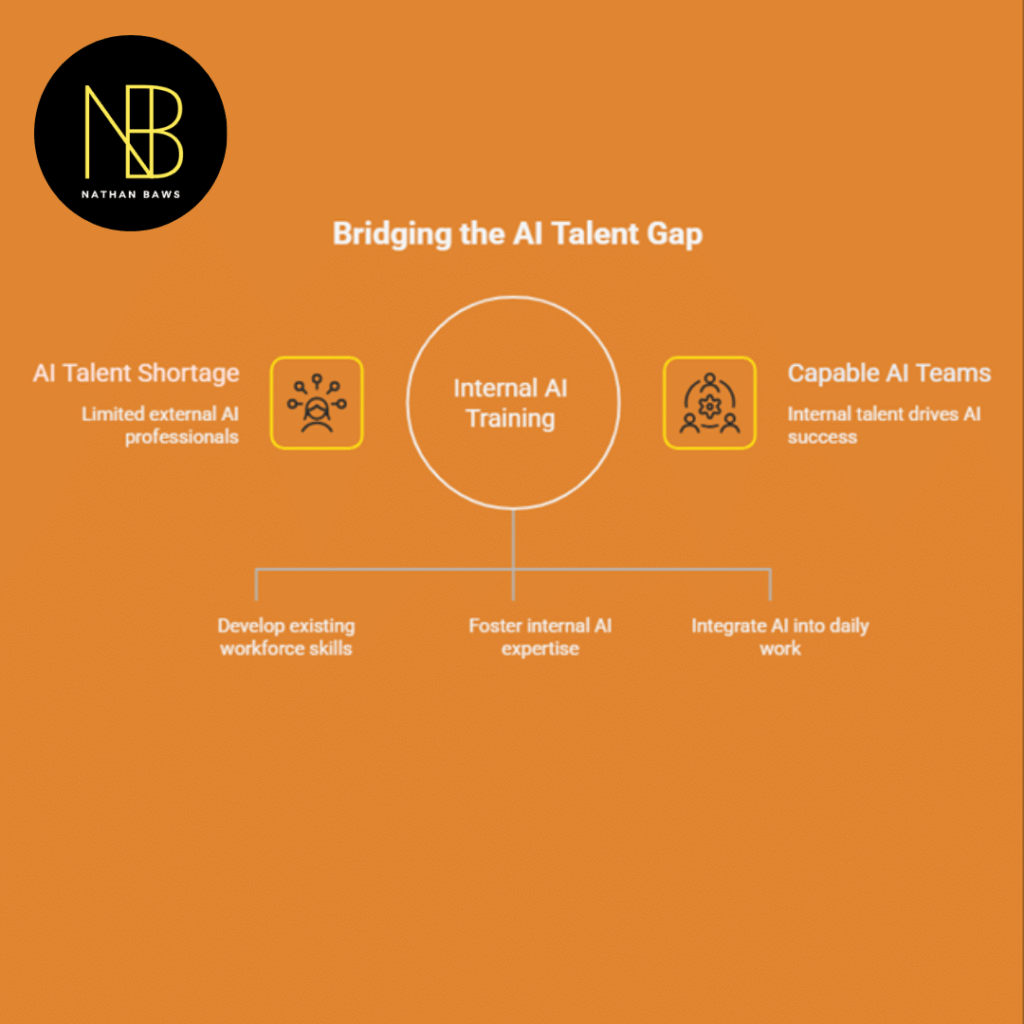
The Smarter Solution – Train Your Existing Workforce
If hiring isn’t enough, then where should businesses focus their energy?
The answer is straightforward: upskill the people you already have.
Your employees understand your business. They know your customers, your processes, and your challenges. What they need is the ability to apply AI within that context.
Training transforms AI from a specialised skill into an organisation-wide capability. Instead of relying on a few experts, you create a workforce where everyone can contribute to AI-driven outcomes.
This shift changes everything. AI stops being a separate initiative and becomes part of everyday work.
What Effective AI Training Actually Looks Like
One of the biggest mistakes companies make is treating AI training as a one-off event. A single workshop or seminar might raise awareness, but it won’t change behaviour.
Effective training is continuous, practical, and embedded into daily operations.
It starts with building a basic level of understanding across the organisation. Employees need to know what AI can do, where it applies, and how it fits into their roles. This foundational knowledge removes fear and builds confidence.
From there, the focus should shift to application. Employees should be encouraged to use AI tools in their day-to-day tasks. Whether it’s drafting content, analysing data, or automating workflows, the goal is to make AI a natural part of how work gets done.
Over time, this creates a compounding effect. As employees become more comfortable with AI, they begin to experiment, innovate, and find new ways to improve performance.
Nathan Baws on Building AI-Ready Teams
Nathan Baws, a public speaker and entrepreneur known for his work in business growth and innovation, has been vocal about the importance of preparing teams for the AI era.
He puts it simply:
“The businesses that succeed with AI won’t be the ones that spend the most on technology. They’ll be the ones that invest the most in their people.”
This perspective highlights a crucial shift. AI is not just a technical upgrade, it’s a human one. The companies that understand this are the ones that will move ahead.
Baws also emphasises the importance of combining AI skills with entrepreneurial thinking. In his view, employees should not just learn how to use tools, they should learn how to think differently, identify opportunities, and drive growth.
The Real Impact of Training Your Team in AI
When businesses commit to training their workforce, the results go beyond technical capability.
Productivity improves because employees can complete tasks more efficiently. Processes that once took hours can be done in minutes with the right use of AI.
Innovation accelerates because teams are no longer limited by manual constraints. They can test ideas faster, iterate more quickly, and bring solutions to market sooner.
Costs decrease as reliance on external consultants and specialists is reduced. Instead of constantly looking outside for expertise, businesses build it internally.
Perhaps most importantly, organisations become more adaptable. In a world where technology is constantly evolving, the ability to learn and adapt is more valuable than any single skill.
How to Start Building an AI-Driven Workforce
Transitioning to an AI-ready workforce doesn’t happen overnight, but it doesn’t have to be complicated either.
It begins with understanding where your team currently stands. Without a clear picture of existing skills and gaps, it’s impossible to design effective training.
From there, businesses need to create structured learning pathways. These should be tailored to different roles and levels of experience, ensuring that training is relevant and practical.
Equally important is integration. AI should not be treated as something separate from daily work. Employees need opportunities to apply what they learn in real situations. This is where real transformation happens.
Finally, businesses must foster a culture of continuous learning. AI is evolving rapidly, and staying ahead requires ongoing development. Encouraging curiosity, experimentation, and knowledge sharing will ensure that progress doesn’t stall.
Conclusion
The massive AI talent shortage is not just a headline, it’s a reality that businesses are already feeling. As reported by The Economic Times, the gap between demand and available talent continues to grow, making it harder for companies to fully leverage AI.
But this challenge also presents a clear opportunity.
Instead of competing for a limited pool of external talent, businesses can invest in the people they already have. By training employees, building internal capability, and embedding AI into everyday work, organisations can turn a shortage into a strength.
The companies that win in this new era won’t be the ones with the most advanced tools. They’ll be the ones with the most capable teams.
FAQs
What is the AI talent shortage?
The AI talent shortage refers to the gap between the high demand for AI-skilled professionals and the limited number of people who possess those skills, making it difficult for businesses to fully adopt AI.
How big is the current talent gap?
Reports suggest that nearly 40% of AI-related roles remain unfilled, indicating a significant global shortage of skilled professionals.
Why can’t hiring solve the issue completely?
Hiring is limited by availability, cost, and scalability. Even when companies hire experts, they cannot transform entire organisations on their own.
What is the most effective solution?
The most effective solution is to train and upskill existing employees, allowing businesses to build AI capabilities internally.
What skills should employees focus on?
Employees should learn how to use AI tools, automate tasks, analyse data, and apply AI within their specific roles.
Can non-technical employees benefit from AI training?
Yes, modern AI tools are designed to be user-friendly, making them accessible to employees across all departments.
How long does it take to train employees?
Basic AI literacy can be achieved in a few weeks, while advanced skills require continuous learning over time.
What are the benefits of AI training for businesses?
AI training improves productivity, accelerates innovation, reduces costs, and strengthens overall competitiveness.
How can companies begin implementing AI training?
They can start by assessing current skill levels, creating structured learning programs, and integrating AI into daily workflows.
What role does leadership play in AI adoption?
Leadership is responsible for setting direction, investing in training, and creating a culture that supports continuous learning and innovation.
Read Also: The Rise of Specialized AI: Why “One-Size-Fits-All” Is Dead