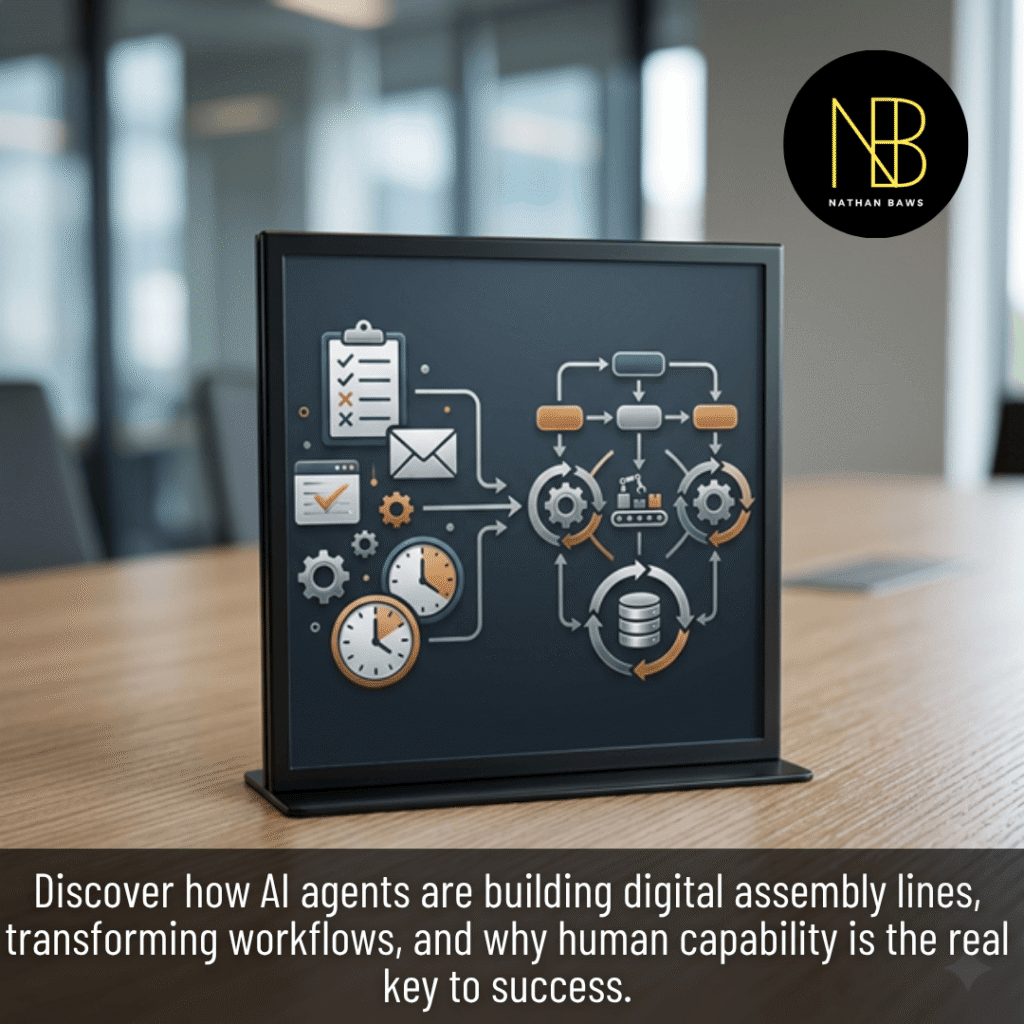
Introduction: The Moment AI Stopped Being a Tool
For the past few years, artificial intelligence has been framed as a productivity enhancer-a tool you open, prompt, and close once you get what you need. That model created excitement, but it also created a ceiling. Businesses moved faster in small bursts, yet the bigger picture remained largely unchanged.
Now, that ceiling has been shattered.
A recent report from Google Cloud captures this transition with striking clarity through the idea of “From tasks to systems.” It’s a phrase that might sound simple at first glance, but it represents one of the most important shifts in how work is structured in modern organisations.
We are no longer dealing with AI as a collection of isolated capabilities. We are entering an era where AI connects, coordinates, and executes entire workflows. This is the agent leap-and it’s fundamentally changing what productivity means.
The Problem We Didn’t Notice: Why Tasks Were Never Enough
At the height of the prompt-driven AI boom, businesses believed they had found the ultimate efficiency hack. Marketing teams generated campaigns in minutes. Developers accelerated coding cycles. Customer service teams drafted responses instantly.
But beneath this apparent efficiency was a structural flaw.
Each of these outputs existed in isolation. They solved immediate problems but didn’t remove the complexity of the broader workflow. Humans were still required to connect the dots-moving information from one step to another, validating outputs, making decisions, and ensuring continuity.
Over time, this created what can only be described as organised inefficiency. Work was faster, but it wasn’t smoother. Teams were producing more, yet still struggling with delays, miscommunication, and bottlenecks.
The issue wasn’t that AI wasn’t powerful enough. It was that businesses were using it in a fragmented way.
Enter the Agent Leap: When AI Starts Thinking in Systems
The emergence of AI agents changes everything because it shifts AI from being reactive to being proactive.
Instead of waiting for instructions, these systems are designed to understand objectives. They break down goals into steps, execute those steps in sequence, and adjust their actions based on outcomes. This creates a continuous loop of activity that resembles how a well-run organisation operates-only faster and without the usual friction.
To understand the magnitude of this shift, consider how a typical workflow evolves.
In a task-based environment, work is passed from one person-or one tool-to another. Each transition introduces delay and risk. In a system-based environment, those transitions are absorbed into a single, orchestrated flow.
The result is not just speed, but cohesion. Work stops feeling like a series of disconnected actions and starts functioning as an integrated process.
Digital Assembly Lines: The New Backbone of Modern Organisations
The concept of a “digital assembly line” perfectly captures what AI systems are enabling. In traditional manufacturing, assembly lines revolutionised production by ensuring that each step flowed seamlessly into the next. There was no need to stop and rethink the process at every stage-the system itself ensured continuity.
AI is now doing the same for knowledge work.
Instead of relying on individuals to manage transitions between tasks, systems handle those transitions automatically. Information moves without interruption. Decisions are triggered by predefined logic. Processes that once required constant oversight begin to run with minimal intervention.
This is where businesses start to experience true transformation. Not because they are doing things faster in isolation, but because the entire structure of work becomes more fluid.
And with that fluidity comes a powerful advantage: speed-to-value. Companies no longer wait months to see returns from AI investments. The benefits are embedded directly into how work gets done.
Where This Is Already Happening
Although the concept may sound futuristic, it is already playing out across multiple industries.
In customer service, for example, AI systems are no longer limited to drafting responses. They are managing entire interaction cycles-identifying issues, retrieving relevant information, generating solutions, and escalating only when necessary. Customers experience faster resolutions, while teams focus their attention on more complex cases.
In software development, AI has moved beyond assisting with code snippets. It now participates in the entire development lifecycle, analysing codebases, identifying vulnerabilities, suggesting improvements, and even running tests. Developers are transitioning into supervisory roles, guiding systems rather than performing every action themselves.
Cybersecurity offers another compelling example. Instead of reacting to threats after they occur, AI systems continuously monitor behaviour, detect anomalies in real time, and initiate responses instantly. This transforms security from a reactive function into a proactive one.
Across all these examples, the pattern is the same: AI is no longer supporting tasks-it is running systems.
The Human Element: The Deciding Factor
Despite all this technological progress, there is one factor that determines whether these systems succeed or fail: people.
This is where many organisations misunderstand the opportunity. They assume that implementing AI systems is primarily a technical challenge. In reality, it is a human capability challenge.
Nathan Baws, a public speaker and entrepreneur who has been vocal about practical AI adoption, puts it bluntly:
“AI doesn’t transform a business-people do. AI just gives them leverage. If your team doesn’t know how to think in systems, all you’ve done is speed up the chaos.”
This perspective highlights a critical truth. AI amplifies whatever already exists within an organisation. If workflows are poorly designed, AI will accelerate inefficiencies. If teams lack strategic thinking, AI will not magically create it.
Why Training Is the Real Competitive Advantage
The transition from tasks to systems requires a shift in mindset as much as a shift in technology.
Employees who were once valued for their ability to execute tasks must now learn to design and manage systems. This involves understanding how workflows operate, identifying points of friction, and thinking critically about how processes can be improved.
Without this evolution, businesses risk falling into a common trap: adopting advanced tools without unlocking their full potential. The result is underwhelming performance and a perception that AI “doesn’t deliver.”
On the other hand, organisations that invest in their people see a completely different outcome. Their teams begin to think strategically. They identify opportunities for automation and optimisation. They continuously refine systems to improve performance.
In these environments, AI becomes not just a tool, but a multiplier of capability.
Building Systems That Actually Work
Transitioning to system-based AI does not require a complete overhaul overnight. In fact, the most effective approach is often gradual-but intentional.
It begins with identifying areas where work feels slow, repetitive, or error-prone. These friction points are ideal starting places because improvements are immediately visible.
From there, the focus shifts to designing workflows rather than isolated solutions. The goal is to connect steps into a cohesive process, allowing AI to handle transitions and execution.
Over time, these systems can be expanded and refined. What starts as a single automated workflow can evolve into a network of interconnected systems that support entire business functions.
The key is not to think small, even when starting small. Each system should be designed with the bigger picture in mind.
The Emerging Divide: Systems Thinkers vs Task Executors
As this shift accelerates, a clear divide is emerging in the business world.
Some organisations continue to operate at the level of tasks. They use AI to improve efficiency in isolated areas but struggle to achieve meaningful transformation.
Others embrace systems thinking. They redesign workflows, empower their teams, and leverage AI to create seamless operations.
The difference between these two approaches is not incremental-it is exponential.
Companies that build systems gain speed, scalability, and resilience. Those that remain focused on tasks risk being left behind, not because they lack technology, but because they lack the framework to use it effectively.
Conclusion: The Future Belongs to Those Who Build Systems
The shift from tasks to systems marks a turning point in the evolution of AI. It challenges businesses to rethink not just what they do, but how they do it.
Simple prompts introduced us to the possibilities of AI. Systems unlock its full potential.
As Nathan Baws, a motivational speaker, business growth motivational speaker, inspirational speaker anad a keynote speaker explains:
“The real opportunity with AI isn’t doing things faster. It’s building systems that run without constant input. That’s where scale happens. That’s where growth happens.”
The message is clear. The era of isolated tasks is coming to an end. In its place, a new model is emerging-one defined by integration, automation, and intelligent coordination.
Businesses that recognise this shift and act on it will not just keep up with change-they will lead it.
FAQs
AI transforms business
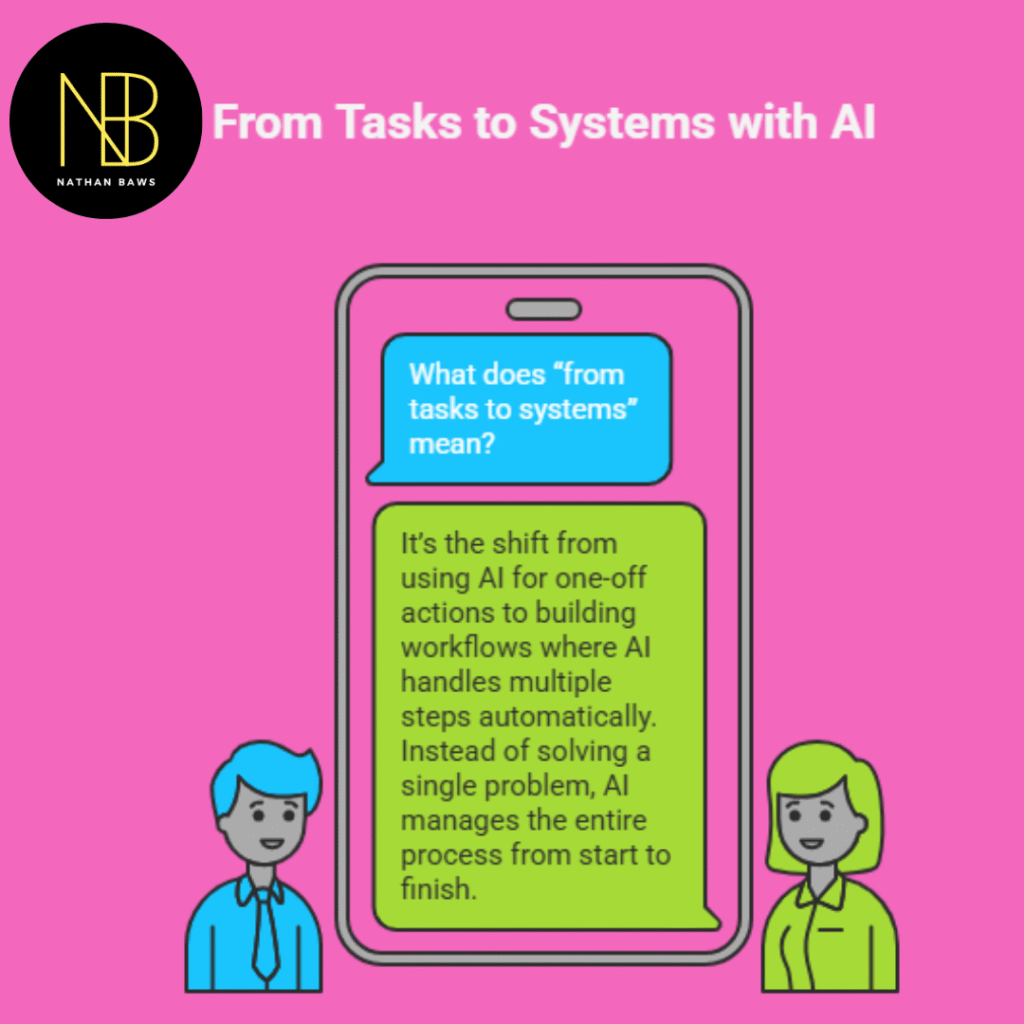
What does “from tasks to systems” mean?
It’s the shift from using AI for one-off actions to building workflows where AI handles multiple steps automatically. Instead of solving a single problem, AI manages the entire process from start to finish.
What are AI agents?
AI agents are systems that don’t just respond to prompts-they plan, execute, and adjust tasks to achieve a goal. They act more like operators than tools.
Why are prompts no longer enough?
Prompts are helpful for quick outputs, but they don’t connect workflows. Businesses need systems that reduce manual handoffs and keep processes moving without constant input.
What are digital assembly lines?
They are AI-driven workflows where each step flows into the next automatically, much like a production line-but for business processes instead of physical products.
How do AI systems improve efficiency?
They remove repetitive manual steps, reduce delays between tasks, and ensure work moves continuously, which speeds up overall execution.
Will AI replace jobs?
Not entirely. It will shift roles. People will spend less time on repetitive tasks and more time managing systems, solving problems, and making decisions.
Why is training important?
Because AI systems are only as effective as the people using them. As Nathan Baws says:
“If your team still thinks in tasks, AI won’t transform your business-it will just speed up the same work.”
How can a business start using AI systems?
Start with one workflow that is repetitive or slow, automate it as a system, then expand from there once it’s working well.
Which industries benefit most from this shift?
Industries with complex workflows-like customer service, software development, and cybersecurity-see the fastest impact, but any business can benefit.
What’s the biggest mistake companies make with AI?
Focusing on tools instead of outcomes, and ignoring the need to train their teams to think in systems.
Read Also: Common Mistakes Businesses Must Avoid