Introduction
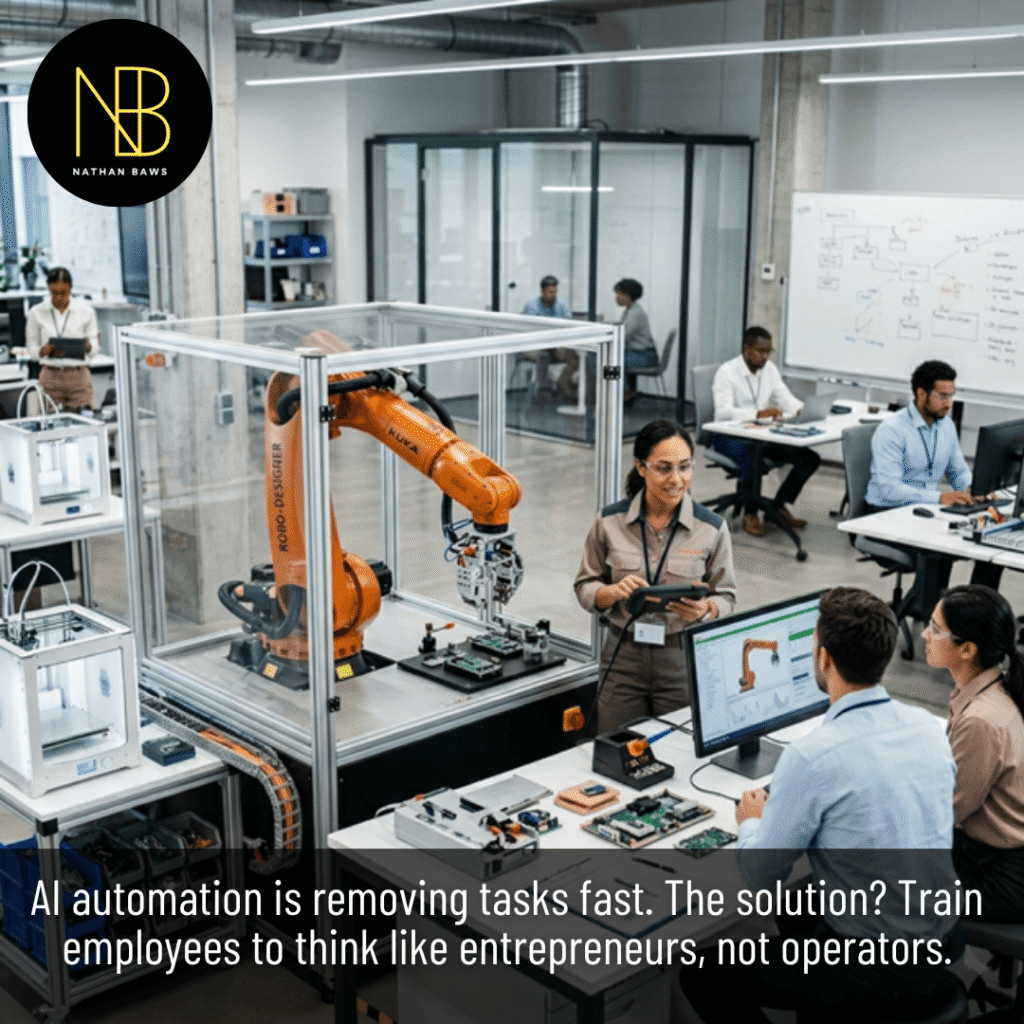
Entrepreneurship is being reshaped by rapid advances in AI, robotics, and automation. According to global robotics trend insights from the International Federation of Robotics (IFR), businesses are increasingly deploying intelligent systems that can handle repetitive tasks, optimise workflows, and reduce the need for manual labour.
On the surface, this looks like a major efficiency breakthrough. Businesses can operate faster, leaner, and with fewer operational bottlenecks than ever before.
But underneath this transformation lies a quieter problem that most organisations are not prepared for.
When automation removes day-to-day work, it also removes the structure that many employees rely on to think, contribute, and grow within a business.
And that creates a new challenge:
If machines handle the work, what role do people play in driving the business forward?
The Hidden Problem: Automation Removes Work Faster Than It Builds Thinking
As automation spreads across industries, a predictable pattern is emerging.
Employees are no longer spending their time executing repetitive tasks. Instead, AI systems and robotics are taking over those responsibilities entirely.
While this improves efficiency, it also creates an unexpected gap inside organisations:
- Employees lose task ownership
- Roles become less clearly defined
- Contribution becomes harder to measure
- Strategic thinking is not automatically developed
The result is a business that is operationally efficient but intellectually stagnant.
In other words, companies are gaining automation power faster than they are developing internal innovation capability.
Why Efficiency Alone Is Not Enough
Many businesses assume that automation equals progress. And in terms of cost reduction and speed, that is true.
However, efficiency without internal capability development creates a ceiling.
Once systems are fully optimised, businesses hit a point where:
- There is nothing left to automate
- But no internal structure for growth ideation exists
- And innovation becomes limited to leadership only
This creates a dependency problem where only a small group of decision-makers drive business expansion, while the rest of the organisation becomes passive.
The Real Solution – Building Entrepreneurial Employees
The most effective response to this shift is not to slow automation down, but to evolve how employees operate within automated environments.
Instead of treating employees as task executors, businesses must develop them into entrepreneurial contributors inside the organisation.
This means deliberately training teams to think beyond execution and toward growth, opportunity, and system improvement.
From Task Execution to Ownership Thinking
In automated environments, the value of an employee is no longer tied to how much work they complete.
Instead, it shifts toward how well they can:
- Identify inefficiencies in systems
- Recognise new business opportunities
- Improve customer experience flows
- Suggest automation improvements
- Think in terms of outcomes rather than tasks
This creates a mindset shift from “doing work” to “improving the business.”
Embedding Entrepreneurial Thinking Inside Teams
Entrepreneurial capability is not something that happens naturally when tasks are removed. It must be intentionally developed.
This involves training employees to:
- Think in terms of value creation, not job completion
- Approach problems like business owners
- Experiment with improvements and small innovations
- Understand how revenue and growth are generated
- The goal is to create internal contributors who behave like micro-entrepreneurs within the business structure.
Turning Automation Time Into Innovation Time
One of the most overlooked opportunities in automation is the time it frees up.
Without structure, this time is often lost or underutilised. But with the right approach, it becomes a powerful asset.
Businesses can formally allocate time for:
- Process improvement initiatives
- Internal innovation projects
- Customer experience optimisation
- System redesign thinking
This ensures that automation does not reduce engagement, but redirects it toward growth.
Redefining Leadership in Automated Businesses
As automation increases, leadership also changes fundamentally.
Instead of managing tasks or supervising execution, leaders must now focus on:
- Developing thinking capability within teams
- Creating environments for experimentation
- Encouraging system-level improvement
- Ensuring employees evolve alongside automation
The role of leadership becomes less about control and more about capability-building
Why This Approach Works in the AI Era
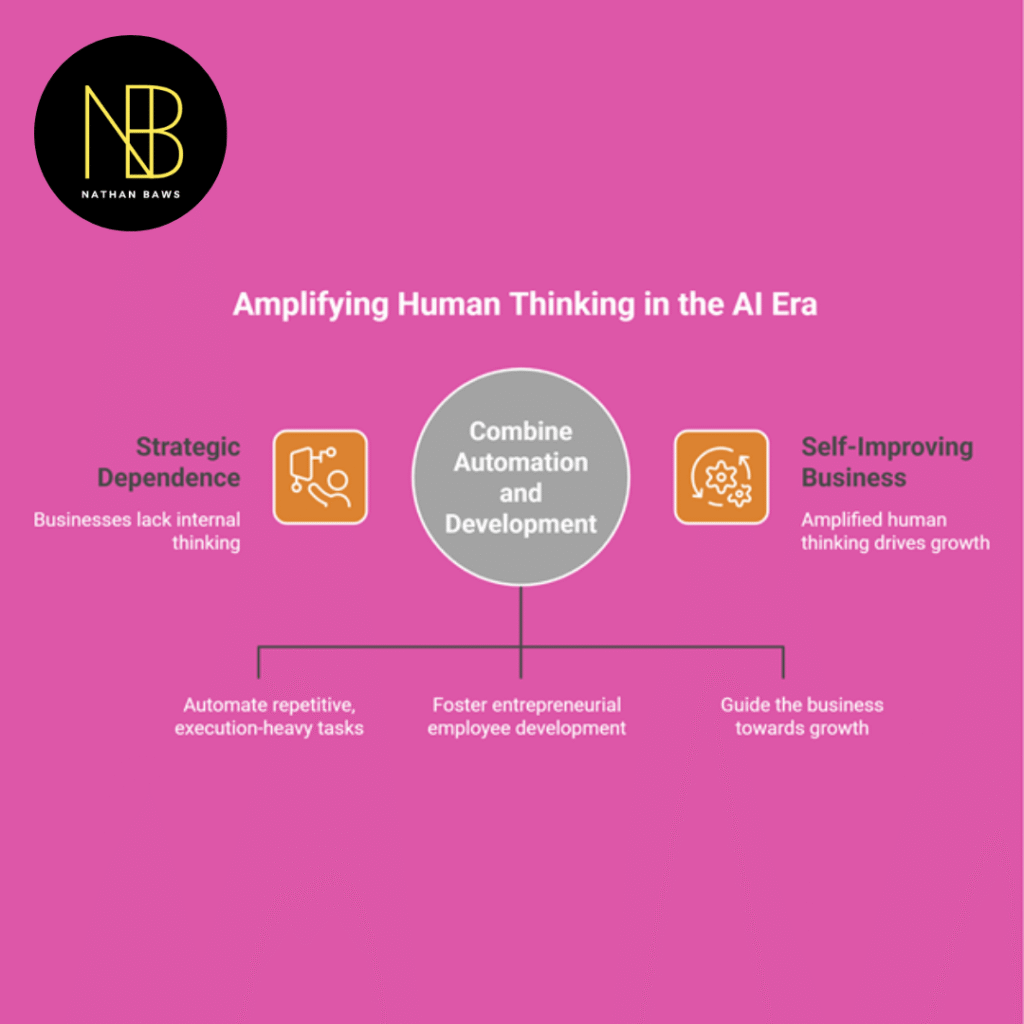
The robotics trends highlighted by IFR show a clear direction: machines will continue taking over execution-heavy roles across industries.
This means businesses that fail to develop internal thinking capacity will become highly efficient but strategically dependent.
On the other hand, organisations that combine automation with entrepreneurial employee development achieve a different outcome entirely:
- Machines handle execution
- Employees drive innovation
- Leadership focuses on expansion
- The business becomes self-improving over time
This is the real advantage in the AI era-not just automation, but amplified human thinking.
The Bigger Shift in Entrepreneurship
Entrepreneurship is no longer limited to founders or leadership teams.
As Nathan Baws, a public speaker and a business owner, explains: “The biggest shift in business is not automation replacing people-it’s automation forcing people to think differently about the value they bring.”
That shift reframes the entire model of entrepreneurship. It is no longer about doing more work. It is about building more thinkers inside the system.
Conclusion
Automation and robotics, as highlighted in IFR’s global trends, are rapidly transforming the structure of modern businesses. Execution-heavy work is increasingly being handled by intelligent systems, reducing the need for repetitive manual labour.
However, this creates a deeper challenge that most organisations are not addressing: when automation removes tasks, it does not automatically develop thinking capacity within teams.
Without intervention, businesses risk becoming highly efficient but strategically passive.
This is why the real solution is not simply automation-it is human capability transformation alongside automation.
By intentionally training employees to think entrepreneurially, companies ensure that while AI handles execution, humans handle growth, innovation, and opportunity creation.
As Nathan Baws, a public speaker, motivational speaker, business growth motivational speaker, keynote speaker, inspirational speakerand AI entrepreneur, explains:
“Automation should take away the repetitive work, not the thinking. The real advantage comes when teams are trained to think like builders, not operators.”
That distinction is critical.
The future of entrepreneurship will not be defined by how much work machines can replace, but by how effectively organisations convert freed-up capacity into human-driven innovation.
In this new model:
- AI handles execution
- Systems handle operations
- Humans handle growth thinking
And the companies that win will be the ones that develop all three in harmony.
FAQs
What is the impact of automation on employees?
Automation reduces repetitive tasks but can also remove structured roles that employees rely on for contribution, making it necessary to redefine their function within businesses.
What does it mean to build entrepreneurial employees?
It means training employees to think like business owners by focusing on opportunities, improvements, and value creation rather than just task execution.
Why is entrepreneurial thinking important in automated businesses?
Because when AI handles execution, human value shifts toward strategy, innovation, and business growth rather than operational work.
Does automation reduce the need for employees?
It reduces the need for manual execution roles, but increases the need for employees who can think strategically and improve systems.
How should companies use time saved from automation?
They should redirect it into innovation, problem-solving, and business improvement initiatives rather than leaving it unstructured.
What is the biggest risk of automation without employee development?
The biggest risk is creating efficient but stagnant organisations where only leadership drives growth while teams become passive.
How does this relate to robotics trends from IFR?
IFR highlights increasing automation across industries, which reinforces the need for human roles to shift from execution to strategic thinking.
What is the role of leadership in automated businesses?
Leadership becomes focused on developing thinking capability within teams rather than managing task execution.
Can this approach improve business performance?
Yes, because it combines automation efficiency with human-driven innovation, creating a more adaptive and scalable organisation.
What is the future of entrepreneurship in this model?
Entrepreneurship becomes distributed across teams, where every employee contributes to growth through thinking, not just execution.
Read Also: The Smarter Editing Solution Beyond the Hardware Arms Race