Introduction
The creator economy powered by AI is no longer a future trend, it is the present reality. Millions of creators are now using artificial intelligence to script, edit, and distribute content faster than ever before. What once required teams, expensive software, and hours of manual work can now be done in minutes.
However, a recent article by TechRadar highlights a critical issue that most creators are only beginning to feel: AI is pushing devices beyond their limits. Smartphones, laptops, and even mid-range production setups are struggling to keep up with the processing demands of modern AI tools.
This has triggered what can only be described as a hardware arms race – where creators are forced to constantly upgrade their gear just to remain competitive.
But this raises an important question:
If AI is meant to simplify content creation, why is it making the process more expensive and technically demanding?
The answer lies not in AI itself, but in how it is currently being used. And more importantly, it points toward a smarter, more sustainable solution.
The Problem: When AI Outgrows the Creator
The promise of AI was accessibility. It was supposed to level the playing field and allow anyone with an idea to become a creator. In many ways, it has delivered on that promise. But beneath the surface, a new barrier is forming – one that is less visible but equally limiting.
As outlined by TechRadar, AI-powered tools are becoming increasingly resource-intensive. High-resolution video processing, real-time rendering, and advanced editing features demand more computing power than standard devices can comfortably provide.
This creates a frustrating reality for creators. On one hand, they have access to powerful AI tools that can transform their content. On the other hand, they lack the hardware required to fully utilise those tools. The result is slower workflows, frequent crashes, storage limitations, and ultimately, a reliance on expensive upgrades.
What was meant to democratise content creation is now quietly introducing a new form of inequality – one based on access to hardware.
The Real Issue Isn’t AI – It’s the Workflow
It is easy to blame AI for this shift, but that would be missing the point. The real issue lies in the way current systems are structured.
Most AI editing tools still follow a traditional model. They require users to install software, manage large files locally, and manually guide the editing process. Even widely used platforms like Adobe Premiere Pro and CapCut, despite their AI enhancements, still depend heavily on the user’s device and technical input.
This means that while AI has improved certain aspects of editing, it has not fundamentally changed the workflow. Creators are still expected to think like editors, manage timelines, and navigate complex interfaces.
In other words, the burden has not been removed – it has simply been reshaped.
The Solution – Zero-Storage, Prompt-Based AI Editing
To truly unlock the potential of the creator economy powered by AI, a more radical shift is required. Instead of improving existing workflows, the entire process needs to be reimagined.
The most practical and scalable solution is what can be described as zero-storage, prompt-based editing.
In this model, the creator no longer interacts with editing tools in the traditional sense. There is no need to download software, manage files, or rely on the performance of a personal device. Everything happens within a browser, powered by cloud infrastructure.
The role of the creator shifts from execution to direction. Rather than manually cutting clips or adding effects, they simply describe the desired outcome. The AI interprets these instructions and produces a finished piece of content.
This approach removes the technical barrier entirely and replaces it with something far more intuitive: intent.
A Workflow Built on Simplicity
Imagine recording a video on your phone and uploading it directly to an online platform. Instead of opening an editing timeline, you are presented with a simple prompt box. You type a request – something like creating short-form clips with captions and dynamic pacing.
Within minutes, the system delivers multiple finished outputs, ready to publish across platforms.
There are no intermediate steps, no rendering delays on your device, and no need to understand editing techniques. The complexity is handled entirely behind the scenes.
Why Removing Storage Changes Everything
One of the most overlooked challenges creators face is storage. High-quality video files are large, and managing them quickly becomes overwhelming. Devices fill up, performance slows down, and workflows become fragmented.
By removing storage from the equation, this new model eliminates a major source of friction. Files are processed and stored in the cloud, meaning the creator’s device is no longer a limiting factor. A basic smartphone becomes more than sufficient because it is only used for capturing content – not producing it.
This shift alone significantly reduces the need for constant hardware upgrades.
The End of the Learning Curve
Traditional editing requires time and effort to master. Even with AI assistance, there is still a learning curve that discourages many potential creators.
Prompt-based editing removes this barrier entirely. It replaces technical knowledge with natural language, allowing creators to focus on ideas rather than execution. This opens the door for a much broader range of people to participate in the creator economy without feeling overwhelmed.
Why This Solves the Hardware Arms Race
The insight from TechRadar becomes far more actionable when viewed through this lens.
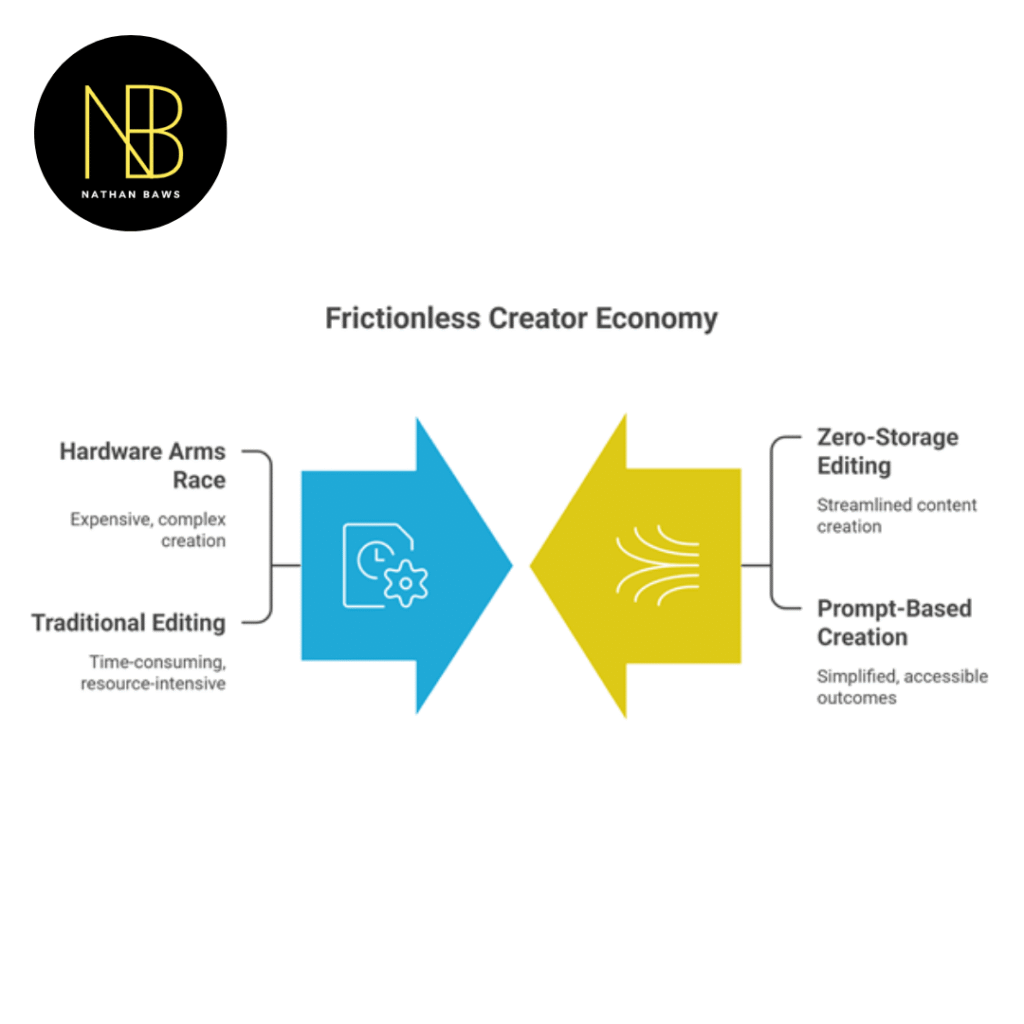
The hardware arms race exists because processing is tied to the user’s device. The moment that dependency is removed, the entire dynamic changes.
Creators no longer need to chase better cameras, faster processors, or larger storage capacities just to keep up. Instead, they can rely on scalable cloud systems that handle these demands more efficiently.
This not only reduces costs but also ensures that access to high-quality content creation is no longer limited by financial resources.
The AppSumo-Style Opportunity
The rise of platforms like AppSumo has shown that creators value simplicity and accessibility over complexity. They are not looking for more tools – they are looking for better outcomes with less effort.
This creates a clear opportunity in the market.
There is space for a new type of platform – one that combines prompt-based editing, zero-storage workflows, and simplified access into a single ecosystem. Instead of forcing creators to juggle multiple subscriptions and tools, this platform would offer a streamlined experience where everything is handled in one place.
Such a model does not just improve efficiency; it fundamentally changes how creators interact with technology.
Applying This Model Today
While fully integrated platforms are still emerging, the principles behind this solution can already be applied. Creators and businesses can begin by shifting their focus away from tools and toward outcomes.
Using cloud-based services like Runway ML and Descript, it is possible to replicate parts of this workflow. More importantly, these tools can be packaged into services that deliver finished content rather than requiring clients to engage with the process.
This approach not only aligns with the direction the industry is heading but also creates immediate value in the present.
The Bigger Shift in the Creator Economy
At its core, the creator economy powered by AI is undergoing a transformation in roles. The emphasis is moving away from technical execution and toward creative direction.
Creators are no longer expected to master every aspect of production. Instead, they are becoming decision-makers who define the vision and let AI handle the complexity.
This shift is subtle but powerful. It reduces barriers, increases output, and allows creators to focus on what truly matters: ideas, storytelling, and connection.
Conclusion
The hardware arms race identified by TechRadar is not an unavoidable consequence of AI – it is a symptom of outdated workflows.
By rethinking how content is created and embracing zero-storage, prompt-based editing, creators can bypass these limitations entirely. This approach not only solves the immediate challenges but also sets the foundation for a more inclusive and scalable creator economy.
As Nathan Baws, a public speaker, motivational speaker, AI entrepreneur,business growth motivational speaker, inspirational speaker and Keynote Speaker explains: “AI shouldn’t make creation more complicated or expensive. The real opportunity is removing friction entirely where creators don’t need better tools, just better systems that deliver outcomes.”
That perspective highlights the real shift taking place. The future of the creator economy powered by AI will not be defined by who has the most advanced hardware, but by who can operate with the least resistance.
The creators who win won’t be the best editors. They’ll be the ones who no longer need to edit at all.
FAQs
What does “creator economy powered by AI” mean?
It refers to a growing digital ecosystem where creators use artificial intelligence to produce, edit, and distribute content faster and more efficiently. AI reduces manual effort and allows individuals to scale content creation without needing large teams or advanced technical skills.
Why is AI creating a hardware arms race for creators?
As highlighted by TechRadar, AI tools require significant processing power for tasks like video rendering, effects, and real-time editing. This pushes creators to constantly upgrade devices such as smartphones, cameras, and laptops just to keep up with performance demands.
What is zero-storage AI editing?
Zero-storage editing is a model where all content processing happens in the cloud instead of on your personal device. This means creators don’t have to store large video files locally or rely on their device’s performance, making content creation more accessible and efficient.
How does prompt-based editing actually work?
Prompt-based editing allows creators to describe the outcome they want instead of manually editing content. For example, a user can request short clips with captions and transitions, and the AI will generate fully edited outputs based on that instruction without requiring technical input.
Do I still need expensive equipment with this model?
No. One of the biggest advantages of this approach is that it removes the dependency on high-end hardware. Since processing is handled in the cloud, even basic smartphones or entry-level laptops can be used effectively for content creation.
Are there tools available today that support this workflow?
Yes, platforms like Runway ML and Descript already offer cloud-based editing and automation features. While they may not be fully prompt-driven yet, they represent a strong step toward this model.
How is this different from traditional video editing software?
Traditional editing tools require users to manually cut clips, arrange timelines, and apply effects. In contrast, prompt-based editing removes these steps entirely by allowing AI to handle execution based on simple instructions, significantly reducing time and complexity.
Can this model work for professional creators as well?
Yes. While it simplifies the process for beginners, it also allows professionals to scale their output without increasing workload. High-volume creators, agencies, and brands can benefit from faster turnaround times and more efficient workflows.
Is this just a trend or a long-term shift?
This is a long-term shift. As AI continues to evolve, the focus will move further away from manual editing and toward automated, intent-based creation. The demand for faster, simpler, and more scalable content production will only continue to grow.
Can this approach be turned into a business opportunity?
Absolutely. Entrepreneurs can offer prompt-based editing as a service, bundle existing AI tools into simplified workflows, or build platforms that automate the entire process. There is a clear gap in the market for solutions that remove complexity and deliver ready-to-publish content.
Read Also: Speaker Warns Costly AI Spending Flip Needs Training