
Introduction
Entrepreneurial growth strategies help founders plan how to grow revenue, reach new customers and scale operations. This guide explains simple, practical steps to build growth that lasts. It uses clear language and gives direct actions you can apply now.
- Understand core growth drivers for your business.
- Test low-cost marketing and product changes fast.
- Expand to new markets while protecting existing revenue.
- Diversify revenue streams to reduce risk.
- Improve customer experience to increase retention and referrals.
Growth strategy: Assessing current position and market share
Audit your current market share
Start by measuring how much of the market you own. Use sales data, competitor research and customer surveys. Knowing your market share helps set realistic targets for market penetration and growth opportunities.
Analyse competitors and existing products
Look at what competitors offer and how customers respond. Identify gaps in product line or service that your business can fill. This helps with product development and positioning.
Set measurable goals for business growth strategies
Create targets for revenue, customer numbers and retention. Use simple KPIs that you can track weekly. Goals should guide decisions like where to focus marketing strategies or product changes.
Business growth strategies: Marketing strategies for increasing market share
Choose channels that match your customers
List the places your customers spend time. It could be email newsletters, social media, search or local events. Focus on a few channels and test them before expanding.
Use a newsletter to build direct relationships
A regular newsletter is a low-cost way to reach customers. Share offers, new product news and useful content. Measure open and click rates to refine your approach.
Leverage content for long-term growth strategy
Create helpful articles, videos or guides that answer common customer questions. Content drives organic traffic and supports other marketing strategies like SEO and email campaigns.
New markets and diversification: Expanding revenue streams
Evaluate new markets carefully
Study demographic, cultural and economic differences before moving into a new market. Small pilots or limited launches can reduce risk and test demand.
Diversify with complementary product line additions
Add products or services that match your brand and customer needs. Diversification can protect your business if one revenue stream slows down.
Use partnerships to enter new markets
Find partners with local knowledge or distribution networks. Partnerships speed up market entry and often cost less than building new capability yourself.
Product development: Improving existing products and launching new ones
Iterate quickly with customer feedback
Use simple experiments to test product changes. Ask customers for feedback, run A/B tests and track usage. Fast iteration reduces waste and improves product-market fit.
Plan product line growth with modular thinking
Design products so you can add features or variants without rebuilding everything. Modular product lines are easier to scale and diversify.
Price strategically to increase revenue streams
Test pricing models like tiered plans, subscriptions or bundles. The right price can boost both sales volume and profit margins.
Market penetration and increasing market share
Focus on the most promising customer segments
Identify segments that give the highest lifetime value. Tailor marketing and product messages to those groups to increase conversion and retention.
Use promotions carefully to grow share
Discounts and promotions can drive short-term growth but may hurt margins. Use targeted promotions to win new customers who are likely to stay.
Measure the cost of customer acquisition
Calculate how much you spend to acquire a customer and compare it to the lifetime value. Lowering acquisition costs is a key part of effective business growth strategies.
Customer experience: Retention and referrals as growth drivers
Map the customer journey
Document every step a customer takes from discovery to purchase and after-sales. Identify friction points and improve them to increase satisfaction.
Create loyalty programs that work
Design loyalty programs that reward repeat purchases and referrals. Keep them simple and valuable to encourage ongoing engagement.
Use feedback loops to improve customer experience
Collect reviews and survey responses, and act on them. Showing customers you listen builds trust and encourages them to recommend you to others.
Scaling operations: Systems and people for sustainable growth
Standardise processes before scaling
Document core processes and train staff. Standardisation reduces mistakes and makes it easier to scale without losing quality.
Invest in scalable systems
Use cloud tools for accounting, CRM and project management. Scalable systems allow operations to grow without a matching increase in cost.
Hire based on future needs
Plan roles that will be needed as you grow. Hire people who can adapt and learn fast. Outsource non-core tasks to stay lean.
Revenue streams: Building multiple, resilient incomes
Create passive and active revenue options
Mix recurring revenue like subscriptions with one-off sales like product purchases. Recurring revenue stabilises cash flow and supports investment in growth.
Test new revenue models with pilots
Run small pilot programs to test membership sites, online courses or licensing. Pilots show real demand before you commit resources.
Protect margins while growing revenue
As you add revenue streams, monitor margins. Growth that erodes profit is not sustainable. Optimise costs and pricing to keep margins healthy.
Effective business growth strategies: Financial planning and funding
Forecast scenarios conservatively
Build financial models that show best, expected and worst cases. Conservative planning prepares you for setbacks and helps secure funding.
Choose funding that fits your goals
Compare self-funding, loans, investors and grants. Each has trade-offs for control and cost. Pick the option that supports your long-term strategy.
Use metrics investors care about
Track unit economics, churn, CAC and LTV. Clear metrics make it easier to attract investors or lenders who understand your business.
Existing market: Deepening presence and customer loyalty
Increase share within your existing market
Offer upgrades, complementary services or exclusive offers to existing customers. This can increase revenue without the cost of finding new customers.
Segment customers for personalised offers
Use simple segmentation like frequency, recency and spend to create targeted offers. Personalisation raises conversion rates and loyalty.
Run local campaigns to boost presence
Local events, partnerships and targeted ads can strengthen brand presence in your primary market. Local credibility helps expand to nearby markets later.
Product line and product development: Long-term innovation
Create a roadmap for product evolution
Plan the next steps for your product line in one, three and five-year views. A clear roadmap aligns the team and informs investment decisions.
Prioritise features that drive growth
Choose features that increase adoption, retention or monetisation. Use customer feedback and data to prioritise.
Balance innovation with core stability
Keep core products stable while experimenting with new ideas. Stability maintains customer trust while innovation opens new growth paths.
Increasing market share: Tactical actions for fast gains
Win back lapsed customers
Reach out to customers who stopped buying with special offers and reminders. Winning them back is often cheaper than acquiring new customers.
Use PR and storytelling to increase brand awareness
Share success stories, customer case studies and media releases. Good stories attract attention and help build authority in the market.
Leverage customer success to fuel referrals
Turn satisfied customers into advocates. A structured referral program with clear incentives can drive steady acquisition.
Growth opportunities: Identifying and prioritising the best paths
Score opportunities by impact and effort
List potential growth initiatives and score them by expected impact and required effort. Focus on high-impact, low-effort items first.
Run small experiments to validate ideas
Use quick tests to learn before investing. Experiments limit risk and give real evidence on what works.
Review and adjust strategies regularly
Check progress monthly and adjust priorities. Flexibility keeps your business aligned with changing market conditions.
Practical tools and templates for entrepreneurial growth strategies
Simple KPI dashboard template
Create a compact dashboard with sales, CAC, LTV, churn and cash runway. A clear dashboard helps you see issues early.
Customer interview template
Use a short set of questions to explore pain points, needs and purchase drivers. Consistent interviews produce repeatable insights.
Experiment plan template
Design experiments with a hypothesis, metric and timeframe. This keeps tests focused and measurable.
Leadership and culture: People-led scaling
Create a culture that supports experimentation
Encourage small bets and learning from failure. A culture that celebrates learning speeds innovation.
Communicate vision and milestones clearly
Share business goals and progress with your team. Clear communication aligns effort and builds trust.
Develop leaders inside your business
Identify and train people to take on more responsibility. Internal leaders carry the culture forward as you scale.
Case studies and real examples of entrepreneurial growth strategies
Local retail business expands with a newsletter
A small shop grew repeat business by using a weekly newsletter with offers and tips. The low-cost channel improved retention and drove steady sales.
Service business diversifies into online courses
A consultant launched a paid course that created a recurring revenue stream and reached customers beyond their city.
Product company entered new markets through partners
A manufacturer used distribution partners to test new regions. Partners reduced risk and accelerated sales growth.
Measuring success: KPIs for effective business growth strategies
Track revenue growth and margin trends
Monitor revenue alongside gross margin. Growth without margin can harm long-term stability.
Watch customer metrics closely
Track churn, retention and NPS. These metrics show whether customers value your product and predict future revenue.
Use cohort analysis for deeper insights
Cohort analysis reveals how different customer groups behave over time. It helps you find segments that drive sustainable growth.
Tips to avoid common growth mistakes
Don’t expand too fast without systems
Rapid expansion without systems leads to poor quality and dissatisfied customers. Build processes first.
Don’t ignore the core business
New opportunities can distract from your best customers. Keep core revenue streams healthy while experimenting.
Don’t scale on intuition alone
Use data and tests to validate choices. Intuition is useful but should be backed by evidence.
How Nathan Baws can help with entrepreneurial growth strategies
Experience in scaling small businesses
Nathan Baws has practical experience helping businesses scale with proven frameworks. His approach focuses on measurable growth and hands-on action.
Clear, simple strategies that work
Nathan offers straightforward plans tailored to small businesses and startups. His strategies are practical, easy to implement and grounded in data.
Access tools and coaching
For direct support, Nathan provides coaching and tools to implement marketing strategies, product development and scaling plans. Learn more at https://nathanbaws.com/.
If you want guided help turning plans into results, visit Nathan Baws and explore services that match your stage and goals. His support is a strong call to action for entrepreneurs who want steady, sustainable growth.
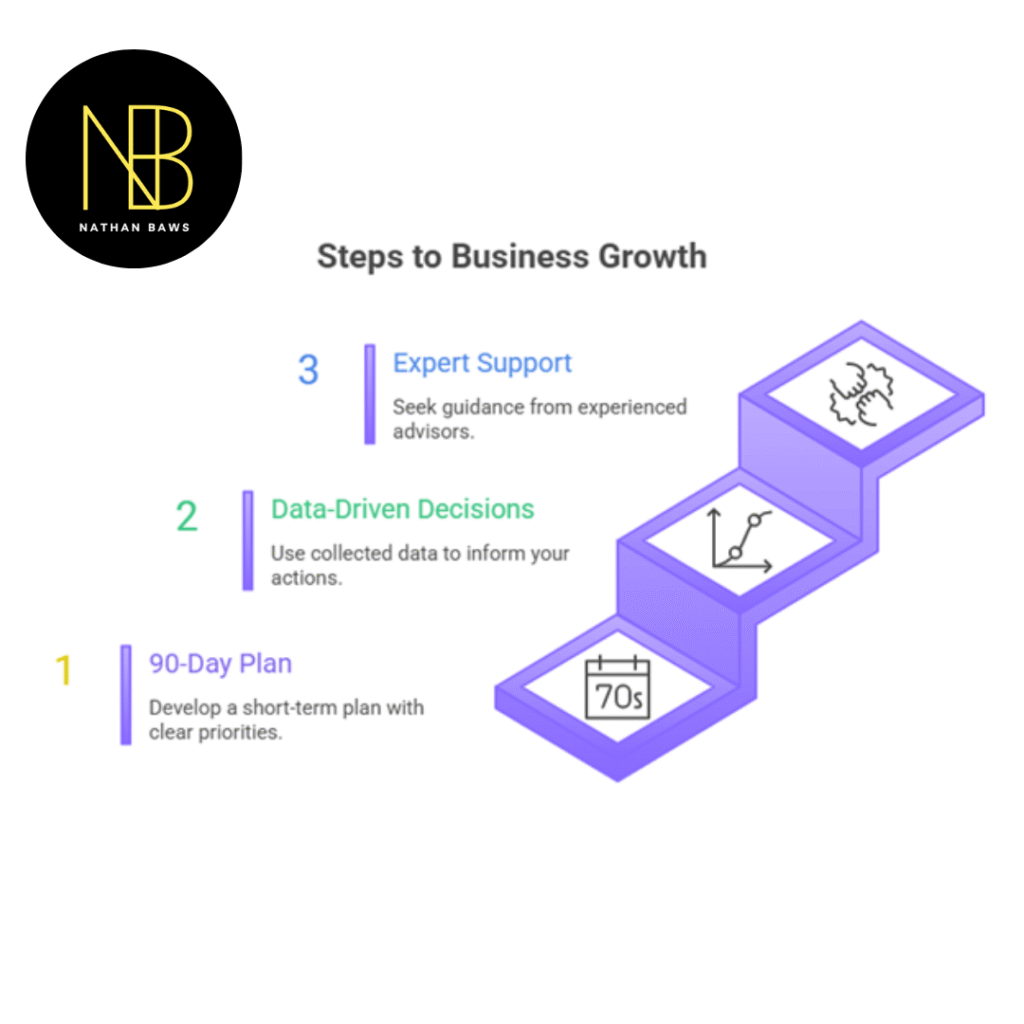
Next steps: Build your customised plan
Start with a 90-day plan
Create a short plan with three clear priorities. Deliver small wins and use them to fund bigger initiatives.
Use data to make decisions
Collect only the data you need and act on it. Simple dashboards and weekly reviews keep your plan on track.
Consider expert support
If you need faster progress, seek help from experienced advisors. Nathan Baws offers tailored support that can accelerate your growth with minimal fuss. Visit https://nathanbaws.com/ to find out more.
Conclusion: Build durable entrepreneurial growth strategies
Entrepreneurial growth strategies are practical steps that help small businesses scale, increase market share and diversify revenue. Focus on customers, test ideas quickly and build systems that support growth. Keep plans simple, measure what matters and adjust often.
Key final actions
- Choose one growth channel and test it for 90 days.
- Create a simple dashboard to track progress.
- Plan hires and systems before large-scale hiring.
- Explore diversification with small pilots.
- Consider coaching from experts like Nathan Baws to speed progress: nathanbaws.com.
FAQs about entrepreneurial growth strategies
- What are entrepreneurial growth strategies?
They are plans and actions taken by business owners to grow revenue, customers and operations. Strategies include marketing, product development, entering new markets and improving customer experience.
- How do I start implementing growth strategies?
Begin with an audit of your current position, set measurable goals, pick one marketing channel and run small experiments to validate ideas.
- How important is diversification?
Diversification spreads risk. Adding complementary products or services can protect against downturns in a single revenue stream.
- Can a small business scale without external funding?
Yes. Many businesses scale by reinvesting profits, using low-cost marketing and automation. Sometimes small loans or grants help accelerate growth.
- What metrics should I track?
Track revenue, gross margin, CAC, LTV, churn and retention. These show if growth is healthy and sustainable.
- How does customer experience drive growth?
Good customer experience increases retention and referrals, which are cheaper than acquiring new customers and often more profitable.
- When should I enter new markets?
Enter new markets when you understand local demand, have tested your product and have partners or systems to support expansion.
- How do newsletters help growth?
Newsletters build direct relationships, drive repeat purchases and support content and SEO efforts. They are low-cost and effective for many businesses.
- What common mistakes should I avoid?
Avoid expanding too quickly without systems, ignoring your core business and scaling based only on intuition without data.
- How can Nathan Baws help my business?
Nathan Baws provides coaching, tools and strategies tailored to small businesses. His practical guidance helps implement proven entrepreneurial growth strategies. Visit https://nathanbaws.com/ to learn more.