Introduction
In today’s oversaturated digital ecosystem, traditional advertising channels are becoming increasingly expensive and less effective. Consumer fatigue is at an all-time high, and ad-blockers have made it incredibly difficult for standard digital banners to break through the noise. To truly stand out, brands need to abandon the predictable and embrace the unconventional.
This is where unconventional marketing steps into the spotlight. By utilizing creative, high-impact, and low-cost methods, businesses can capture public attention without draining their corporate bank accounts. Implementing highly effective guerrilla marketing tactics allows companies of all sizes to level the playing field, making creativity rather than a massive budget their ultimate competitive advantage.
When you master the art of the unexpected, you create memorable brand experiences that resonate deeply with your target audience. Instead of shouting at consumers through traditional television commercials or expensive print ads, you meet them where they live, work, and play. The goal is to spark a visceral reaction that drives organic conversation, social sharing, and long-term brand loyalty.
What is Guerrilla Marketing?
To fully appreciate the power of these unique promotional strategies, we must first understand the origins and core definition of the concept. The term was originally coined by Jay Conrad Levinson in his 1984 book Guerrilla Marketing. Inspired by guerrilla warfare, which relies on atypical strategies like ambushes, raids, and elements of surprise, this approach applies the same disruptive mentality to the business landscape.
At its core, it is an advertising strategy that focuses on low-cost, unconventional marketing techniques that yield maximum results. Rather than relying on a multi-million dollar ad spend, it relies heavily on personal energy, deep consumer psychology, imagination, and perfectly timed execution. It is about capturing the public’s attention in their everyday environments and leaving an indelible impression.
For small businesses and ambitious startups, this methodology acts as the ultimate equalizer. It proves that you do not need the deepest pockets to dominate your industry; you simply need the sharpest ideas. When executed correctly, these campaigns bypass the analytical mind of the consumer and target their emotions, triggering immediate curiosity and word-of-mouth buzz.
The Benefits of Using Guerrilla Marketing Tactics
Why should your business pivot away from safe, predictable advertising models? The benefits of executing these campaigns stretch far beyond simple cost savings. By integrating disruptive guerrilla marketing tactics into your broader promotional strategy, you unlock unprecedented levels of audience engagement and cultural relevance.
Extreme Cost Efficiency
The most obvious advantage of this approach is its incredibly low financial barrier to entry. Traditional campaigns require massive investments in ad space, airtime, and media agencies. Conversely, unconventional campaigns rely primarily on intellectual capital. Your primary investments are time, energy, and creativity, making it an ideal playbook for bootstrapped startups.
Unmatched Viral Potential
In our hyper-connected world, people love to share things that are weird, funny, or genuinely surprising. A well-placed street installation or a brilliantly coordinated public stunt naturally begs to be photographed and recorded. When bystanders pull out their smartphones to capture your campaign, they become your brand ambassadors, distributing your message to thousands of people online for free.
Deep and Lasting Customer Connections
Traditional ads are usually viewed as annoying interruptions. Guerrilla campaigns, however, are experienced as welcome surprises or interactive spectacles. Because they blend into the consumer’s daily life, they break down consumer skepticism. This builds a powerful emotional bond, transforming passive viewers into enthusiastic brand advocates.
Street Marketing and Ambient Installations
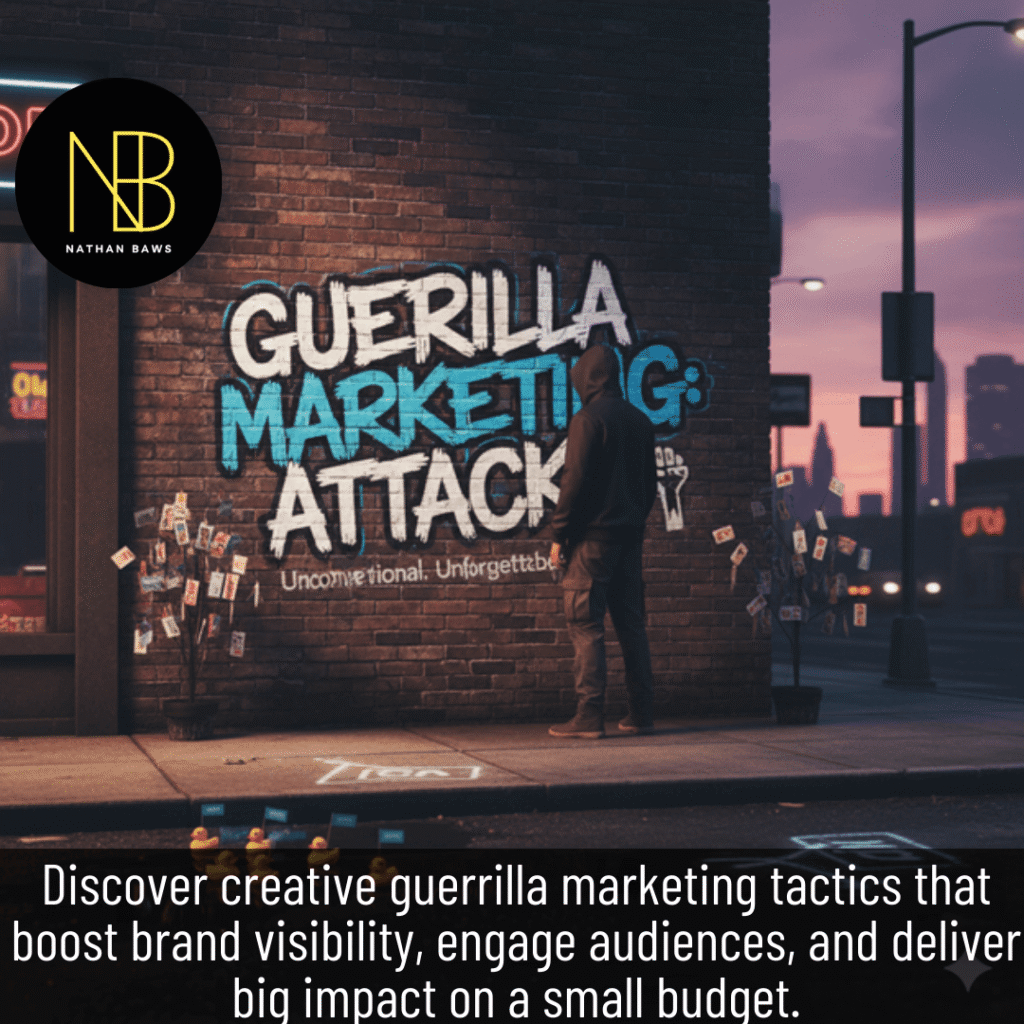
One of the most effective ways to deploy guerrilla marketing tactics is by transforming physical public spaces into temporary brand playgrounds. Street marketing and ambient installations take advantage of existing urban infrastructure, reimagining everyday objects to convey a highly memorable brand message.
Transforming Urban Spaces
Think about the mundane items people walk past every single day without a second thought: sidewalks, park benches, bus shelters, and crosswalks. Ambient marketing takes these ordinary structures and infuses them with artistic, unexpected brand messaging. For example, a famous campaign by a major cleaning brand painted a single stripe of a city crosswalk bright white, leaving the rest dingy, to demonstrate the product’s power.
To make this work for your brand, look for physical elements in your local community that align with your product’s core value proposition. If you run a fitness brand, you might temporarily transform a public bench into a barbell weight. The key is to blend seamless artistic execution with a crystal-clear message that requires zero explanation from the observer.
Sidewalk Chalk Art and Stencils
Another highly effective, non-destructive street tactic is the use of reverse graffiti or temporary chalk stencils. Reverse graffiti involves placing a stencil over a dirty sidewalk and power-washing the exposed areas, leaving your clean brand message embedded in the pavement. It is eco-friendly, visually striking, and completely legal in most jurisdictions because you are technically cleaning the streets.
If power-washing is not feasible, high-quality chalk art can achieve a similar disruptive effect. Hiring a local street artist to create a stunning 3D illusion on a popular pedestrian walkway naturally forces passersby to stop, stare, and take photos. It breaks the monotony of their daily commute and associates your brand with creativity and joy.
Experiential Marketing and Pop-Up Stunts
Modern consumers value real-world experiences far more than physical possessions. Experiential marketing involves creating live, immersive brand activations that invite the audience to actively participate rather than passively observe. By engineering interactive pop-up stunts, you can generate immense localized excitement.
The Power of Flash Mobs
While flash mobs have evolved over the years, their foundational psychological impact remains incredibly potent. A flash mob involves a seemingly spontaneous group of people gathering in a crowded public space to perform an unusual act.such as a synchronized dance or a dramatic freeze before quickly dispersing back into the crowd.
The success of a flash mob depends entirely on the elements of surprise and precision. The performance must feel entirely organic until the final, dramatic brand reveal. Furthermore, it is absolutely essential to film the entire event from multiple hidden angles. The live crowd provides the initial spark, but the high-quality video uploaded to YouTube or TikTok is what drives long-term viral growth.
Interactive Pop-Up Activations
Creating interactive installations that reward consumers for participating is another highly reliable way to use guerrilla marketing tactics. Imagine setting up an outdoor vending machine that doesn’t accept money, but instead requires users to perform a fun task like doing ten jumping jacks or singing a song.to receive a free sample.
These fun activations work wonders because they gamify the consumer experience. They trigger a shot of dopamine, linking positive feelings directly to your logo. People walk away from these interactions smiling, and they will almost certainly recount the story to their friends, family, and social media followers.
Viral and Digital Guerrilla Campaigns
Guerrilla marketing tactics are not restricted to physical streets. The same disruptive, rule-breaking philosophy can be applied beautifully to the digital landscape, allowing brands to hijack social algorithms and secure massive online visibility.
Strategic Trend Hijacking
Digital guerrilla marketing often manifests as trend hijacking or “newsjacking.” This involves keeping a close eye on pop culture events, breaking news stories, or viral memes, and finding a clever way to insert your brand into the conversation. It requires speed, wit, and a deep understanding of internet subcultures.
- Monitor Real-Time Trends: Keep tabs on trending hashtags, live sporting events, and awards shows.
- Act Quickly: The lifespan of an internet trend is incredibly short; your content must drop while interest is peaking.
- Keep it Authentic: Avoid looking like a desperate corporation trying to sound trendy. Ensure your contribution is genuinely funny or insightful.
A classic example of this occurred during a major live sporting event when the stadium lights suddenly went out. Within minutes, a famous cookie brand tweeted a simple graphic that read: “You can still dunk in the dark.” That single, lightning-fast digital post earned more engagement and media coverage than many multi-million dollar television commercials broadcast during the very same game.
Creating Shareable Social Stunts
To spark an organic digital movement, you need to create content that challenges assumptions or touches an emotional nerve. This could involve launching a provocative, unpolished video that looks like user-generated content rather than a polished corporate ad. In the digital space, raw authenticity always outperforms expensive production value.
Consider running an online challenge that gently disrupts standard social media behavior. Ask your audience to post unconventional photos using a specific brand hashtag, or create a free, highly interactive digital tool or quiz that addresses a major frustration in your industry. When your digital assets are built to entertain rather than sell, the internet will handle the distribution for you.
Stealth and Undercover Marketing
Stealth marketing, often referred to as undercover marketing, is the art of promoting a product to consumers without them explicitly realizing they are being marketed to. It is a highly nuanced strategy that relies on subtle psychological influence rather than overt sales pitches.
Subconscious Brand Placement
The primary objective of a stealth campaign is to generate positive word-of-mouth buzz in a natural environment. A famous early example involved a mobile phone company hiring actors to portray tourists at popular landmarks. These actors would hand their new camera phones to strangers, politely asking them to take their picture while highlighting how easy the phone was to use.
During these interactions, the strangers never felt the pressure of a sales pitch. They simply thought they were helping an everyday tourist while getting a hands-on look at an impressive piece of new technology. This organic discovery process creates a completely frictionless path to brand consideration.
Word-of-Mouth Product Seeding
You can implement modern stealth tactics by strategically placing your products in environments where your target audience naturally gathers. For instance, you could provide your product to respected community figures, local business owners, or campus micro-influencers without asking for formal, sponsored posts.
When people see trusted peers using a product in everyday life, their natural curiosity takes over. This unforced visibility builds immense credibility. Consumers feel they have discovered an exciting new brand entirely on their own, making them far more passionate about sharing their discovery with others.
Practical Tips for Execution
While executing bold guerrilla marketing tactics can yield massive rewards, it also carries inherent risks. Because these campaigns push boundaries and challenge norms, careful planning and flawless operational execution are required to keep your campaign from backfiring.
Know Your Audience Inside and Out
Before launching any unconventional campaign, you must have a crystalline understanding of your target demographic. What are their deep frustrations, hobbies, and daily routines? Where do they hang out online and offline? A campaign that delights a young, tech-savvy urban crowd might completely confuse or alienate an older, more conservative audience.
Respect Local Laws and Public Safety
There is a very fine line between a brilliant marketing stunt and a public nuisance. Before deploying any physical street installations, thoroughly research local municipal codes, permit requirements, and property laws. Your campaign should never damage public property, obstruct traffic, or put anyone’s personal safety at risk.
If your activation causes genuine public panic or requires city emergency services to intervene, your brand will face severe legal penalties and a major public relations disaster. The goal is to pleasantly surprise people, not to terrify or inconvenience them. Always have a clear backup and exit plan.
Keep the Core Message Simple and Clear
Because guerrilla campaigns catch people off guard, you only have a few precious seconds to convey your message. If your installation is overly complex or abstract, passersby will simply walk away confused. Your brand name, logo, or a memorable call to action must be cleanly integrated into the design.
Case Studies: Real-World Success Stories
Examining historical successes provides invaluable inspiration for designing your own unique campaigns. Let’s look at how prominent brands successfully leveraged guerrilla marketing tactics to secure global media coverage and explosive growth.
The Massive Urban Sofa Installation
A well-known international furniture retailer wanted to promote its design solutions in a crowded urban environment. Instead of purchasing traditional billboards, they placed actual, fully dressed living room sets inside busy city bus shelters. Commuters could sit on comfortable sofas and admire stylish decorations while waiting for their buses.
This campaign worked masterfully because it solved a real-world problem: making a long, tedious wait pleasant. It allowed commuters to physically interact with the brand’s furniture, proving its comfort and durability in a high-traffic environment. The sheer absurdity of a living room on a public sidewalk generated massive local PR and endless social media shares.
The Epic Stratosphere Jump
A popular energy drink company orchestrated one of the most audacious guerrilla marketing tactics in modern history by sponsoring a record-breaking freefall jump from the edge of space. The entire world watched a live stream as an athlete jumped from a capsule in the stratosphere, breaking the sound barrier in freefall.
This stunt did not feature a single traditional sales pitch. Instead, the brand’s logo was prominently displayed on the capsule and space suit. By associating their name with a historic feat of human bravery and extreme sport, the company solidified its brand identity as an entity that “gives you wings.” The event generated millions of dollars in free media exposure and cemented their place in pop culture history.
Measuring the Success of Your Campaign
A common criticism of unconventional advertising is that it is incredibly difficult to track quantitative metrics. However, with modern digital analytics tools, you can accurately measure the return on investment (ROI) of your guerrilla marketing tactics.
Monitor Social Media Amplification
The true reach of a modern guerrilla campaign is measured by its digital footprint. Create a highly unique, easily readable hashtag for your campaign and place it prominently on your physical installations. Monitor platforms like Instagram, TikTok, and X to track total hashtag usage, video views, and organic mentions.
Track Direct Inbound Traffic and Sales Lift
Look closely at your website’s analytics data during and immediately after your campaign launch. A successful real-world stunt should trigger a noticeable surge in direct traffic and organic search queries for your brand name.
To track conversions directly, display a custom QR code or a highly specific, memorable discount code on your physical installations. This allows you to trace exact sales back to the specific street corner or pop-up event where the user discovered your brand.
Conclusion
Embracing guerrilla marketing tactics is about shifting your perspective from outspending your competition to outthinking them. By leveraging surprise, imagination, and deep human psychology, you can create high-impact campaigns that break through digital noise and forge deep, lasting connections with your target audience.
Remember, the most successful campaigns are those that respect the consumer’s intelligence, offer genuine entertainment or utility, and spark organic conversations. Step away from the safety of predictable advertising, trust your creative instincts, and design an unforgettable experience that gets the entire world talking about your brand.
Frequently Asked Questions
What are some examples of guerrilla marketing tactics?
Common examples include ambient street installations that transform public objects like benches or crosswalks, flash mobs in high-traffic plazas, reverse graffiti using stencils and power-washers, interactive pop-up sampling stations, and witty trend-hijacking campaigns on social media networks.
Is guerrilla marketing legal?
Yes, it is entirely legal when planned correctly. However, because it pushes boundaries, it can risk violating local ordinances if you don’t do your homework. To stay compliant, avoid damaging public property, do not block traffic, obtain necessary municipal permits, and always prioritize public safety.
How much does a guerrilla marketing campaign cost?
The financial cost can be incredibly low, as these strategies prioritize creativity and human effort over a large ad spend. Many highly successful street or digital campaigns cost next to nothing to execute, making them incredibly effective options for bootstrapped startups and small businesses.
Can large corporations use guerrilla marketing tactics?
Absolutely. While these strategies were originally built for small businesses, major global corporations frequently deploy them to appear authentic, agile, and culturally relevant. Large brands use these methods to humanize their image and connect with younger demographics who reject traditional media ads.
How do I measure the success of an unconventional campaign?
You can measure performance by tracking custom social media hashtags, monitoring surges in organic search traffic and direct website visits, using localized QR codes, and calculating earned media value from newspaper, blog, or television coverage generated by the event.
What is the biggest risk of guerrilla marketing?
The primary risk is a negative public reaction or misinterpretation. If a stunt is poorly planned, it can cause public confusion, safety hazards, or property damage, leading to legal fines and bad PR. Ensuring your core message is positive, safe, and clear minimizes this risk.
Also Read: 10 Unorthodox Growth Hacks That Helped Me Thrive After Shark Tank