Introduction
Artificial intelligence has moved from hype to budget line.
Across industries, businesses are investing heavily in tools like ChatGPT, expecting faster workflows, reduced costs, and scalable output. On paper, the promise is compelling. In practice, the results have been far less consistent.
Recent reporting from Axios highlights a growing disconnect: companies are increasing their AI spending, yet many still struggle to link that investment to tangible returns.
This shift has been described as the “AI spending flip”, a moment where spending continues to rise, but confidence in outcomes begins to waver.
At the centre of this problem is not the technology itself, but how it is being used.
What Is the AI Spending Flip?
The AI spending flip reflects a widening gap between investment and impact. Businesses have moved quickly to adopt AI tools, often across multiple departments at once, without fully understanding how those tools fit into existing workflows.
The assumption has been straightforward: better tools will naturally lead to better results. But that assumption is proving flawed.
AI does not operate effectively in isolation. It depends heavily on the quality of input, the clarity of instruction, and the judgement applied after output is generated. Without those elements, even the most advanced tools produce inconsistent or low-value results.
What we are seeing now is a correction in mindset. Companies are beginning to realise that access to AI is not the advantage but effective usage is.
Why AI Tools Alone Don’t Deliver Results
The expectation that AI can be simply “plugged in” and left to perform is one of the biggest reasons companies are underwhelmed by their returns.
In many organisations, employees are using AI without clear guidelines or training. Prompts are written differently from person to person, outputs vary in quality, and time is often spent correcting or rewriting what AI produces. Instead of accelerating work, it creates friction.
At the same time, some businesses fall into the opposite trap, over-reliance. They allow AI-generated content or decisions to move forward without proper review. This introduces risk, whether in the form of inaccuracies, poor communication, or misaligned messaging.
There is also the issue of under-utilisation. Most teams only scratch the surface of what AI tools are capable of. Without structured training, they default to basic use cases, leaving significant efficiency gains untapped.
In all of these scenarios, the problem is not the tool. It is the absence of capability behind it.
The Real Solution: Train Employees to Use AI Effectively
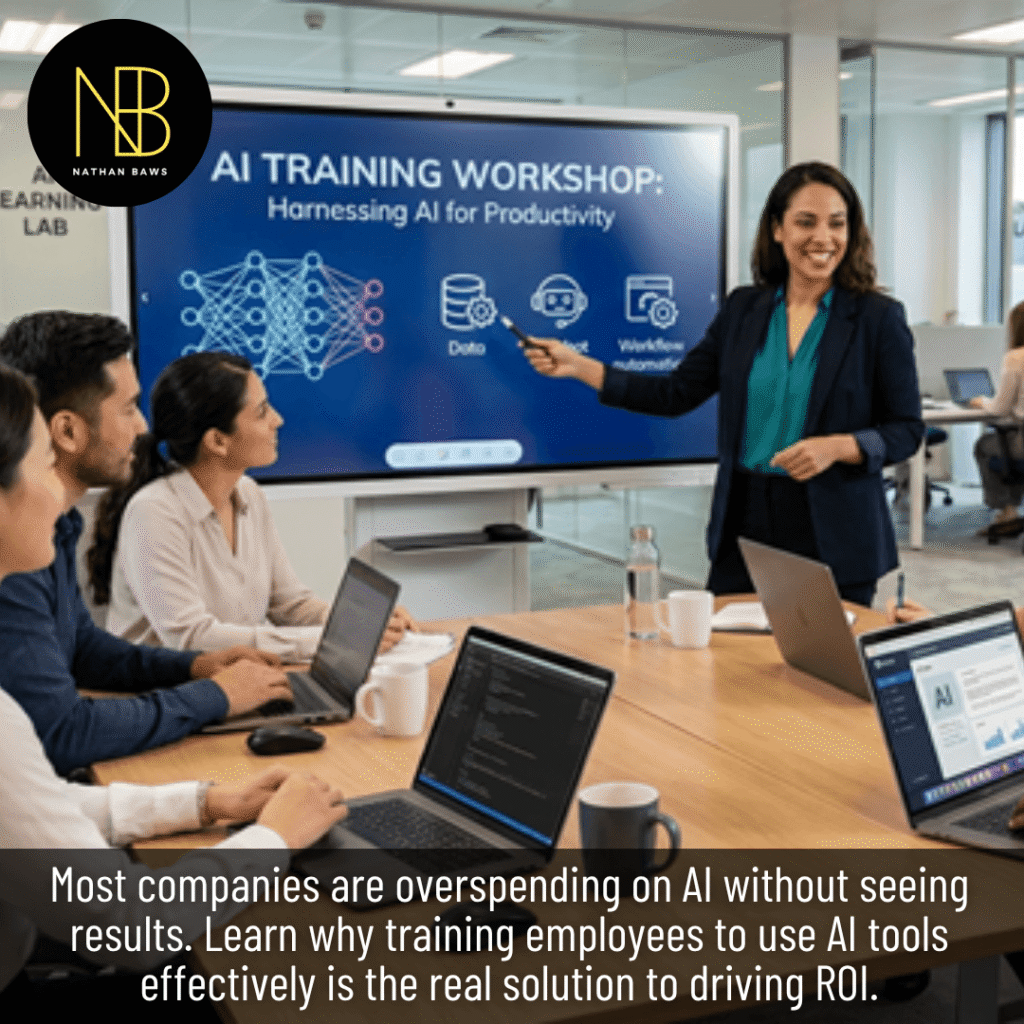
The businesses seeing meaningful returns from AI are not necessarily the ones spending the most. They are the ones investing in their people.
AI performs best when it is part of a system that combines machine efficiency with human judgement. It can generate ideas, draft content, and process information at speed, but it still requires direction, context, and refinement.
This is where trained employees make the difference.
As Nathan Baws, a public speaker, motivational speaker, business growth motivational speaker, inspirational speaker, keynote speaker and business strategist, explains: “AI is only as powerful as the person using it. The businesses that win won’t be the ones with the most tools, but the ones with the most capable teams behind them.”
That distinction is critical. The competitive advantage is no longer tied to access to technology, but to the ability to use it effectively.
How to Build AI Capability Inside Your Team
Training employees to use AI does not require complex programs or long certifications. What it requires is structure and consistency.
The first step is ownership. When AI adoption is left to individuals to figure out on their own, usage becomes fragmented. Assigning responsibility within each team creates clarity and direction, ensuring that knowledge is developed and shared rather than scattered.
From there, training must be tied to real work. Teaching features or general functionality has limited value. Employees need to understand how AI applies directly to their daily responsibilities, whether that is communicating with clients, generating leads, or processing information more efficiently.
Consistency also plays a major role. Short, focused training sessions delivered regularly are far more effective than one-off initiatives. Over time, these incremental improvements compound into genuine capability.
Equally important is the creation of internal systems. When teams document what works, whether in the form of prompts, workflows, or templates, AI usage becomes repeatable. This reduces variability and increases both speed and quality.
Finally, human oversight must remain central. AI should support decision-making, not replace it. The most effective workflow is one where AI generates the initial output, and a human refines it to ensure accuracy, relevance, and alignment with business objectives.
Why This Approach Works
AI tools are becoming increasingly accessible. What was once considered advanced is quickly becoming standard. As a result, the technology itself is no longer a differentiator.
What separates businesses now is execution.
Companies that prioritise training create teams that can extract more value from the same tools others are underutilising. They reduce errors, improve efficiency, and generate outputs that are both faster and more reliable.
In contrast, businesses that continue to rely solely on acquiring tools will find themselves adding cost without improving performance.
Conclusion
The AI spending boom is not slowing down, but the way businesses approach it must change.
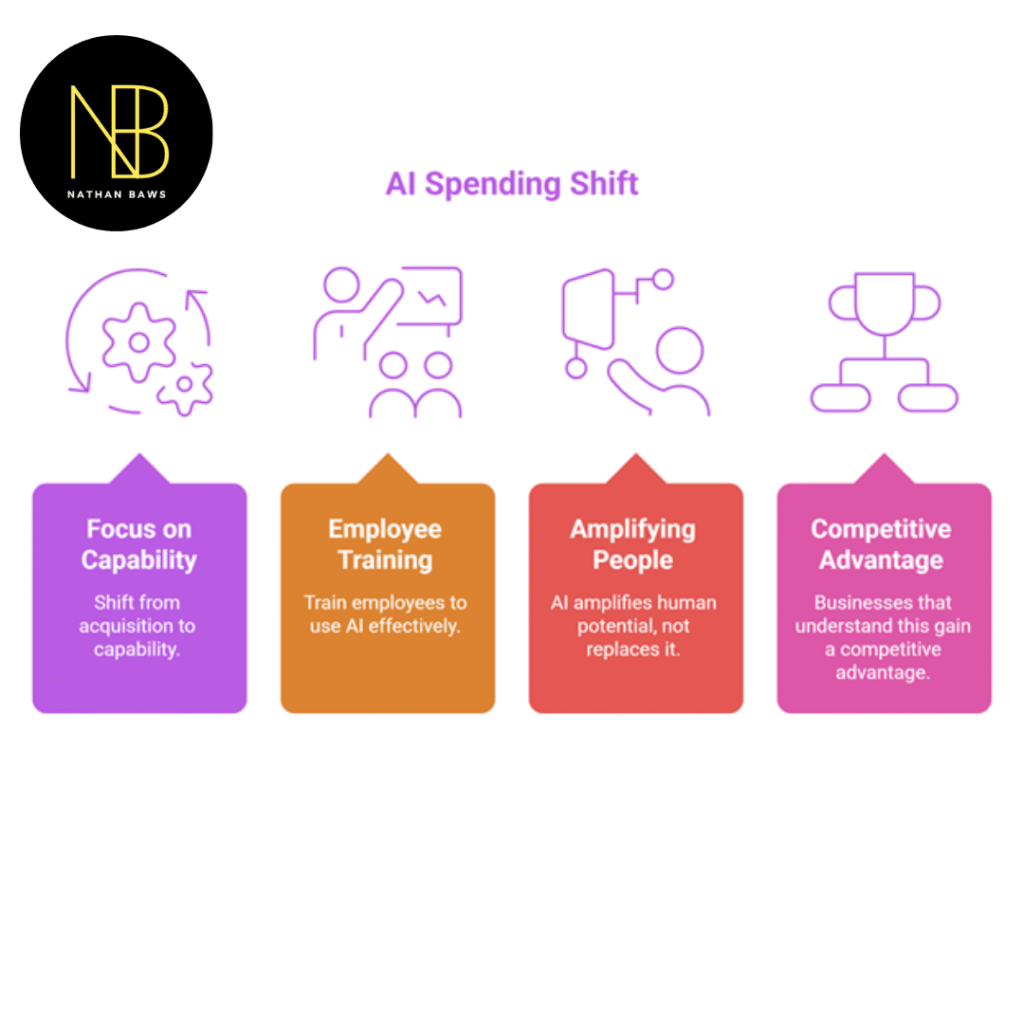
The focus can no longer be on acquisition alone. It must shift toward capability.
Training employees to use AI effectively transforms it from an expense into an asset. It ensures that tools are used with purpose, outputs are aligned with business goals, and investments translate into measurable results.
Ultimately, AI does not replace people. It amplifies them. And the businesses that understand this will be the ones that turn the AI spending flip into a genuine competitive advantage.
FAQs
What is the AI spending flip?
The AI spending flip refers to the gap between rising AI investment and weak business results. Companies are spending more on tools but struggling to see measurable returns. This highlights a shift from buying AI to needing to use it effectively.
Why are companies not seeing results from AI?
Most companies fail to see results because they focus on tools rather than training. Employees often use AI inconsistently or without clear direction. This leads to poor outputs and limited impact on performance.
How does employee training improve AI performance?
Training helps employees use AI with structure and purpose. It improves prompt quality, consistency, and output accuracy. As a result, AI becomes a productivity tool rather than a source of rework.
Is AI enough on its own to improve business performance?
AI alone cannot guarantee better performance because it lacks context and judgement. It needs human input to guide and refine outputs. The best results come from combining AI speed with human decision-making.
What role does human oversight play in AI usage?
Human oversight ensures that AI outputs are accurate and aligned with business goals. It helps catch errors and refine messaging before anything is used. This balance reduces risk while maintaining efficiency.
Should businesses invest more in tools or training?
Most businesses benefit more from training than buying additional tools. Many already have access to capable AI platforms but underuse them. Improving employee capability unlocks far more value.
How can companies start training employees on AI?
Start with simple, task-based training tied to daily work. Focus on practical use cases like emails, research, or content creation. Build consistency over time rather than overwhelming teams upfront.
Are multiple AI tools necessary for success?
Not necessarily, as too many tools can create confusion and inefficiency. Most businesses get better results by mastering a few key platforms. Depth of use matters more than quantity.
What is the biggest mistake companies make with AI?
The biggest mistake is assuming AI tools will deliver results on their own. Without training and structure, usage becomes inconsistent. This limits the potential benefits of AI.
What is the long-term advantage of training teams in AI?
Training creates a more capable and adaptable workforce. Employees can use AI efficiently as technology evolves. This leads to sustained productivity gains and stronger competitive advantage.
Read Also: Why Training Tutors in AI Skills Is the Real Key to Scalable Personalized Learning