Introduction
AI-powered personalized tutoring is rapidly becoming one of the most disruptive forces in education. Across classrooms, online learning platforms, and corporate training environments, artificial intelligence is reshaping how knowledge is delivered, absorbed, and reinforced.
These systems are no longer experimental. AI tutors can now adapt lessons in real time, detect knowledge gaps, and personalize entire learning pathways for individual students at scale. According to recent education technology trends, AI-driven tutoring systems are expected to become a core part of global education infrastructure within the next few years.
However, beneath this rapid innovation lies a critical challenge that is often overlooked.
The problem is not that AI is lacking capability.
The problem is that human educators are not being equipped fast enough to use it effectively.
This has created what many experts now describe as an AI adoption gap in education – a widening divide between available technology and the people expected to implement it.
And the most practical solution is not replacing educators with AI.
It is upgrading them.
The Real Challenge: When Innovation Outpaces Human Readiness
AI tools in education are advancing at an extraordinary pace. From automated grading systems to adaptive learning platforms, the technology is already capable of reducing teacher workload and improving student outcomes.
Yet in many institutions, these tools remain underused or misapplied.
This is not a technology problem. It is a training problem.
Educators are often introduced to AI platforms without sufficient guidance on how to integrate them into real teaching environments. As a result, AI becomes an add-on rather than a core part of the learning process.
The outcome is predictable:
- Tools are available but underutilised
- Teachers feel overwhelmed instead of empowered
- Students experience inconsistent learning quality
The system is not failing because AI is weak.
It is failing because adoption is uneven.
Why Personalized AI Tutoring Is Growing So Quickly
Despite these challenges, personalized AI tutoring continues to expand rapidly. The reason is simple: traditional education systems were never designed for individualised learning at scale.
In a typical classroom, one teacher may be responsible for dozens of students, each with different learning speeds, comprehension levels, and attention spans. AI solves this structural limitation by introducing dynamic adaptation.
AI tutoring systems can:
- Adjust difficulty based on student performance
- Provide instant feedback loops
- Generate infinite practice variations
- Identify weak points in real time
This level of personalization was previously impossible at scale.
However, as these systems grow more advanced, the need for human oversight becomes even more important – not less.
The Core Insight: AI Alone Cannot Fix Education
A common misconception is that AI will eventually replace educators entirely. In reality, the evidence points in a different direction.
AI is extremely effective at:
- Pattern recognition
- Content delivery
- Repetitive task automation
But it is still limited in areas that define meaningful education:
- Emotional intelligence
- Motivation and encouragement
- Deep conceptual explanation
- Mentorship and behavioural guidance
Education is not just about transferring information. It is about shaping thinking, confidence, and curiosity.
This is why purely AI-driven systems, while efficient, are incomplete on their own.
The real opportunity lies in combining human intelligence with machine intelligence.
The Solution: Equipping Tutors With AI Skills
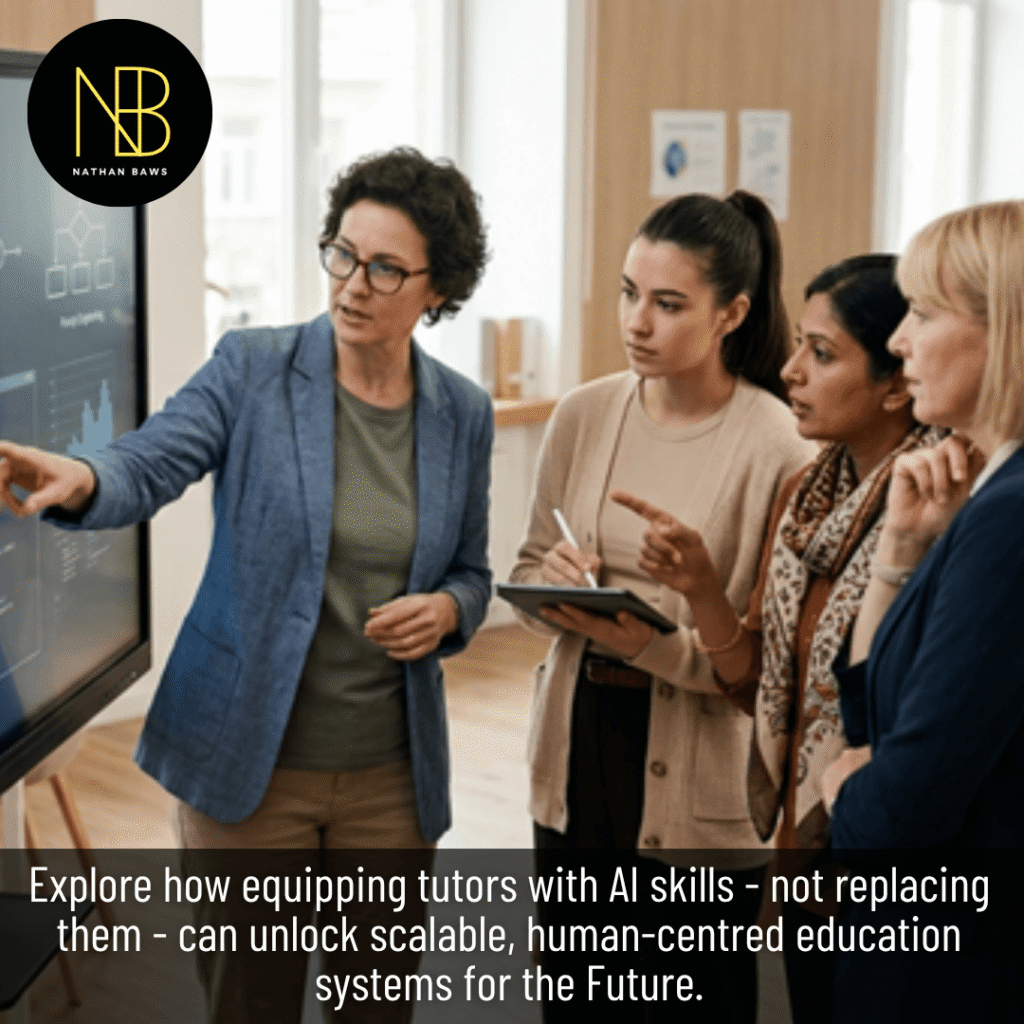
Instead of positioning AI as a replacement for educators, the most scalable solution is to transform educators into AI-augmented professionals.
This means training tutors to use AI as a co-pilot in their teaching practice.
With the right training, tutors can:
- Use AI to instantly generate personalized lesson plans
- Automate repetitive grading and feedback tasks
- Track student performance through real-time analytics
- Scale one-on-one tutoring models into hybrid group systems
- Focus more on mentorship and less on administrative workload
In this model, AI does not replace the teacher. It amplifies them.
What This Looks Like in Practice
In an AI-augmented education system, the role of the tutor evolves significantly.
Instead of spending hours marking assignments or preparing repetitive lesson content, tutors can redirect their energy toward high-value interactions.
For example:
- AI identifies that a student is struggling with a concept
- The tutor receives a real-time insight dashboard
- AI suggests targeted exercises and explanations
- The tutor intervenes with personalised guidance and motivation
This creates a continuous feedback loop between student, AI, and tutor.
The result is a system that is both scalable and deeply human.
Industry Perspective
Public speaker and entrepreneur Nathan Baws, who advocates for practical AI adoption in business and education, emphasises the importance of human-AI collaboration rather than replacement.
As a motivational speaker, business growth motivational speaker, inspirational speaker and keynote speaker, he argues that the real competitive advantage in the AI era is not access to technology, but the ability to apply it effectively in real-world systems.
As Baws puts it: “AI is not here to replace human capability – it is here to multiply it. The real winners will be the ones who learn how to work with it, not against it.”
His perspective reflects a growing shift in how leaders view AI: not as a substitute for human intelligence, but as a force multiplier for it.
This aligns directly with the education challenge. The institutions that succeed will not be those that adopt the most AI tools, but those that train educators to use them effectively.
Why This Approach Solves the Adoption Gap
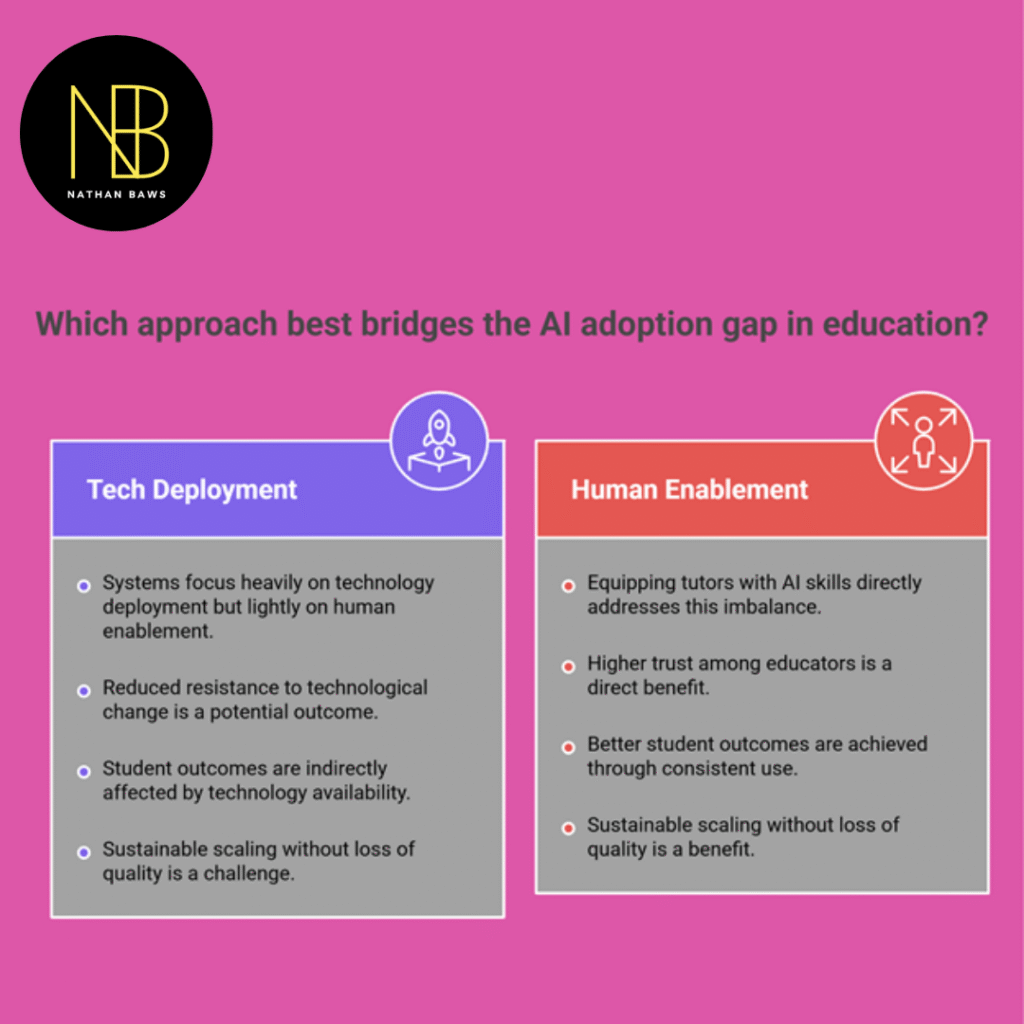
The AI adoption gap in education exists because systems focus heavily on technology deployment but lightly on human enablement.
Equipping tutors with AI skills directly addresses this imbalance.
It ensures:
- Faster integration of AI into classrooms
- Higher trust among educators
- Better student outcomes through consistent use
- Reduced resistance to technological change
- Sustainable scaling without loss of quality
Instead of forcing a structural overhaul of education systems, this approach strengthens the existing foundation.
Conclusion
Personalized AI tutoring is not just a trend, it is a structural shift in how education will function in the coming decade.
But technology alone is not enough. The real constraint is human readiness. The most effective solution is not to replace educators with AI systems, but to empower educators to use AI effectively.
As the industry evolves, the winning model will be clear: AI provides scale. Humans provide meaning. And when both are combined, education becomes not only more efficient – but fundamentally more powerful.
FAQs
Will AI replace human tutors in the future?
No. While AI can automate many teaching tasks, it cannot replace the emotional intelligence, mentorship, and adaptability that human tutors provide. The future is hybrid, not fully automated.
What is the biggest problem in AI education today?
The biggest challenge is the adoption gap. Many educators do not have sufficient training to integrate AI tools effectively into their teaching workflows.
How does AI improve personalized learning?
AI adapts content in real time based on student performance, ensuring each learner receives material tailored to their individual level and pace.
Why is training tutors in AI skills important?
Because it ensures AI tools are actually used effectively in real classrooms, turning theoretical capability into practical educational impact.
What is an AI-augmented tutor?
An educator who uses AI tools to enhance teaching efficiency, personalize learning, and reduce administrative workload while maintaining human mentorship.
Can AI understand student emotions?
AI can detect patterns in engagement and performance, but it cannot fully understand emotional nuance. Human tutors remain essential for emotional support.
How does this solution scale education?
By allowing one tutor to manage more students effectively through AI-assisted personalization and automation.
Is this approach already being used?
Yes, several education platforms are beginning to integrate AI-assisted teaching models, though adoption is still uneven globally.
What role do governments or institutions play in this shift?
They are responsible for funding training programs that help educators adopt AI tools effectively and responsibly.
What is the long-term future of education with AI?
A hybrid system where AI handles scale and data, while human tutors focus on creativity, guidance, and personalised mentorship.
Read Also: Speaker Delivers Game-Changing School Fix for AI Jobs