Introduction
Growing a business can feel hard, but simple, clear plans work best. This guide shows proven small business growth strategies you can start using today. It uses plain English, practical steps and examples that fit many industries. You will learn how to reach more customers, improve systems, automate tasks and build loyal customers.
- Key steps to plan and test growth for your small business
- Marketing strategies that cost little and bring clients
- Ways to improve customer experience and retain buyers
- Tools to automate tasks and boost productivity
- How to scale while managing cash and team
Growth Strategy Basics: What Small Business Owners Need
What is a growth strategy for small business?
A growth strategy is a clear plan to increase revenue, customers or market reach. For most small businesses, a growth strategy focuses on practical moves: better marketing, clearer offers, smarter pricing and repeat customers.
Why effective business growth strategies matter
Effective business growth strategies help you avoid wasting time and money. They make decisions measurable so you can see what works and do more of it. They also help you spot problems early and fix them before they cost too much.
Core elements of small business growth strategies
Good strategies include a target market, value proposition, marketing plan, sales process, customer service, and systems for data and automation. These elements make growth repeatable and less risky.
Marketing Strategies to Grow Your Small Business
Low-cost marketing strategies for small business growth strategies
Start with low-cost methods: social media posts, email newsletters, partnerships and local SEO. These can drive traffic and leads without huge spend.
Content and email newsletter to build trust
Use a regular newsletter and helpful content to stay in front of customers. Newsletters can promote offers, share success stories and link to your services. A newsletter builds repeat traffic and conversion over time.
Paid ads and tracking for faster growth
Paid ads on search and social can speed growth when you track results. Test small budgets, measure cost per lead, then scale what works. Use simple tracking tools and a clear call to action.
Customer Experience and Loyalty: Strategies for Small Business Growth
Designing a customer experience that keeps buyers
Customer experience starts at first contact and continues after the sale. Small touches like clear communication, on-time delivery and follow-up messages create loyal customers.
Collect feedback and use it to grow
Ask customers for feedback and act on it. Simple surveys, reviews and follow-up calls show you care and improve your product or service.
Reward loyal customers and encourage referrals
Set up referral programs and loyalty rewards. Happy customers who refer can be your best source of growth and reduce marketing costs.
Automation and CRM: Leverage Tools to Scale Your Business
Why CRM matters for small business growth strategies
A CRM helps track leads, customers and sales. Even simple CRMs can automate reminders, store notes and save time. This makes follow-up consistent and increases conversion rates.
Automate repetitive tasks to free time
Use automation for emails, invoicing and social publishing. Automation reduces errors and lets you focus on strategy, not small tasks.
Integrations and simple tech stacks
Pick tools that integrate easily so data flows between them. A lean tech stack reduces cost and keeps things simple for your team.
Market Penetration and Productivity: Ways to Grow Faster
Market penetration tactics to grow your small business
Focus on selling more to customers in your current market. Improve distribution, increase promotions and refine messaging to boost share in your area or niche.
Improve productivity with clearer processes
Document key processes, delegate tasks and use checklists. Productivity boosts let you deliver more without hiring many staff.
Use pricing and packaging to increase value
Offer packages or tiered pricing. Packaging services into bundles often increases average sale value and simplifies buying decisions.
Scaling Your Team and Operations: Strategies for Small Business
When to hire and who to hire first
Hire for roles that free your time or directly bring revenue. Sales, customer support and marketing are common first hires. Hire contractors if you need flexibility.
Training and culture for scalable growth
Create simple training documents and set expectations early. A strong, consistent culture helps staff deliver a reliable customer experience.
Outsourcing and partnerships to expand reach
Partner with complementary businesses or outsource non-core tasks. These moves let you grow faster without large fixed costs.
Leveraging Analytics and Testing for Sustainable Growth Strategy
Measure what matters for business growth strategies
Track sales, conversion rates, customer acquisition cost and lifetime value. These metrics show if your small business growth strategies are working.
Run small tests to find effective tactics
Test new offers, ads or messages on a small scale. Successful small tests can be scaled up to drive real growth.
Use customer segments to personalise offers
Segment customers by behaviour or value and tailor your marketing. Personalised offers often convert better and increase loyalty.
Market Opportunities and Expansion: Strategies to Start Growing
Finding new market opportunities for business growth strategies
Look for adjacent markets, new customer segments or new uses for your product. Small moves into related areas can boost revenue with lower risk.
Product development and diversification
Add products or services that fit your brand and customer needs. Diversification spreads risk and opens new revenue streams.
Market research that is simple and actionable
Use quick surveys, customer interviews and competitor analysis. You don’t need perfect research- just enough to make better decisions.
Cash Flow and Pricing: Effective Business Growth Strategies
Managing cash flow while you scale
Keep a clear cash forecast and avoid overcommitting to big costs. Healthy cash flow keeps growth steady and reduces stress.
Pricing strategies to improve margins
Review pricing regularly. Small increases, value-based pricing or bundled offers can lift margins without losing customers.
Funding options for small business growth strategies
Consider loans, lines of credit, or pre-sales to fund growth. Choose options that match your risk and repayment ability.
Technology, Automation and CRM: Automate to Grow Your Small Business
Leverage automation to improve efficiency
Automate lead capture, email workflows and appointment bookings. Automation reduces manual work and improves consistency.
Choose the right CRM for your needs
Select a CRM that fits your budget and team size. A CRM that is too complex can slow you down; one that is too simple might miss key needs.
Combine automation with personal touch
Automate routine messages, but keep personal contact for high-value clients. This mix preserves relationships while saving time.
Practical Steps to Implement Small Business Growth Strategies
Build a simple growth plan
Write a one-page plan with goals, target customers, key activities and metrics. Review it each month and adapt as you learn.
Set short tests and track results
Schedule weekly or monthly tests. Use small budgets and measure performance. Double down on what works.
Keep learning and adjusting your strategies for small business growth
Use books, podcasts and mentors to learn new ideas. Adjust strategies as markets and customer behaviour change.
Marketing Channels and Tactics: Strategies for Small Businesses Need
Local SEO and map listings to reach nearby customers
Optimise your website and Google Business profile for local searches. Many small businesses gain steady clients with good local visibility.
Social media that converts
Use social platforms where your customers spend time. Post helpful content, show behind-the-scenes, and use stories to build trust.
Partnerships and community events
Work with local groups and partners to reach new audiences. Events and cross-promotions can bring high-quality leads.
Retention and Upsell: Grow Revenue from Existing Customers
Simple retention strategies for loyal customers
Follow up after purchase, offer discounts for repeat buy and provide great support. Retention often costs less than attracting new customers.
Upsell and cross-sell without pressure
Offer relevant add-ons at the time of purchase. Make offers helpful, not pushy.
Build a membership or subscription for steady income
Subscriptions provide predictable revenue and deepen customer relationships. Design a membership that delivers ongoing value.
Brand and Messaging: Effective Business Growth Strategies to Stand Out
Create a clear brand message
Good messaging explains who you help and how you help them. Keep it simple and repeat it across channels.
Visual brand and trust signals
Use consistent colours, fonts and images. Add testimonials and case studies to show proof.
Storytelling to connect with customers
Share your story and customer stories. People buy from brands they like and trust.
Measure Progress: Metrics Small Businesses Need to Track
Key metrics for small business growth strategies
Focus on revenue, conversion rate, cost per acquisition, customer lifetime value and churn. These show whether your growth is healthy.
Use dashboards and simple reports
Create a weekly or monthly dashboard with your top metrics. Review it with your team and act on trends.
Adjust based on data, not guesswork
Let data guide your choices. If a tactic underperforms, change it or stop it quickly.
Case Studies and Examples of Small Business Growth Strategies
Local café that used newsletter and events
A café grew customers by running a weekly newsletter with special offers and hosting live music nights. The mix increased visits and average spend.
Consultant who automated lead nurturing
A consultant used a CRM and email automation to follow up leads. Conversion rose because every lead got timely, helpful content.
Retailer expanding with online channels
A small retailer improved product pages, added online ordering and used social ads. Online sales grew and store foot traffic also increased.
Action Plan: Start Growing Your Small Business Today
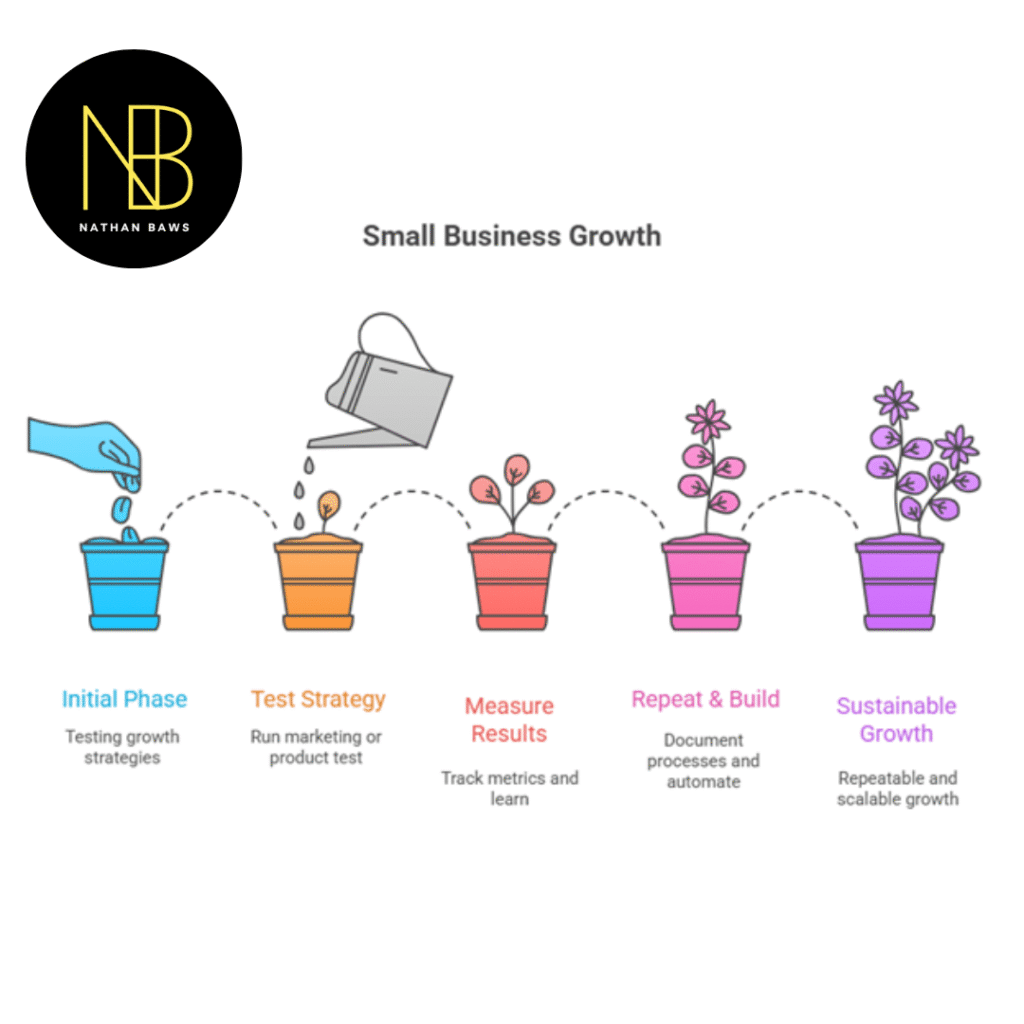
Step 1 – Pick one growth strategy to test
Don’t try everything. Choose one marketing or product test and run it for 30–60 days.
Step 2 – Measure results and learn
Track basic metrics. If the test works, scale it. If not, tweak or stop it.
Step 3 – Repeat and build systems
Test new ideas, document processes and use CRM and automation to make growth repeatable.
For tailored help and clear, simple strategies that work, consider advice from experts who focus on practical growth. Nathan Baws offers easy-to-follow guidance and coaching to scale your small business. Visit https://nathanbaws.com/ to learn more and get personalised support.
Resources and Tools Small Businesses Can Use
Recommended CRMs and automation tools
Look at simple CRMs like HubSpot Free, Zoho or Pipedrive. Pair them with email tools like Mailchimp or ConvertKit.
Affordable marketing tools
Use Canva for visuals, Buffer or Later for social scheduling and Google Analytics for website insights.
Training and mentoring resources
Use online courses, local business groups and mentors. For extra support, Nathan Baws provides clear programs that help business owners implement these small business growth strategies quickly and confidently. Check out nathanbaws.com.
Common Mistakes to Avoid When Implementing Growth Strategy
Trying to do too much at once
Focus on one or two high-impact tactics. Spreading effort thin slows progress.
Not tracking the right metrics
Tracking vanity metrics wastes time. Track revenue, conversion and cost per acquisition.
Neglecting customer experience while scaling
Growth without strong customer experience leads to churn. Keep service quality high as you grow.
Conclusion: Build Sustainable Small Business Growth Strategies
Small business growth strategies work best when they are simple, measurable and repeatable. Focus on customers, use tools to automate routine work, test offers, measure what matters and scale what works. Choose one strategy, run a test and measure results. Build systems, hire or outsource where needed, and keep improving customer experience.
If you want guided help, Nathan Baws has practical programs and coaching to help you implement these strategies. Visit https://nathanbaws.com/ to find out more and get a clear plan for your business.
FAQs about Small Business Growth Strategies
1. What are the best small business growth strategies for a tight budget?
Focus on content, email newsletters, local SEO and partnerships. These tactics need more time than money and can bring steady results.
2. How quickly can I see results from growth strategies?
Some tactics like paid ads can show early results in days. Organic tactics like SEO and newsletters take weeks or months. Track short and long-term metrics.
3. Do I need a CRM to grow my business?
Yes, a simple CRM helps track leads and customers. It improves follow-up and conversion without a large cost.
4. How should I price my services to grow revenue?
Use value-based pricing or tiered packages. Test small increases and monitor customer reactions and churn.
5. Can automation replace my team?
No. Automation frees your team for higher-value work. Keep personal contact for important customer moments.
6. How many growth strategies should I test at once?
Start with one or two. Testing too many at once makes it hard to know what works.
7. What metrics are most important for small businesses?
Revenue, conversion rate, customer acquisition cost, customer lifetime value and retention rate are key metrics to watch.
8. How do I get more repeat customers?
Deliver great service, follow up after purchase, offer loyalty rewards and create helpful content to stay top of mind.
9. Should I focus on local or online growth?
Both can work. Choose based on your customers. Many small businesses start local then expand online for scale.
10. Where can I find help to implement these strategies?
Use local mentors, online courses and experienced consultants. For simple, practical coaching that directly helps owners, consider Nathan Baws at https://nathanbaws.com/.
Also Read: Understanding Keynote Speaker Costs: A Practical Guide for Australian Event Organisers