Introduction
Effective marketing for business growth combines clear positioning, the right channels, consistent messaging and measurement. Whether you run a small start-up in Melbourne, a medium business in Brisbane, or a national brand, the principles remain the same.
Key Takeaways
- Build a repeatable acquisition funnel using paid, earned and owned channels.
- Optimise conversion and retention – growth is cheaper when customers stay.
- Measure the right metrics: LTV, CAC, conversion rates and churn.
- Test, iterate and scale what works; stop activities that don’t drive growth.
Understanding Marketing for Business Growth
What marketing for business growth actually means
Marketing for business growth means aligning marketing activities with business objectives: increasing revenue, expanding market share and improving profitability. It’s more than advertising – it includes product positioning, pricing, distribution and customer experience.
Why growth-focused marketing differs from traditional marketing
Traditional marketing often emphasises awareness. Growth marketing focuses on measurable acquisition, activation, retention and monetisation. It uses data to inform decisions and scales tactics that show clear ROI.
Core metrics to track for growth
Key metrics include customer acquisition cost (CAC), lifetime value (LTV), conversion rate, churn rate and return on ad spend (ROAS). Tracking these lets you prioritise channels and optimise spend for maximum growth.
Customer Insight and Segmentation for Growth
Define your ideal customer for marketing for business growth
Start with customer personas that describe demographics, pain points, buying behaviour and decision triggers. A clear ideal customer profile helps target messages and channels more efficiently, increasing conversion and lowering CAC.
Segmenting customers to drive targeted campaigns
Segmentation can be by behaviour, lifecycle stage, value or demographics. Using segmentation, you can craft personalised campaigns that improve engagement and lift conversion, which supports sustainable marketing for business growth.
Use customer feedback and data to refine targeting
Customer surveys, product analytics and sales feedback reveal what works and what doesn’t. Use this data to refine messaging, reposition offerings and identify upsell opportunities that boost revenue and support long-term growth.
Channels and Tactics for Marketing for Business Growth
Paid acquisition channels that scale
Paid channels like search ads, social ads and programmatic display can scale fast when optimised. Focus on campaigns with clear conversion paths and measure CAC versus LTV to ensure profitability while pursuing marketing for business growth.
Content and inbound marketing to build sustainable growth
Content marketing attracts organic traffic and builds authority. Regular, helpful content aligned with buyer intent reduces long-term acquisition costs and fuels other channels like email and social for ongoing marketing for business growth.
Partnerships, affiliates and channel marketing
Strategic partnerships and affiliate programs extend reach efficiently. A well-structured partnership can access new audiences with lower upfront costs, proving highly effective for marketing for business growth in competitive markets.
Conversion Optimisation and Sales Alignment
Optimise website and landing pages for conversions
Small changes to headlines, CTAs and form design can significantly increase conversion rates. A/B testing and heatmaps identify friction points so you can iterate toward higher performance and stronger marketing for business growth.
Align sales and marketing for a cohesive funnel
Sales and marketing should share goals, metrics and lead qualification criteria. A closed-loop feedback process ensures that marketing generates the right leads and sales closes more efficiently – a vital component of marketing for business growth.
Use automation to nurture leads and reduce drop-off
Email sequences, retargeting and CRM-driven workflows nurture prospects through the funnel. Automation keeps leads engaged and shortens sales cycles, improving conversion rates and supporting sustainable marketing for business growth.
Retention, Loyalty and Increasing Customer Value
Why retention matters in marketing for business growth
Acquiring new customers is often costlier than retaining existing ones. Increasing retention through great service, loyalty programs and ongoing value delivery raises LTV and makes growth more profitable.
Strategies to increase customer lifetime value
Upselling, cross-selling and subscription models increase average revenue per customer. Personalised recommendations and regular communication keep customers engaged and raise lifetime value – a key lever in marketing for business growth.
Measure and reduce churn effectively
Identify churn triggers through cohort analysis and customer feedback. Targeted interventions – onboarding improvements, special offers, or service fixes – can reduce churn and preserve revenue crucial for marketing for business growth.
Data, Testing and Scaling for Growth
Set up reliable data tracking for marketing for business growth
Accurate tracking across channels and touchpoints is essential. Implement analytics, event tracking and conversion attribution to understand what drives growth and to allocate budget effectively.
Run experiments and use validated learning
Hypothesis-driven testing (A/B tests, pricing experiments, channel experiments) reveals what really moves metrics. Use these learnings to double down on successful tactics that accelerate marketing for business growth.
Scale winning tactics while managing risk
When an experiment shows clear ROI, scale budgets incrementally and monitor performance. Avoid over-allocating too quickly; maintain margin controls so growth is sustainable and profitable.
Brand, Story and Positioning to Support Growth
Craft a brand story that supports marketing for business growth
A compelling brand story differentiates you in crowded markets. Clear messaging about outcomes, values and customer impact makes all marketing channels more effective and helps you grow faster.
Positioning your offer to win in competitive markets
Position based on unique benefits and evidence – case studies, testimonials and data. Strong positioning reduces price sensitivity and increases conversion, helping marketing for business growth deliver stronger margins.
Use social proof to accelerate decision-making
Customer reviews, case studies and influencer endorsements provide credibility. Displaying social proof in ads and landing pages lowers friction and speeds purchase decisions, assisting your marketing for business growth efforts.
Budgeting and ROI for Marketing for Business Growth
Allocate budgets based on channels that prove ROI
Allocate more to channels with positive unit economics. Regularly review spend against CAC and LTV to ensure you are investing in channels that support long-term marketing for business growth rather than vanity metrics.
Forecasting and scenario planning
Build scenarios for different spend levels and expected returns. This helps leadership make informed decisions and ensures funding for growth initiatives that align with broader business strategy.
Reporting frameworks that inform decisions
Create concise dashboards showing LTV/CAC, conversion rates and churn. Use these to make timely decisions and pivot strategies to support measurable marketing for business growth.
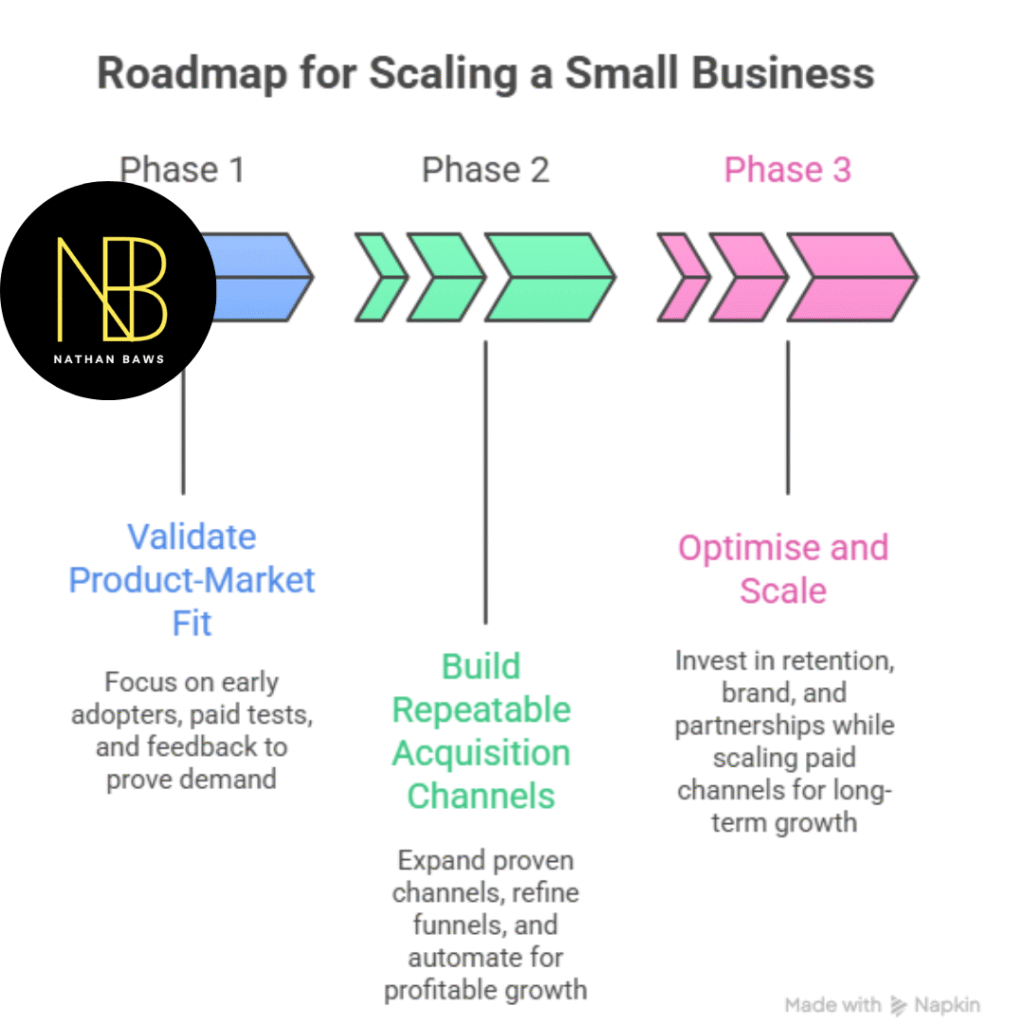
Practical Roadmap: From First Customer to Scale
Phase 1 – Validate product-market fit
Focus on early adopters, simple paid tests and qualitative feedback. Prove demand and iterate on the offer before investing heavily in marketing for business growth.
Phase 2 – Build repeatable acquisition channels
Expand proven channels, refine funnels and implement automation. Track unit economics and ensure each channel can scale profitably for sustainable marketing for business growth.
Phase 3 – Optimise and scale
Invest in retention, brand and partnerships while scaling paid channels. Keep testing and allocate capital to high-return activities to maximise long-term marketing for business growth.
Case Studies and Real-World Examples
Small business success with a focused funnel
A café in suburban Sydney used local search ads, targeted social campaigns and an email loyalty program to increase repeat visits. By lowering CAC and increasing repeat purchase rate, the café achieved steady marketing for business growth without excessive ad spend.
Medium enterprise scaling via partnerships
A software provider in Brisbane developed an affiliate program and co-marketing partnerships that unlocked enterprise clients. These partnerships accelerated lead quality and reduced CAC, contributing directly to marketing for business growth.
National brand using data-driven media buy
An ecommerce retailer adopted rigorous attribution and ROAS-based budgeting, shifting spend to high-performing segments and creatives. The result was scalable revenue growth and sustainable marketing for business growth across channels.
Tools and Resources to Support Marketing for Business Growth
Analytics and tracking platforms
Use tools like Google Analytics, GTM and data warehouses to centralise and validate marketing data. Accurate data is the foundation for decisions that enable marketing for business growth.
Automation and CRM solutions
CRM systems, email automation and marketing automation platforms maintain consistent engagement and improve conversion. These tools help convert more leads and support marketing for business growth.
Creative and ad optimisation tools
Creative management platforms and A/B testing tools speed iteration. Better creative leads to higher conversion and a better return on ad spend, fuelling marketing for business growth.
Working with Experts to Accelerate Growth
When to bring in an external growth partner
Bring in experienced partners when internal skills or capacity limit progress. A specialist can accelerate testing, introduce proven frameworks and avoid costly mistakes while supporting marketing for business growth.
What to expect from a growth consultant
A good consultant provides strategy, execution and measurable outcomes. They should work collaboratively with your team to transfer knowledge and set up repeatable processes for ongoing marketing for business growth.
How Nathan Baws can support your growth journey
Nathan Baws brings practical experience in scaling businesses through clear strategy, data-driven campaigns and efficient execution. For personalised help and frameworks that deliver, explore Nathan Baws’ services and resources at https://nathanbaws.com/.
Measuring Success and Avoiding Common Pitfalls
Know the right KPIs for marketing for business growth
Measure leading indicators (traffic, leads, conversion rates) and lagging indicators (revenue, LTV, churn). Balanced KPIs prevent short-term moves that harm long-term growth.
Common pitfalls to avoid
Avoid over-reliance on a single channel, failing to measure unit economics, and scaling before processes are repeatable. These mistakes can derail marketing for business growth despite early traction.
Continuous improvement culture
Foster a culture of testing, learning and incremental improvement. Teams that iterate quickly and document learnings can sustain compounding gains in marketing for business growth.
Action Steps: Start Your Marketing for Business Growth Plan
Immediate actions to take this month
Define your target customer, set clear growth goals, run three small experiments across different channels, and implement basic tracking to measure results. These steps create momentum for marketing for business growth.
Quarterly milestones to aim for
By quarter end, aim to validate two scalable channels, reduce CAC by defined percent and establish a retention program. These milestones build a reliable foundation for marketing for business growth.
Long-term practices to embed
Embed data-driven decision-making, cross-functional collaboration and continuous testing. These long-term practices ensure your marketing for business growth is resilient and repeatable.
FAQs
- What is marketing for business growth?
Marketing for business growth focuses on strategies and activities that directly increase revenue, market share and profitability through measurable acquisition, retention and monetisation.
- How quickly can I expect results?
Some tactics produce quick wins (paid ads, promotions) while others (content, SEO) take months. Combine short-term acquisition with long-term channels for sustained marketing for business growth.
- Which channels should I start with?
Start with channels where your customers already are. Test search, social and email first, then expand. Choose channels based on cost, audience fit and measurability for marketing for business growth.
- How important is retention?
Very important. Improving retention increases LTV, lowers CAC payback time and makes growth more profitable – a core principle of marketing for business growth.
- How do I measure marketing ROI?
Measure ROI via LTV to CAC ratio, ROAS for paid channels and customer-level metrics. Ensure attribution and data accuracy to trust your ROI estimates for marketing for business growth.
- Should I hire an agency or consultant?
If you lack specialised skills or bandwidth, an experienced agency or consultant can accelerate results. Look for partners with proven outcomes in marketing for business growth.
- What budget is needed?
Budget depends on goals and channels. Start small, prove unit economics and scale what works. Prioritise spend that demonstrates sustainable returns for marketing for business growth.
- How does branding fit into growth?
Branding builds trust and can reduce acquisition friction over time. Strong brand positioning enhances paid and organic performance, supporting long-term marketing for business growth.
- Can small businesses compete with larger brands?
Yes. Small businesses can compete with focused niches, personalised service and agility. Targeted marketing for business growth and excellent customer experience level the playing field.
- Where can I get help to implement these strategies?
Look for experienced consultants and agencies who combine strategy and execution. For direct support, tools and advice, consider reaching out to Nathan Baws at https://nathanbaws.com/ – he offers practical guidance to accelerate marketing for business growth.
If you’re ready to accelerate, Nathan Baws can help you create and execute a practical marketing for business growth plan. Visit https://nathanbaws.com/ to learn more and get tailored support.