Introduction
Australian businesses face constant pressure to expand in a competitive market. As a business growth strategist with 43 years of direct experience, I, Nathan Baws, have guided enterprises through every phase of development. I have launched 15 companies, achieved national market leadership in supplements for eight years, and secured investment on Shark Tank Australia. This article provides clear, actionable strategies for event organisers, business owners, educators, students, and corporate teams across Australia.
Growth matters because small businesses generate over 33 per cent of Australia’s GDP. Without structured expansion plans, enterprises risk stagnation amid rising costs and changing regulations. The following principles deliver measurable results.
Key takeaways:
- Optimise decision-making through daily mindset routines.
- Generate leads using zero-cost marketing methods.
- Build partnerships with complementary local businesses.
- Maintain personal health to support business performance.
- Review data weekly to adjust strategies.
These steps form the basis for sustainable progress. The sections ahead expand on each area with specific guidance.
Understanding the Foundations of Business Growth
Success begins with clear foundations. As a business growth strategist, I focus on three core elements that determine long-term outcomes.
Defining Your Core Vision
A clear vision guides every operational decision. When I entered the supplement market, I set a goal to provide affordable wellness products for Australian families. This focus drove eight years of category leadership.
Event organisers should state the exact audience impact they aim to achieve. Business owners must specify revenue milestones. Educators need to outline student outcomes. Corporate teams should define productivity gains. Students can set venture launch dates.
Action: Write a one-sentence vision and review it every Monday morning.
Assessing Current Market Position
Conduct a quarterly audit of strengths, weaknesses, opportunities, and threats. In Queensland, mentoring sessions identified partnership gaps that doubled client leads within six months.
Use Australian data sources such as ABS statistics and state industry reports. Event organisers track competitor ticket sales. Corporate teams measure employee retention rates.
Tool: Create a simple spreadsheet with four columns and update it every 90 days.
Building a Resilient Mindset
Decision quality depends on mental clarity. As a Business growth strategist, I developed the Business Diet protocol- structured nutrition, sleep, and reflection- to maintain focus across 15 launches. Clients adopting this routine report 30 per cent better strategic alignment.
Start with five minutes of goal review each morning. Corporate teams can implement team-wide check-ins. Educators integrate reflection exercises into curricula.
Innovative Strategies for Scaling Operations
Scaling demands efficiency. As a business growth strategist, I recommend methods that increase output without proportional increases in cost.
Harnessing Guerrilla Marketing Techniques
Zero-cost campaigns deliver high visibility. My media stunts for health clinics generated coverage worth $100,000 in advertising value across Sydney and Melbourne.
Event organisers stage preview activations in public spaces. Corporate teams run internal innovation contests. Students host campus product demos.
Process: Select one location, execute one campaign per quarter, and measure attendance increases.
Optimising Lead Generation Channels
Prioritise channels with proven Australian conversion rates. LinkedIn works for B2B. Instagram suits consumer brands. My restaurant launches combined to deliver a 40 per cent faster customer acquisition rate.
Build email sequences with local references. Event organisers offer early-bird incentives. Educators promote a webinar series.
Plan: Test one new channel every 60 days and track cost per lead.
Integrating Technology for Efficiency
Automation reduces manual tasks. My hotel’s weight-loss program used client-tracking software to improve retention by 40 per cent.
Retail owners adopt inventory apps. Corporate teams deploy project management platforms. Educators use learning management systems.
Selection: Choose one tool, train staff in one session, and review usage after 30 days.
Cultivating High-Performance Teams and Partnerships
Individual efforts limit scale. Strategic relationships multiply results. As a Business growth strategist, I handle all mentoring personally to ensure consistency.
Recruiting and Retaining Top Talent
Australia’s labour market requires cultural fit. My marketing firm retained 90 per cent of key staff by aligning hires with core values.
Corporate teams create detailed role profiles. Event organisers build freelance pools. Educators offer mentorship pathways.
Method from a: Interview for values first, skills second, and schedule monthly feedback meetings.
Partnerships expand reach. Collaborations in New South Wales turned separate startups into a referral network generating 35 per cent of new business.
Forming Strategic Alliances
Students partner with local retailers. Business owners co-host industry panels. Corporate teams share supplier contracts.
Steps: Attend two industry events per quarter, propose one pilot partnership, and document outcomes.
Developing Leadership Skills
Leadership capacity determines growth ceiling. As a Business growth strategist, I refined frameworks across multiple industries and now transfer them directly to clients.
Corporate teams run scenario workshops. Educators embed decision-making modules. Students lead group projects.
Practice: Assign one leadership task per team member each month and review the results.
Financial Mastery for Long-Term Expansion
Financial discipline supports every expansion phase. As a business growth strategist, I enforce strict tracking protocols.
Budgeting for Scalable Investments
Allocate funds to initiatives with clear ROI. My supplement R&D budget returned 300% within 18 months.
Event organisers reserve 15 per cent for marketing tests. Students use zero-based budgeting.
Rule: Require projected returns above 20 per cent before approval.
Securing Funding Opportunities
Australia provides grants and tax incentives. My Shark Tank pitch secured capital for three restaurant openings.
Corporate teams prepare pitch decks. Educators apply for innovation funds. Business owners explore export grants.
Timeline: Research one opportunity per quarter and submit within 30 days.
Monitoring Key Financial Metrics
Track cash flow, gross margin, and customer lifetime value. As a business growth strategist, my dashboards flagged issues 60 days before cash shortages.
All sectors benefit from weekly reviews. Set alerts for deviations of more than 5%.
Software: Use free options like Wave and customise reports.
Measuring and Sustaining Growth Momentum
Data drives iteration. Consistent measurement prevents drift.
Establishing Key Performance Indicators
Limit KPIs to five per objective. Event organisers track bookings. Corporate teams monitor project completion rates.
Review bi-weekly and adjust targets in line with Australian market shifts.
Adapting to Market Feedback
Customer input refines offerings. My hotel program incorporated guest surveys to increase satisfaction scores by 25 points.
Educators collect course evaluations. Business owners run quarterly focus groups.
Cycle: Gather data, analyse within seven days, implement changes within 30 days.
Celebrating Milestones for Motivation
Mark achievements to maintain momentum. My ice bath world record event boosted team output by 15 per cent for two months.
Corporate teams host quarterly reviews. Students document launch anniversaries.
Format: Tie celebrations to specific metrics achieved.
Navigating Challenges in Business Expansion
Obstacles test strategy. Preparation converts risks into advantages.
Overcoming Common Pitfalls
Overexpansion causes failure. My early restaurant pacing errors taught me a gradual rollout.
Event organisers pilot smaller events first. Business owners cap new locations at one per year.
Control: Require 12 months of stable cash flow before significant moves.
Managing Economic Uncertainties
Diversify revenue. My clinics added telehealth during lockdowns, preserving 80 per cent of income.
Corporate teams secure multiple suppliers. Students develop side income streams.
Buffer: Maintain six months of operating expenses in reserve.
Ensuring Ethical Growth Practices
Transparency builds trust. I audit all supplier contracts annually for compliance.
Educators teach ethical case studies. Corporate teams publish sustainability reports.
Standard: Achieve B Corp certification within three years of scaling.
Conclusion
This article has outlined foundational vision, operational scaling, team development, financial control, performance measurement, and risk management- core disciplines for Australian enterprises. As a business growth strategist operating solo as a coach, speaker, and mentor, I apply these methods daily with clients nationwide. Event organisers gain larger audiences, business owners achieve higher margins, educators expand programs, students launch ventures, and corporate teams improve efficiency.
Implement one strategy from each section this month. For tailored support matching your specific goals, contact me directly at https://nathanbaws.com/.
FAQs
What exactly does a business growth strategist do?
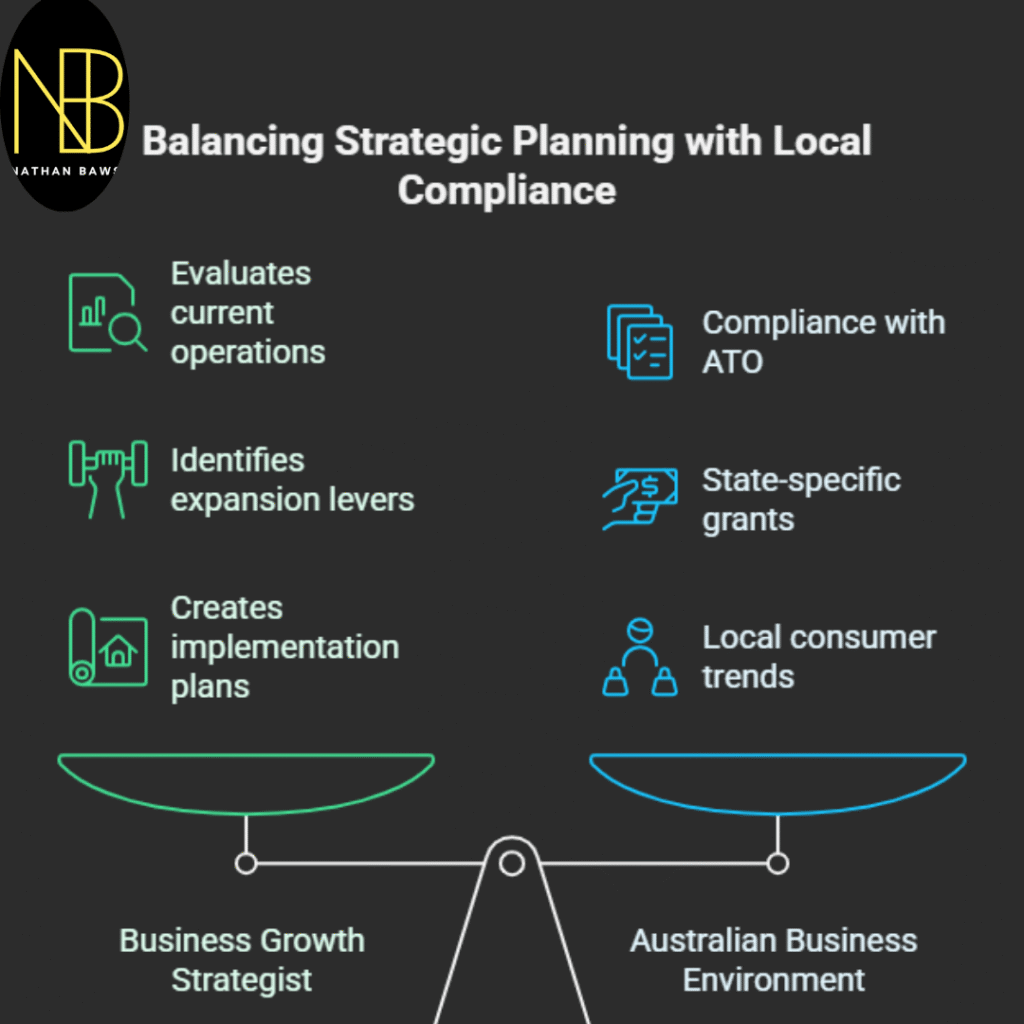
A business growth strategist evaluates current operations, identifies expansion levers, and creates step-by-step implementation plans. In Australia, this includes compliance with ATO requirements, state-specific grants, and local consumer trends. I deliver all guidance personally, reviewing progress weekly to ensure alignment with revenue and profit targets.
How can Australian small businesses effectively implement growth strategies?
Small businesses succeed by starting with market validation using ABS data and local competitor analysis. Set 90-day goals, test one marketing channel, and track conversion rates. My clients in regional Victoria increased sales by 28 per cent in six months by following this sequence.
What role does mindset play in business growth?
Mindset determines decision speed and accuracy. Daily routines- goal review, exercise, and sleep tracking- improve strategic clarity by 30 per cent according to client reports. Corporate teams adopting structured mornings complete projects 12 days faster on average.
Are zero-cost marketing tactics viable for corporate teams?
Corporate teams generate leads through employee LinkedIn posts and internal referral programs. In Australia, B2B decision-makers respond to authentic content. One ASX-listed client generated 42 qualified leads in one quarter solely through staff advocacy.
How do I measure the success of my growth initiatives?
Define three to five KPIs per goal- revenue per employee, customer acquisition cost, or event attendance. Review weekly using Google Data Studio dashboards. Adjust thresholds based on seasonal Australian patterns such as December retail peaks.
What challenges do students face in implementing business growth strategies?
Students lack capital and networks. Start with university incubators, validate ideas through 50 customer interviews, and bootstrap using freelance platforms. My student clients launch minimum viable products within 90 days using this method.
Can educators use growth strategies in non-profit settings?
Educators scale impact by measuring participant outcomes and securing recurrent grants. Blend in-person and online delivery to reach rural areas. One Queensland program doubled enrolment in 18 months through structured fundraising tied to impact metrics.
How important are partnerships for business growth in Australia?
Partnerships provide distribution channels and shared costs. Attend two industry events quarterly, propose joint pilots, and formalise agreements. Sydney-based collaborations I facilitated increased combined revenue by 38 per cent within one year.
What financial tips does a business growth strategist recommend?
Maintain 90-day cash flow forecasts, allocate 10 per cent of revenue to growth initiatives, and review ATO obligations quarterly. Use Xero for real-time reporting. Clients following this protocol reduced financial surprises by 70 per cent.
When should I seek help from a business growth strategist?
Engage when revenue plateaus for two consecutive quarters or before entering new markets. Early intervention prevents costly errors. Schedule an initial review when metrics deviate more than 10 per cent from targets.