Introduction
AI is no longer a future disruption, it is already actively reshaping how work is structured. Across industries, companies are using automation and machine learning to increase productivity, reduce costs, and streamline tasks that once required entire teams.
While major financial research from institutions like Goldman Sachs and Morgan Stanley suggests that the overall unemployment impact is still relatively modest, the deeper shift is structural rather than statistical. Jobs are not simply disappearing, they are being redesigned.
Routine tasks are being automated. Entry-level roles are shrinking. And traditional career pathways are becoming less predictable.
This creates a critical question: if the job market is changing this quickly, why is education still preparing students for a static version of it?
The answer is clear – it shouldn’t be.
AI Is Reshaping Work, Not Just Removing It
AI does not operate as a simple replacement mechanism. Instead, it redistributes work across three areas:
First, it automates repetitive and structured tasks that previously required human labour. Second, it enhances existing roles by increasing productivity and reducing time spent on basic execution. Third, it creates entirely new categories of work tied to AI systems, infrastructure, and oversight.
Research shows the net effect on employment is still relatively small in aggregate terms, but the internal composition of jobs is shifting rapidly. In particular, industries exposed to AI are already seeing changes in how entry-level work is structured.
The result is not collapse – it is reorganisation.
But reorganisation still creates friction, especially for those entering the workforce.
The Entry-Level Problem No One Is Addressing Properly
For decades, entry-level jobs acted as the foundation of career development. They provided experience, exposure, and progression into more advanced roles.
AI is now absorbing many of those foundational tasks.
Activities such as basic reporting, administrative coordination, research summarisation, and data processing are increasingly automated or AI-assisted. These were once the training ground for new workers.
This means fewer traditional “starting points” into careers.
And that creates a deeper issue: if the first rung of the ladder is disappearing, the entire structure of career progression needs to be reconsidered.
Education Has Not Kept Up With Economic Change
Most education systems were designed for a world where:
- careers were stable
- industries evolved slowly
- skills remained relevant for longer periods
- employers trained workers over time
That world no longer exists in the same form.
Today, industries can change in months, not decades. Skills become outdated quickly. And employers expect immediate productivity from new hires.
Yet education is still heavily focused on:
- memorisation
- exam performance
- predefined career pathways
- employment as the default outcome
This creates a mismatch between how people are trained and how the modern economy actually functions.
The Solution: Entrepreneurial Thinking in Schools
The solution is not to abandon education or traditional careers – it is to expand the definition of preparation.
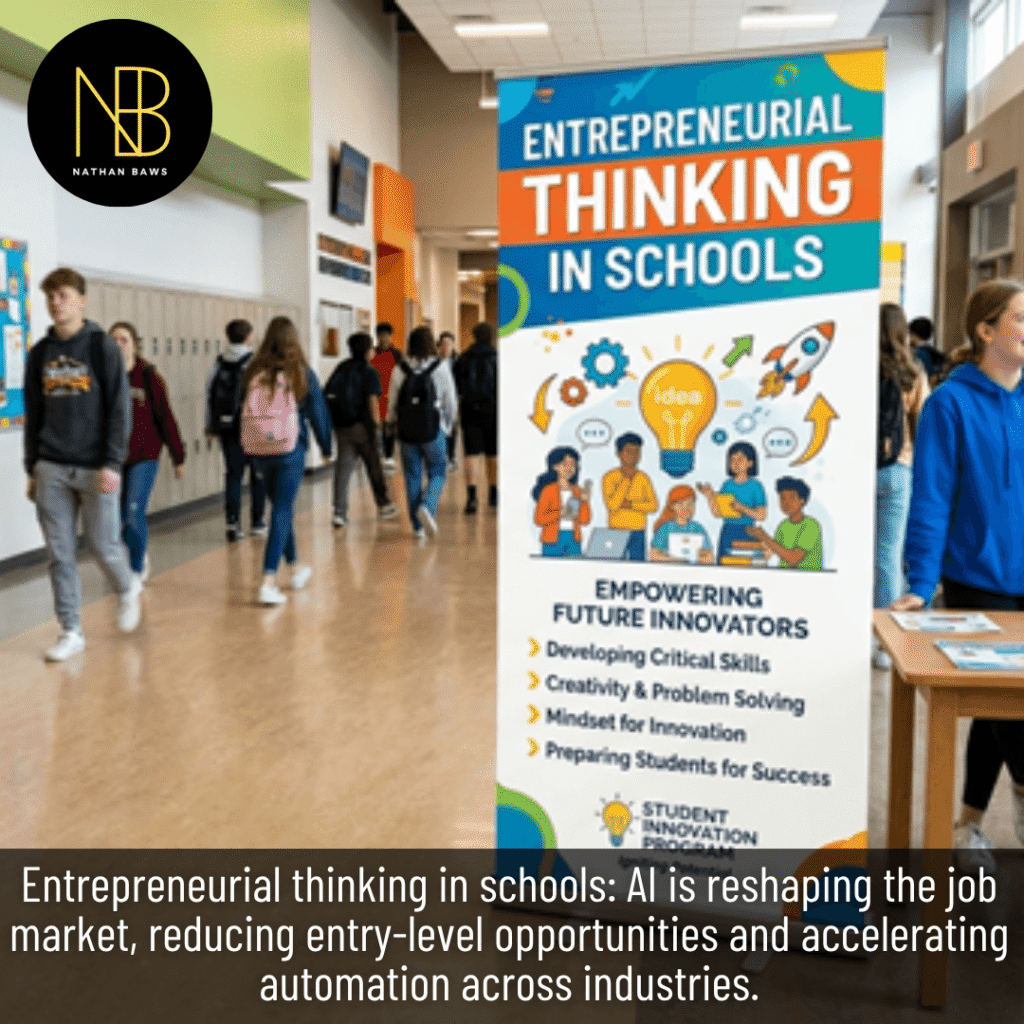
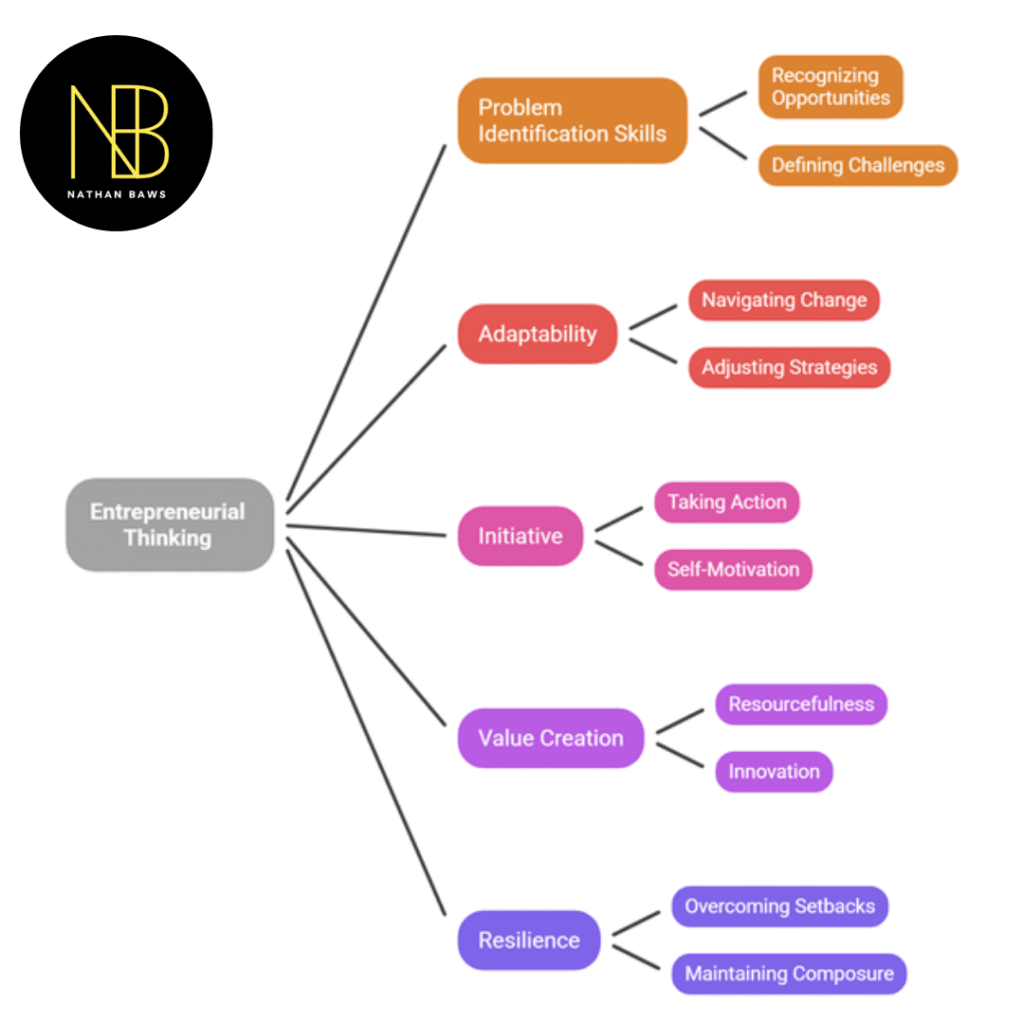
Schools must begin teaching entrepreneurial thinking, which focuses on the ability to create value, solve problems, and adapt in uncertain environments.
This does not mean every student must become an entrepreneur. It means every student should learn how opportunity is created, not just how employment is applied for.
Entrepreneurial thinking develops:
- problem identification skills
- adaptability in changing systems
- initiative without external instruction
- value creation using available tools
- resilience in uncertain environments
In an AI-driven economy, these are not optional skills- they are essential survival skills.
Real-World Education Already Moving in This Direction
This shift is already being introduced in parts of Australia through school-based entrepreneurship programs and incursions.
One example is Nathan Baws, an entrepreneur, public speaker, motivational speaker, business growth motivational speaker, inspirational speaker and a keynote speaker who delivers school incursions focused on entrepreneurship, financial literacy, and real-world business thinking. He also draws on his experience as a business builder and his Shark Tank Australia background to engage students in practical discussions about opportunity creation and mindset.
In his work with schools, he focuses on exposing students to how businesses are built in practice and how ideas become real-world outcomes.
He also contributes to broader efforts around financial literacy education for young people, reinforcing the idea that understanding value creation is as important as traditional academic learning.
This type of exposure helps bridge the gap between classroom theory and real-world economic behaviour.
Why This Matters More in an AI Economy
AI dramatically reduces the cost of execution. Tasks that once required teams can now be completed by individuals using AI tools.
This shifts the economy in three important ways:
- execution becomes cheaper
- competition increases
- ideas and adaptability become more valuable than labour alone
In this environment, relying solely on structured employment becomes increasingly risky.
Those who can identify opportunities, build solutions, and adapt quickly to change will be significantly more resilient.
Entrepreneurial thinking is what enables that shift.
Conclusion
AI is not simply removing jobs – it is reshaping how work is created, distributed, and valued. While the overall employment impact is gradual, the structural changes are already visible, particularly at the entry level.
The real challenge is not technological change – it is educational alignment.
If schools continue preparing students only for employment in its traditional form, they risk preparing them for a system that no longer exists in the same way.
The solution is clear: educamajor financial research on AI employmeAI employment impact researchnt impacttion must evolve toward entrepreneurial thinking, where students learn how to create value, adapt quickly, and operate effectively in uncertainty.
In an AI-driven economy, the most important skill is no longer just employability. It is adaptability and creation.
FAQs
Is AI currently causing major job losses?
Not on a large-scale statistical level. Most research shows AI’s overall unemployment impact is still modest, though changes are visible in specific roles and industries.
Which jobs are most affected by AI?
Roles involving repetitive, structured, or administrative tasks are most exposed, particularly entry-level positions.
Why are entry-level jobs shrinking?
Because many entry-level tasks are now being automated or accelerated by AI systems, reducing the need for traditional training-ground roles.
What is entrepreneurial thinking?
It is the ability to identify opportunities, solve problems, and create value independently rather than relying only on predefined job roles.
Do students need to become entrepreneurs?
No. The goal is not to force business creation, but to develop mindset skills that allow independence, adaptability, and value creation.
How does Nathan Baws contribute to this space?
Nathan Baws is an entrepreneur and public speaker who delivers school incursions focused on entrepreneurship, financial literacy, and real-world business thinking, helping students understand how opportunity creation works in practice.
Why is entrepreneurial thinking important in the AI era?
Because AI reduces the cost of execution, meaning ideas, adaptability, and initiative become more valuable than routine labour.
Can schools realistically teach this?
Yes. Through project-based learning, financial literacy, real-world problem solving, and exposure to entrepreneurs working in practice.
What happens if education does not change?
Students risk entering a job market that no longer matches how they were trained, leading to underemployment and reduced opportunity pathways.
What is the main takeaway?
AI is changing the structure of work, and education must shift from producing job seekers to developing opportunity creators.
Read Also: Why Training Tutors in AI Skills Is the Real Key to Scalable Personalized Learning