Introduction
Scaling a company requires intentional choices, repeatable processes, and clear priorities. In this comprehensive guide, we explore growth strategies in business across marketing, product, operations, partnerships, finance, and talent. Whether you are a startup founder in Perth, a corporate executive, or a growth leader, this article provides the frameworks and tactics needed to accelerate measurable expansion while managing risk.
Scaling isn’t just about doing more; it’s about doing the right things that lead to a compounding effect. We will break down how to implement growth strategies in business using a data-driven approach, ensuring that your path to 10X growth is built on a solid foundation of operational excellence and market relevance.
Key Takeaways
- Alignment is Everything: Choose business growth strategies that align with your current product-market fit and organisational capacity.
- Data-Driven Decisions: Measure unit economics and specific KPIs (Key Performance Indicators) to validate each growth strategy in business before pouring in capital.
- The “Fail Fast” Rule: Prioritise experiments, iterate quickly based on feedback, and scale only the verified growth strategies in business.
- Sustainability Over Speed: High-speed growth is useless if it leads to burnout or bankruptcy. Sustainable expansion requires systemic support.
The Strategic Foundation of Expansion
Before diving into specific tactics, it is crucial to understand the core concepts that govern how successful companies scale. Growth strategies in business are not “set-and-forget” plans; they are living frameworks that adapt to market shifts and internal milestones.
Defining Growth Strategies in Business
At its core, growth strategies in business are the planned, systematic approaches companies use to increase revenue, capture more market share, and scale their internal operations. These can be defensive (protecting what you have) or offensive (taking new territory). A common mistake is thinking growth only means “more customers.” In reality, growth can come from increasing customer lifetime value (LTV), expanding into new geographic regions, or diversifying your product lines.
Why Defined Strategies Matter
Without a defined set of growth strategies in business, an organisation risks “random acts of marketing” and operational strain. Strategic clarity ensures that every dollar spent on performance marketing and every hour spent on product development contributes to a singular vision. This is especially vital for businesses in competitive markets like Western Australia, where local nuances and international competition collide.
The Three Pillars of Scalability
- Market Insight: Knowing exactly who your customer is and what they are willing to pay for.
- Product Excellence: Ensuring your solution solves a “hair-on-fire” problem so well that retention becomes automatic.
- Execution Capacity: Having the people, systems, and “operations support” to handle a 500% increase in demand without breaking.
Market-Driven Growth Strategies in Business
Market-based approaches are often the first port of call for companies looking to expand. These focus on how your existing (or new) products interact with the marketplace.
Market Penetration and Geographic Expansion
Market penetration is often the safest of all growth strategies in business. It involves selling more of your current product to your existing market. You achieve this through pricing adjustments, aggressive promotions, and optimising distribution channels. For a local Perth business, this might mean dominating the suburbs before looking at the city center.
Once local penetration is maximised, geographic expansion – market development – becomes the next logical growth strategy in business. This could mean taking a successful WA brand into the Eastern States or even international markets. This requires a deep dive into localisation, regulatory compliance, and finding the right local channel partners.
Diversification and Adjacent Markets
Diversification is the most aggressive of the growth strategies in business. It involves entering entirely new markets with entirely new products. While high-risk, it can also lead to high rewards if you leverage your existing brand equity. Think of a gourmet food delivery service in Perth expanding into wedding catering – the core competence is food, but the market and product delivery are completely different.
Product Innovation and Acquisition Strategies
Product-led growth is one of the most sustainable growth strategies in business because it relies on the value of the product itself to drive adoption and retention.
Product Line Expansion and Platformization
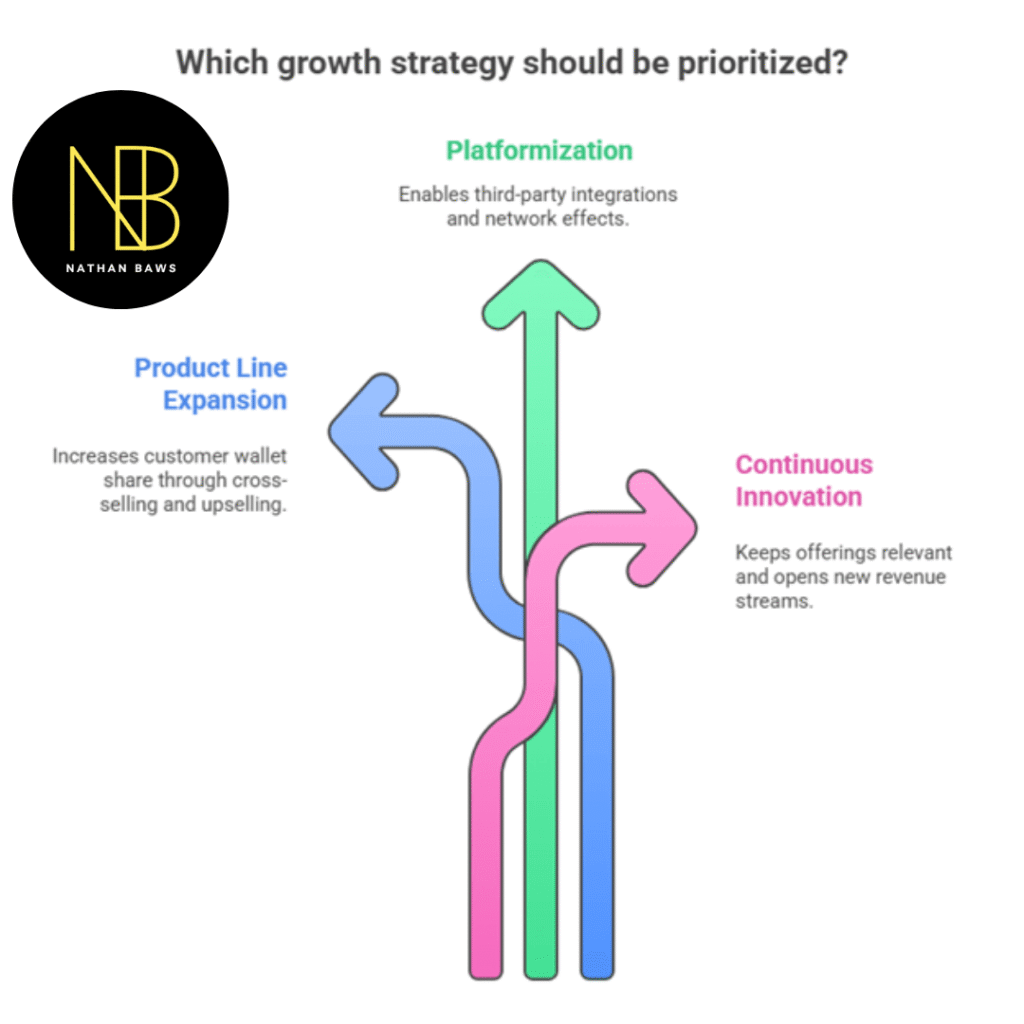
Adding complementary features or an entirely new product line is a proven growth strategy to increase “wallet share.” If your customers already trust you for one thing, they are more likely to buy the “next logical step” from you.
Taking it further, “Platformization” is a advanced growth strategy in business. This involves turning your product into an ecosystem where third-party developers or partners can integrate their services. This creates powerful network effects – as more people use the platform, the platform becomes more valuable to everyone.
Scalable Acquisition Channels
To support your product, you need a marketing engine. Performance marketing (paid search and social) is a direct growth strategy in business for immediate customer acquisition. However, for long-term health, you must balance this with organic growth – specifically, high-volume SEO and content marketing. Producing 40+ SEO-optimised blogs per week can position your brand as the undisputed authority in your niche, lowering your long-term Customer Acquisition Cost (CAC).
Operational Excellence and Talent Alignment
You cannot implement successful growth strategies in business if your “back office” is a mess. Scaling demand without scaling operations is a recipe for disaster.
Building Scalable Systems and SOPs
Operational scalability is the silent partner of every great growth strategy in business. This involves documenting Standard Operating Procedures (SOPs), automating repetitive tasks, and implementing robust CRM systems. Whether it’s managing “Shark Tank” style incursions in schools or high-volume bookkeeping for accounting firms, having clear systems ensures that quality remains high as volume increases.
Organisational Design and Culture
Hiring the right talent is a people-focused growth strategy in business. As you scale, you must transition from a “doer” culture to a “leader” culture. This means designing roles that allow for autonomy and aligning incentives with growth metrics. A culture that rewards experimentation and data-driven decisions will adapt to new growth strategies in business much faster than a rigid, top-down hierarchy.
Financial Discipline and Measurement
Finally, the “math” must work. Every business growth strategy must be scrutinised through the lens of unit economics.
Profitability-First Scaling
While many venture-backed companies focus on growth at all costs, a “Profitability-First” approach is often more sustainable for the average business. This means focusing on margin expansion and cost control even as you scale. Unit economics – specifically the ratio of LTV to CAC – is the most important metric for evaluating any growth strategy in business.
Setting and Tracking KPIs
To manage what you measure, you need a central analytics stack. Key metrics to track include:
- Monthly Recurring Revenue (MRR): For predictable growth.
- Churn Rate: To ensure your bucket doesn’t have a hole in the bottom.
- Conversion Rate: To maximize the efficiency of your funnel.
- Net Promoter Score (NPS): To ensure your customers actually like you
Challenges and Pitfalls to Avoid
Even the best growth strategies in business can fail if executed poorly.
- Premature Scaling: Spending big on marketing before you have a product that people actually want to keep.
- Ignoring the Numbers: Running a growth strategy in business that costs more to acquire a customer than they are worth in their lifetime.
- Over-Diversification: Trying to do five things at once and doing none of them well. Focus is a superpower in scaling.
Conclusion: Designing Your Repeatable Growth Engine
Implementing effective growth strategies in business is not about finding a “magic bullet.” It is about the disciplined application of market research, product excellence, operational rigor, and financial common sense.
Use the frameworks provided in this guide to design a tailored growth plan that matches your specific industry, resources, and long-term vision. Whether you are aiming for local dominance in Perth or global expansion, the principles remain the same: Measure, Experiment, and Scale.
For those looking for hands-on guidance, mentorship, or operations support to implement these growth strategies in business, Nathan Baws offers strategic consulting and partnership opportunities designed to turn bold ideas into thriving enterprises. Visit Nathan Baws to start your scaling journey today.
Also Read: 10 Unorthodox Growth Hacks That Helped Me Thrive After Shark Tank
FAQs
What are the most cost-effective growth strategies in business for startups?
For startups, organic content, SEO, and referral programs are the most sustainable and cost-effective growth strategies in business. These allow you to build an audience and trust without the massive overhead of traditional advertising.
How do I choose between multiple growth strategies in business?
Use a prioritisation framework like ICE (Impact, Confidence, Effort). Rank your ideas based on how much they will move the needle versus how much work they take. Pilot the “low effort, high impact” growth strategies in business first.
When should a company seek external funding for growth?
Seek funding when you have a proven “machine” that just needs more fuel. If your growth strategies in business are already working and you have positive unit economics, external capital can help you capture the market faster than competitors.
How do I balance short-term wins with long-term growth strategies in business?
Follow the 70/20/10 rule. Spend 70% of your time on core growth strategies in business, 20% on adjacent expansions, and 10% on “wildcard” experiments that could be the future of your company.
Why do many growth strategies in business fail during the execution phase?
Execution usually fails due to a lack of “operations support.” If you don’t have the systems to handle the new business you’re bringing in, your customer service and product quality will suffer, leading to high churn.
Can a small business use enterprise-level growth strategies in business?
Yes, but they must be scaled down. A small business can still use “Platformization” (e.g., creating a local directory around their service) or “Inbound Marketing” on a smaller, hyper-local budget.
How often should we update our business growth strategies?
Review your tactical KPIs monthly, but do a deep strategic dive every quarter. The digital market moves fast, and your growth strategies in business need to stay ahead of algorithm updates and competitor moves.
What role does “Brand” play in growth strategies in business?
Brand is the “moat.” A strong brand makes every other growth strategy in business more effective by increasing trust and lowering the psychological barrier for a customer to buy from you.
How do you measure the ROI of long-term content-based growth strategies?
Track organic traffic growth over 6-12 months and look at “assisted conversions” – cases where a customer read multiple blog posts before eventually making a purchase.
How can I get expert help to implement these growth strategies in business?
Consulting with growth strategists who have “been there and done that” can save you years of trial and error. Explore the partnership and mentorship options at NathanBaws.com for tailored support. Milestones help keep investors engaged with growth strategies in business.