Introduction
Picture this: you walk into a conference room in Sydney, the room humming with quiet chatter, and then one person starts talking. Everyone stops. Listens. Really listens. That is the power of a good guest speaker. I’m Nathan Baws. For more than 40 years, I have built businesses from scratch right across Australia – from dusty workshops in Perth to high-rise offices in Melbourne. I have stood on stages in Brisbane, Adelaide, Hobart, and everywhere in between. And I can tell you this: the right guest speaker does not just fill time. They change the room.
This article is for you – whether you run a small business in regional Victoria, organise corporate off-sites in the Whitsundays, teach at a TAFE in Cairns, or lead a university society in Canberra. You want your next event to matter. You want people to leave differently from when they arrived. I will walk you through exactly how a guest speaker makes that happen, how to pick the right one, and how to make sure the day works. By the end, you will know what to do next.
Key Takeaways:
- A guest speaker brings outside energy and real-world proof that keeps people paying attention.
- Match the speaker’s experience to your crowd – a tech talk for engineers, a mindset for sales teams.
- Stories from actual Australian businesses beat slides full of theory every time.
- Check results afterwards: what did people do differently on Monday morning?
Understanding the Role of a Guest Speaker in Australian Events
Australia runs on events. Trade mornings in Geelong. Leadership days in Darwin. School career nights in Launceston. A guest speaker is the person who walks in, spends an hour or two, and leaves everyone talking about it for weeks.
What Actually Makes a Guest Speaker Work
I have watched speakers flop, and I have watched them fly. The ones who fly do three things. First, they know their stuff cold – no waffling, no guessing. Second, they talk like a normal person, not a textbook. Third, they finish with clear next steps. When I spoke at a startup breakfast in Newcastle last year, I spent ten minutes on how I turned a $400 marketing budget into $40,000 in sales. People took notes. They emailed me later. That is the benchmark.
How a Guest Speaker Keeps a Room Alive
Energy drops after lunch. Phones come out. A guest speaker stops that. They ask questions. They pause. They look people in the eye. At a mining safety day in Kalgoorlie, I got the whole room to stand up and swap seats with someone they did not know. Two minutes of movement, ten minutes of new conversation, and suddenly everyone was awake. Simple, but it works.
Fitting the Talk to the Crowd
One size never fits all. A room of year-12 students in Alice Springs wants different examples from a boardroom in Sydney’s Barangaroo. I change the stories every time. For students, I talk about the side hustle I started at 19 while studying. For directors, I talk about the merger that almost sank me in 2008: same lessons, different packaging.
Selecting the Ideal Guest Speaker for Your Event
You have a date, a venue, and a budget. Now you need the person.
Checking Experience Against Your Goals
Look at what they have actually done. Not the fancy bio – the results. Have they grown a business in Australia? Survived a recession? Turned around a failing team? I keep a folder of case studies: the café in Fremantle that tripled foot traffic, the online store in Toowoomba that cracked $1 million. Ask for those stories up front.
Watching How They Actually Speak
YouTube is your friend. Watch a full talk, not the polished three-minute reel. Do they rush? Do they say “um” in every sentence? Do they answer questions properly? I record every talk I give. If I watch it back and cringe, I fix it before the next one.
Working the Numbers
Travel adds up fast in Australia. A speaker flying from Melbourne to Broome is two flights, one night’s accommodation, and maybe a 4WD transfer. Get quotes early. Most speakers bundle travel into the fee. Ask what is included – prep time, follow-up emails, and handouts. I always throw in a resource pack because people forget 70% of what they hear within 24 hours unless you give them something to keep.
Preparing Your Event for a Guest Speaker’s Success
A great speaker still needs a great host.
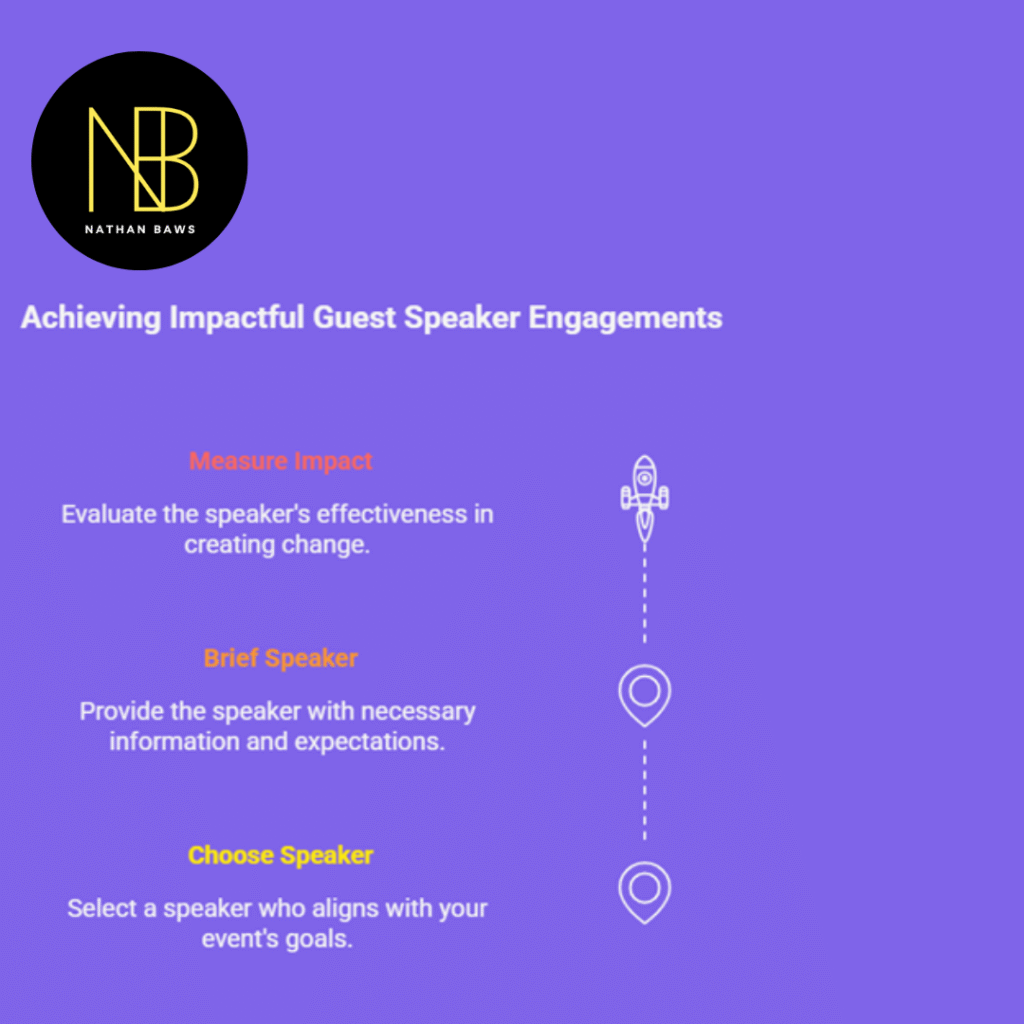
The Pre-Event Brief
Send one page, no more. Who is in the room? What keeps them up at night? What do you want them walking out ready to do? I had an organiser in Wagga Wagga send me a list of the exact pain points her retail members faced. I rewrote half the talk the night before. Worth every minute.
Building in Interaction
Do not let the speaker talk for 90 minutes straight. Break it up. Ten minutes of stories, five minutes of table talk, repeat. At a franchise conference on the Gold Coast, we ran a quick “text your biggest hurdle” poll. I answered the top three live. The room loved it.
Getting the Word Out
Start teasing the speaker four weeks out. Short video clip, one killer quote, a photo from a past event. I once had an organiser post a 15-second clip of me drawing a business model on a napkin. Registration jumped 40% in two days.
Measuring the Impact of Your Guest Speaker
If you cannot measure it, you cannot manage it.
Quick Feedback That Actually Helps
Hand out a half-page survey as people leave. Three questions: What will you do differently? What was the best part? What could improve? I read everyone. At a leadership day in Townsville, 22 people wrote that they would change their Monday morning meeting. That is gold.
Checking In Later
Email attendees four weeks later. Ask for a one-line update. I do this after every corporate gig. Last month a GM in Adelaide told me the delegation framework I shared saved his team 18 hours a week. Numbers like that justify the fee.
Tweaking the Next One
Look at what worked and what did not. Too much theory? Cut it. Not enough stories? Add two. I keep a running log. Every event gets better.
Integrating Guest Speakers into Educational and Youth Programs
Classrooms and lecture halls need outside voices.
Bringing the Real World In
Students light up when someone who has done it walks in. I spoke to 200 hospitality students in Bendigo about the café I opened with $20,000 and no clue. Six months later, three of them had launched pop-ups. Theory became action.
Starting Mentor Links
Give students five minutes at the end to swap contact details. One email can change a trajectory. I still mentor a young engineer I met at a Griffith University talk in 2019. He now runs his own firm.
Speaking to Different Learners
Some kids need diagrams, some need debate, some need to move. Mix it up. I get accounting students in Rockhampton to map cash flow on butcher’s paper. Hands-on beats PowerPoint every time.
Leveraging Guest Speakers for Corporate Team Development
Teams do not bond over trust falls anymore.
Creating Shared Reference Points
When everyone hears the same story – the near-bankruptcy I survived in 1997 – they have a common language afterwards. I see it in follow-up workshops: “Remember what Nathan said about cash buffers?”
Sparking New Ideas
Give the speaker a problem to solve live. At a tech firm in North Sydney, we crowd-sourced a new client onboarding process in 20 minutes. They rolled it out the next week.
Growing the Next Leaders
Target your rising stars. Let the speaker run a 15-minute hot-seat where three managers get live coaching. I did this in Canberra. Two of them were promoted within a year.
Case Studies: Successful Guest Speaker Engagements in Australia
Proof over promises.
Sydney Startup Conference, 2023
500 founders. One hour on low-cost growth hacks. Post-event survey: 68% tried at least one tactic within 30 days. Local media picked up three newsworthy wins.
Brisbane University Workshop Series
Six sessions across two semesters. Attendance up 30%. Five student startups launched, and two are still trading profitably.
Whitsundays Corporate Retreat
80 executives, two days. Resilience focus. Team pulse survey three months later showed a 22% lift in cross-department collaboration scores.
Conclusion
A guest speaker is only as good as the change they create. You now know how to choose one, brief one, and measure one. You know the difference between a nice talk and a game-changer. If you have an event coming up anywhere in Australia and you want someone who has built, lost, and rebuilt businesses on this soil for four decades, let’s talk. Head to https://nathanbaws.com/ and send me a message. I answer everyone myself.
FAQs
What should I ask a potential guest speaker before booking?
Ask for two things: a video of a full recent talk and two references from events similar to yours. Then ask what they need from you to make the session land. I send organisers a short questionnaire – audience size, biggest challenge, desired outcome. The more I know, the better I serve.
How far ahead should I book a guest speaker?
Popular dates fill six months out, especially around EOFY and conference season. For a safe bet, lock in three to four months ahead. I keep a public calendar on my site so you can see availability instantly.
Will a guest speaker travel to regional areas?
Yes, if the logistics work. I have driven six hours from Melbourne to Shepparton for a 90-minute breakfast talk because the organiser made it simple – one email, a clear brief, and travel covered. Regional crowds often give the best feedback.
What if my budget is tight?
Look for half-day rates or virtual options. A 45-minute Zoom keynote costs less and still packs a punch. I have done free 20-minute Q&As for community groups when the cause aligns. Ask – the worst answer is no.
How do I stop the talk from feeling like a sales pitch?
Set the rule up front: no direct selling from the stage. Share that with the speaker. I never pitch my coaching during a keynote; I give value and let people approach me afterwards if they want more.
Can a guest speaker run a full-day workshop?
Absolutely. I run intensive days on sales systems or mindset resets. We break every 75 minutes, mix teaching with exercises, and finish with personal action plans. Attendees leave exhausted but equipped.
What tech do I need to provide?
Laptop, projector or large screen, handheld mic for rooms over 50 people, clicker for slides. I bring my own adapters and backups. Test everything an hour before doors open.
How do I handle a speaker who runs over time?
Give them a five-minute warning sign from the side. Most respect it. I built in a buffer so even if questions run long, we finish on schedule.
What follow-up should I send attendees?
Within 48 hours: thank-you email, link to slides or handout, one key takeaway, and the speaker’s contact if they offer it. I provide a one-page summary for every talk. Keeps the momentum alive.
How has virtual speaking changed things?
Shorter attention spans, bigger need for interaction. I now cap virtual keynotes at 45 minutes and use polls every ten. Works just as well from Broome to Bondi as long as the Wi-Fi holds.