Introduction
Unconventional Partnerships are reshaping how organisations expand, innovate and access new markets. In this article, we explain why unconventional alliances offer superior returns compared with traditional approaches, and we provide actionable frameworks for designing, evaluating, and implementing these collaborations. We draw on practical experience to guide leaders through risks, benefits and measurable outcomes. If you want to transform your growth strategies through unconventional partnerships, we can help. Please contact Nathan Baws for tailored support.
Key Takeaways
- Unconventional Partnerships unlock new value by combining complementary assets, audiences and capabilities that conventional deals overlook.
- Successful unconventional partnerships require clear strategic intent, robust governance and measurable KPIs aligned to shared outcomes.
- Practical frameworks help identify partners, structure deals, and manage risk across legal, operational and cultural dimensions.
- We provide step-by-step implementation guidance, case studies and tools to pilot partnerships with minimal capital outlay.
- Contact Nathan Baws to assess fit, design pilots and scale partnerships for sustainable growth.
Why Unconventional Partnerships Matter
Expanding Beyond Traditional Alliances
Unconventional Partnerships differ from traditional alliances by focusing on non-obvious complementarities. Rather than partnering within the same industry or supply chain, organisations seek partners in adjacent sectors, technology platforms, community networks and service ecosystems to create new offerings. This approach broadens the scope for innovation and revenue generation.
Driving Innovation and Competitive Advantage
When we engage in unconventional partnerships, we gain access to novel capabilities and customer segments. These collaborations accelerate product development, reduce time-to-market and create defensible differentiation. The strategic value lies in the collision of diverse assets and perspectives.
Cost-Effective Growth and Market Access
Unconventional Partnerships can be capital efficient. By leveraging partner distribution channels, data assets and brand equity, organisations reduce acquisition costs and expand reach more quickly than through organic investment alone.
Types of Unconventional Partnerships
Cross-Industry Collaborations
These partnerships pair organisations from distinct industries to create novel value propositions. Examples include retail-tech collaborations or health-care and hospitality partnerships that deliver integrated customer experiences.
Platform and Ecosystem Alliances
Partnering with digital platforms, marketplaces, or data ecosystems enables rapid scaling. Unconventional Partnerships with platform operators unlock access to active user bases and integration benefits that enhance product utility.
Community and Non-Profit Collaborations
Working with community organisations or non-profits can deliver social impact while strengthening brand trust. These partnerships often tap into networks and values-driven audiences that traditional partnerships do not reach.
Strategic Framework for Identifying Partners
Define Strategic Objectives
Begin by clarifying what we intend to achieve: revenue growth, customer acquisition, capability enhancement or market entry. Goals must be specific, measurable and time-bound to inform partner selection.
Map Complementary Assets
Create an asset map outlining each potential partner’s unique resources, distribution channels, technology, regulatory licences, datasets, or brand loyalty. The best unconventional partnerships combine assets that are hard to replicate independently.
Evaluate Strategic Fit
Assess cultural alignment, decision-making speed and risk tolerance. Unconventional Partnerships require trust and agility; organisations with mismatched rhythms or governance models rarely sustain long-term value.
Structuring Unconventional Partnerships
Deal Types and Commercial Models
Commercial structures for unconventional partnerships vary: revenue sharing, co-development agreements, equity stakes or joint ventures. Select a model that aligns incentives, balances risk and enables iterative testing.
Governance and Decision Rights
Define governance up front: steering committees, escalation paths and performance review cycles. Explicit decision rights mitigate confusion and keep the partnership focused on outcomes.
Contractual Protections and IP Management
Agreements must address intellectual property, data sharing, confidentiality and exit clauses. For unconventional partnerships, these clauses should support collaboration while protecting core assets.
Implementation Framework: From Pilot to Scale
Phase 1: Discovery and Design
In discovery, we co-create hypotheses with the partner, define MVPs and outline KPIs. Use minimal viable pilots to validate assumptions with representative users.
Phase 2: Pilot and Learn
Run short, tactical pilots with clear measurement frameworks. Collect qualitative and quantitative data, iterate on the proposition and refine commercial terms based on real-world learnings.
Phase 3: Scale and Institutionalise
Once validated, formalise the partnership with scalable processes, integrated systems and aligned incentives. Transition from experimental governance to operational integration and continuous improvement.
Operational Playbook for Managing Partnerships
Communication and Relationship Management
Regular, structured communication prevents misalignment. Establish weekly operational syncs, monthly strategy reviews and shared dashboards to maintain transparency in unconventional partnerships.
Performance Measurement
Define leading and lagging KPIs tied to joint outcomes, including customer acquisition cost, lifetime value uplift, joint revenue, and engagement metrics. Use dashboards to track performance against agreed targets.
Resource Allocation and Accountabilities
Assign dedicated cross-functional teams and single points of contact. In unconventional partnerships, clarity on who owns what reduces delay and ensures rapid problem resolution.
Actionable Insights for Executives
Prioritise High-Leverage Experiments
Focus on partnership pilots that address high-value problems and require limited capital. Unconventional Partnerships are most effective when they solve a clear pain point for both parties.
Negotiate for Flexibility
Build option-based clauses and milestone reviews into agreements. Flexibility reduces friction during early stages and allows the partnership to pivot based on evidence.
Invest in Partnership Capabilities
Develop internal skills in partnership management, commercial negotiation, and platform integration. We recommend dedicated training and playbooks to professionalise collaboration activities.
Risks and How to Mitigate Them
Strategic Misalignment
Risk: Partners pursue divergent priorities, undermining joint objectives. Mitigation: Set shared KPIs, governance rhythms and clear termination criteria to align incentives across unconventional partnerships.
Operational Complexity
Risk: Integration challenges increase cost and delay. Mitigation: Start with lightweight pilots, standardise APIs and align on data schemas before full-scale integration.
Reputational and Compliance Risks
Risk: Partner behaviours negatively affect the brand or contravene regulations. Mitigation: Conduct due diligence, include compliance covenants and maintain continuous oversight within unconventional partnerships.
Benefits and Value Realised
Accelerated Market Entry
Unconventional Partnerships enable faster entry into new markets by leveraging local partners’ distribution and regulatory knowledge, reducing time and capital requirements.
Enhanced Product Innovation
Combining distinct capabilities often yields superior products and services. Unconventional Partnerships create opportunities for co-innovation that would be resource-intensive to develop internally.
Improved Customer Experience and Loyalty
Integrated offerings delivered through credible partners enhance customer convenience and trust, improving retention and lifetime value.
Financial and Legal Considerations
Valuation and Revenue Sharing
Agree on valuation methods and revenue split models that reflect contribution and risk. Use performance-based remits to align incentives in unconventional partnerships.
Tax and Regulatory Implications
Different partnership structures carry distinct tax and regulatory obligations. Obtain specialist advice to structure arrangements that comply with Australian law and, where relevant, international regulations.
Exit Strategies and Contingency Plans
Define exit mechanisms that preserve value and protect customers. Contingency provisions in unconventional partnerships should address asset transfers, customer transition and IP rights.
Case Studies and Hypothetical Examples
Retail-Technology Collaboration
A major retailer partners with a logistics tech start-up to offer same-day fulfilment in regional areas. The unconventional partnership reduces delivery costs and opens an underserved market, demonstrating rapid payback.
Health Service and Accommodation Provider
An accommodation provider partners with a telehealth service to support long-stay guests requiring medical oversight. The unconventional partnership expands service scope and improves customer outcomes.
Financial Services and Education Platforms
A financial institution partners with an education platform to deliver microloans and financial literacy bundles for online learners. The unconventional partnership increases product adoption and builds long-term customer relationships.
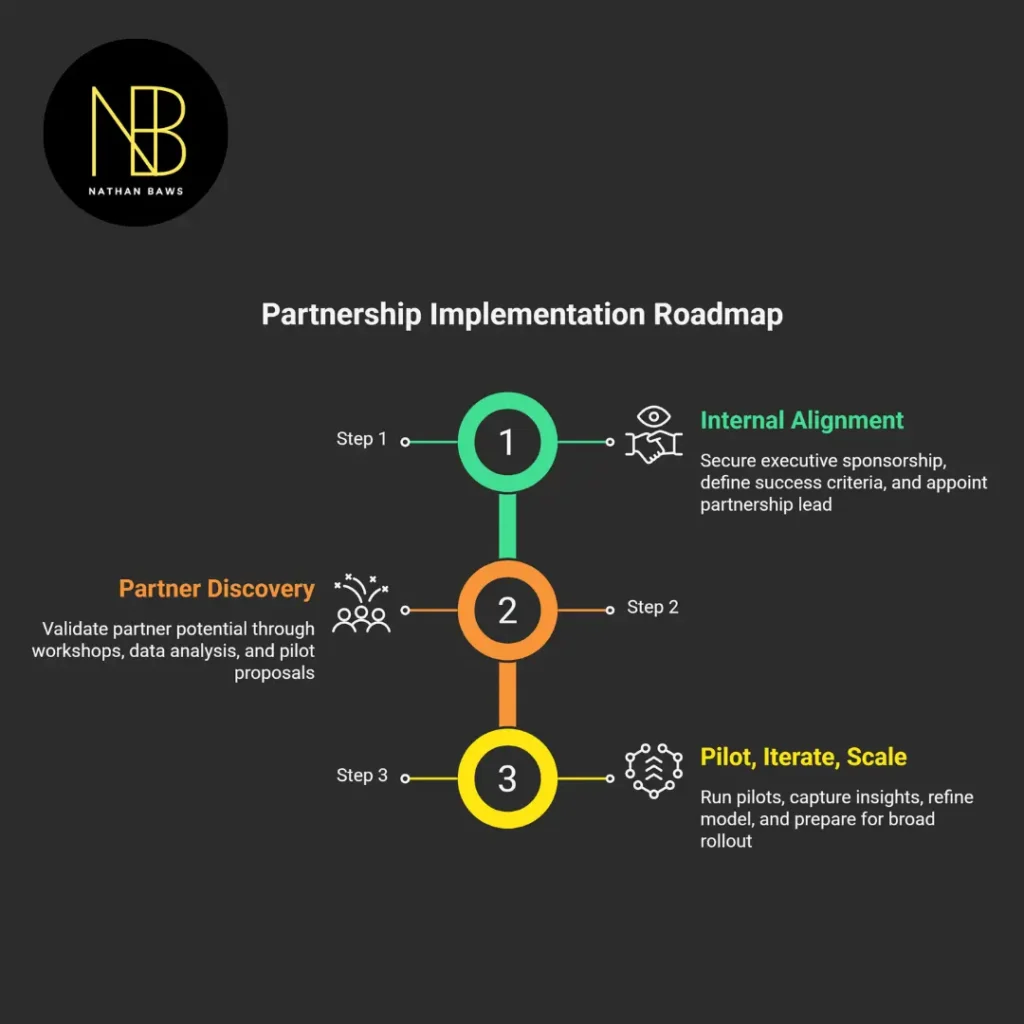
Implementation Roadmap
Step 1: Internal Alignment
Secure executive sponsorship and cross-functional buy-in. Define success criteria and allocate a partnership lead with decision authority.
Step 2: Partner Discovery and Validation
Use workshops, data analysis and pilot proposals to validate partner potential. Prioritise partners with measurable mutual benefit and operational compatibility.
Step 3: Pilot, Iterate, Scale
Run time-bound pilots, capture insights, refine the model and prepare for scale. Ensure legal and operational infrastructure is in place before a broad rollout.
Tools and Templates to Support Unconventional Partnerships
Partner Assessment Scorecard
Use a scorecard with weighted criteria for strategic fit, capability complementarity, cultural alignment and commercial potential to rank prospective partners.
Pilot Design Template
Create a standard template for pilot scope, metrics, timeline and resource commitments to accelerate launch and ensure consistency across initiatives.
Governance and KPI Dashboard
Implement a shared dashboard with live metrics and risk indicators. Visibility into performance accelerates decision-making and accountability within unconventional partnerships.
Scaling and Long-Term Management
Institutionalising Successful Partnerships
To scale, we embed partnership governance into operational processes, training and performance reviews. Institutionalisation ensures sustained collaboration and continuous value creation.
Portfolio Approach to Partnerships
Manage partnerships as a portfolio, balancing experimental pilots with strategic, long-term alliances. Diversification reduces concentration risk and increases the flow of opportunities.
Continuous Innovation and Renewal
Regularly reassess partnership value and pivot where necessary. Renew agreements to capture evolving opportunities and maintain strategic relevance.
How We Support Organisations
Strategic Assessment and Roadmapping
We assess current capabilities, identify high-impact partnership opportunities and develop roadmaps to pilot and scale unconventional partnerships.
Deal Structuring and Negotiation Support
We advise on commercial models, governance frameworks and contractual terms to ensure balanced, scalable agreements tailored to each partnership.
Implementation and Operating Model Design
We help design operating models, resource plans and dashboards to manage partnerships effectively and to sustain value over time.
Measuring Success
Outcome-Based KPIs
Measure success using outcome KPIs: incremental revenue, customer retention uplift, cost savings and time-to-market reduction attributable to the partnership.
Process and Health Metrics
Track process KPIs, such as integration time, issue resolution velocity, and governance adherence, to monitor partnership health.
Value Realisation and Attribution
Use attribution models to allocate joint outcomes fairly. Regularly review contributions and adjust commercial terms as the partnership matures.
Common Pitfalls and How to Avoid Them
Overcomplicating Early-Stage Agreements
Pitfall: Heavy legal structures delay pilots and create friction. Avoidance: Start with simple, time-bound agreements and expand terms after validation.
Insufficient Resourcing
Pitfall: Partnerships fail due to a lack of dedicated resources. Avoidance: Assign committed teams and budget to support pilots and early integration phases.
Poor Change Management
Pitfall: Internal stakeholders resist partnership initiatives. Avoidance: Communicate benefits, involve key teams early and provide training to support integration.
Practical Checklist to Launch an Unconventional Partnership
- Define clear, measurable objectives for the partnership.
- Create an asset map to identify complementary strengths.
- Use a partnership scorecard to shortlist candidates.
- Design a minimal viable pilot with agreed KPIs.
- Establish governance, communication and performance dashboards.
- Negotiate flexible commercial terms with milestone-based reviews.
- Allocate dedicated resources and define escalation paths.
- Measure, learn and decide on scale or exit within the pilot timeframe.
Conclusion
Unconventional Partnerships present a substantial opportunity to accelerate growth, unlock innovation and access new markets by combining complementary assets and capabilities in novel ways. Implementing these partnerships requires strategic clarity, practical frameworks and disciplined execution. We are available to support every stage of the journey from partner identification and pilot design to deal structuring and scaling. Contact Nathan Baws to assess opportunities and develop a tailored partnership strategy that generates measurable results.
Contact Us: Visit nathanbaws.com or reach out directly to arrange a consultation on Unconventional Partnerships and collaborative growth strategies.
Frequently Asked Questions
What exactly are Unconventional Partnerships?
Unconventional Partnerships are strategic alliances formed across non-traditional boundaries to create new value propositions. They combine complementary assets, audiences or capabilities that would not typically collaborate.
How do Unconventional Partnerships differ from joint ventures?
Joint ventures often involve formal equity structures and long-term commitments. Unconventional Partnerships may be more fluid, using revenue sharing, pilots and platform integrations to test value before deeper commitments.
What industries benefit most from Unconventional Partnerships?
All industries can benefit, but sectors experiencing rapid disruption, such as retail, health, finance and technology, often gain significant value from cross-industry collaborations and platform alliances.
How do we measure success in these partnerships?
Success is measured with both outcome KPIs (revenue, retention, LTV) and process KPIs (integration time, issue resolution). Attribution models help determine the partnership’s contribution to results.
What are common legal issues to consider?
Key legal issues include intellectual property rights, data protection, confidentiality and exit clauses. Early legal input is essential to draft flexible yet protective agreements for unconventional partnerships.
How do we find the right partner?
Use an assets-focused approach: map potential partners’ capabilities, audiences and distribution channels. Score candidates on strategic fit, cultural alignment and commercial potential.
What budget is required to pilot an Unconventional Partnership?
Budgets vary, but pilots should be capital-efficient. Allocate funding for technology integration, marketing tests and operational resources, with clear stop-loss criteria to limit exposure.
How long should a pilot run?
Pilots typically run 3–6 months, depending on complexity. The period should be sufficient to collect meaningful data and iterate, with predefined decision points for scale or exit.
How do we manage cultural differences between partners?
Address cultural differences through structured onboarding, joint workshops and agreed operating norms. Leadership alignment and clear communication channels mitigate cultural friction.
Can small organisations benefit from Unconventional Partnerships?
Yes. Small organisations can leverage partnerships to access markets and capabilities they cannot build on their own. Unconventional Partnerships are often a capital-efficient path to scale for smaller players.