Introduction
Operating a successful venue in the modern food and beverage sector requires far more than exceptional culinary execution and aesthetic appeal. The contemporary market demands rigorous financial discipline, precise operational workflows, and an innovative approach to brand positioning. When an elite hospitality business consultant evaluates an underperforming restaurant, café, or catering operation, they look beyond the surface to diagnose systemic inefficiencies and implement sustainable growth models.
Developing a highly profitable venue does not occur by chance. It requires a sophisticated understanding of consumer psychology, meticulous supply chain management, and an intentional strategy designed to maximise table turnover and average spend. Whether a business is currently navigating severe margin compression or an established brand is seeking to scale its operations across multiple locations, implementing deliberate operational methodologies will fundamentally transform financial outcomes.
This comprehensive guide examines the core strategic pillars that drive venue transformation, focusing on menu engineering, staff optimisation, experiential branding, and financial waste reduction. By analysing these critical methodologies, owners and operators can successfully navigate market volatility with absolute confidence. Embracing these advanced corporate strategies ensures your establishment remains competitive, resilient, and highly profitable long into the future.
Key Objectives
- Learn to immediately identify hidden profit leakages within standard venue operations.
- Understand why carefully engineered menu structures are essential for protecting profit margins against inflation.
- Master actionable workforce optimisation techniques to stabilise labour costs without compromising service quality.
- Discover proven methodologies for translating guest data into repeatable, high-volume catering and event revenue.
Execute Precision Menu Engineering
When a hospitality business consultant initiates a venue turnaround, the menu is invariably the primary subject of analysis. A menu is not merely a price list or a piece of marketing collateral; it is the central engine of a hospitality enterprise. Failing to mathematically optimise this asset forces a venue to absorb rising ingredient costs, ultimately eroding the bottom line.
The Mathematics of Menu Profitability
Commencing menu design based on guesswork or historical pricing habits frequently results in immediate financial strain. Predictable, uncalculated pricing structures fail to account for microscopic ingredient inflation, quietly transferring financial pressure directly to the operator.
A calculated menu overhaul serves as a vital opportunity to protect gross profit margins. Instead of relying on arbitrary price adjustments, an expert hospitality business consultant utilises a strict matrix analysis, categorising every menu item based on sales volume and individual profitability.
Items are systematically classified to isolate high-volume, low-margin products from low-volume, high-margin choices. This structural data serves as the foundation for menu redesign – ensuring the venue’s offerings are mathematically optimised for maximum financial return.
Strategic Placement and Psychology
A menu layout should mirror the psychological path of the consumer’s eye movement, directing the guest’s attention toward items that maximise profitability. For example, placing high-margin signature dishes within the primary focal areas of a physical or digital menu immediately influences consumer choice.
The description of each item must remain precise, focus explicitly on premium sensory elements, and omit intrusive currency symbols that trigger price sensitivity. This strategic design methodology allows a hospitality business consultant to shift the sales mix toward highly profitable inventory without alienating the existing customer base.
Operational Waste Trimming
Amateur operators frequently make the mistake of maintaining excessively large menus with extensive ingredient lists. Saturated menus complicate kitchen prep, slow down ticket times, and lead to substantial inventory waste.
Furthermore, expansive menus dilute a kitchen team’s consistency, impacting the overall guest experience. Venuestreamline their offerings down to core, cross-utilisable ingredients to maintain strict control over food costs and maximise storage efficiency.
Implement Data-Driven Staff Optimisation
Human capital represents one of the largest ongoing expenses in any food and beverage operation. Long before labour shortages and rising wage awards impacted industry margins, elite hospitality enterprises utilised advanced labour tracking. In modern venue management, data-driven scheduling serves as the primary tool for balancing service excellence with lean operational expenditure.
The Reality of Labour Cost Metrics
Schedules constructed purely on intuition or static weekly templates frequently suffer from costly labour inefficiencies. While ensuring adequate coverage is crucial, overstaffing during unexpected shoulder hours quickly destroys the daily net margin.
Conversely, severe understaffing during critical peak hours damages service speed and compromises long-term guest retention. For an analytical hospitality business consultant, historical Point of Sale (POS) data serves as the foundation for predictive scheduling.
Analysing hourly transaction volumes allows operators to align staff schedules directly with verified revenue waves. Aligning labour precisely with consumer demand ensures optimal labour efficiency while protecting the frontline service standard.
Methodologies for Workforce Performance
Cross-Training for Fluid Agility
To maximise operational efficiency, a hospitality business consultant focuses on building a highly agile, cross-trained workforce. Front-of-house staff should possess a fundamental understanding of basic kitchen workflows, and back-of-house teams should understand service pressures.
Cross-training prevents operational bottlenecks during sudden high-volume spikes. For example, a food runner capable of stepping onto the espresso machine or assisting with basic plating minimises the need for excessive headcount, reducing total labour percentages.
Establishing Performance-Based Incursions
Venue operators do not need to rely on micro-management to drive frontline productivity; instead, they should implement transparent, performance-based incentive frameworks. Designing internal sales competitions centred on specific high-margin upsells – such as premium appetisers, specialised desserts, or curated beverage pairings – motivates staff to actively sell rather than passively take orders. Because front-of-house teams recognise the direct benefits of these programs, they consistently execute upselling strategies with professionalism.
Standardise Rigorous Inventory Systems
Operational profitability is heavily dependent on the precision of back-of-house inventory controls. Blindly ordering supplies without verifying exact variance percentages compromises cash flow and masks internal stock leakages. For a qualified hospitality business consultant, implementing rigorous, repeatable inventory controls is a non-negotiable step toward securing venue longevity.
Eradicating Stock Variance and Leakage
Inexperienced hospitality managers often reorder stock based on a visual scan of the walk-in cool room or dry storage area. This unstructured approach introduces significant variance between theoretical stock levels and actual physical inventory.
A systematic weekly inventory count, tracked against real-time POS sales data, exposes exact discrepancy areas. Identifying these variances allows a hospitality business consultant to locate hidden waste sources – whether due to over-portioning, kitchen errors, or internal shrinkage – and apply immediate corrective measures.
Precision Portion Architecture
Kitchen teams must never plate dishes based on visual approximation or unmeasured habits. Handing out arbitrary portion sizes compromises recipe cost modelling and dilutes brand consistency.
Every single recipe must be structurally archived with exact gram weights, accompanied by photographic plating guides posted clearly above the preparation stations. Ensuring precise, standardised portion control across every service shift allows a venue to reliably protect its forecast gross margins.
Managing Vendor Relationships
Proprietors should avoid relying exclusively on a single supply vendor without conducting regular market cost comparisons. Over time, subtle supplier price creep can quietly undermine a venue’s financial health.
Operators must regularly audit invoice data, negotiate preferred pricing structures based on volume commitments, and establish clear secondary supplier channels. Diversifying supply chains protects the enterprise from localised ingredient shortages and volatile market price fluctuations.
Maximise Average Guest Spend Through Upselling
Increasing top-line revenue does not strictly require a massive influx of new customers; a more capital-efficient strategy focuses on expanding the transactional value of your existing patron base. A seasoned hospitality business consultant shifts the organisational focus toward maximising average guest spend via sophisticated, non-intrusive upselling techniques executed seamlessly by frontline staff.
The Psychology of Premium Recommendations
Frontline service staff should never approach guests with generic, open-ended inquiries such as “Would you like anything else?” These uninspired prompts naturally invite a negative response from consumers.
Instead, a business consultant trains floor staff to utilise descriptive, assumed-close recommendations. Suggesting a specific, imported Italian wine that matches perfectly with a handmade pasta dish guides the consumer’s decision-making process. This psychological alignment subtly elevates the overall dining experience while driving transaction values upward.
Structured Beverage and Dessert Pairings
Beverages and desserts represent some of the highest gross-profit segments within a hospitality enterprise. Floor staff must be meticulously trained to introduce curated beverage pairings automatically during the primary ordering phase, rather than treating them as an afterthought.
Furthermore, introducing the dessert menu before the conclusion of the main course keeps the consumer engaged. A hospitality business consultant implements specific staff rewards for achieving high dessert and beverage attachment rates, ensuring sustained revenue growth.
Leveraging Strategic Menu Add-Ons
Menu architectures should explicitly feature premium add-ons and ingredient modifications directly below main dish descriptions. Offering high-quality additions – such as truffle infusions, specialised side dishes, or premium proteins – allows guests to easily customise their meals. These micro-transactions carry exceptionally low incremental labour costs, allowing the resulting revenue to flow directly into the venue’s net operating profit.
Diversify Revenue via High-Margin Catering
Relying exclusively on standard foot traffic or dining room covers exposes a hospitality business to severe seasonal fluctuations and local economic downturns. To establish true financial resilience, a professional hospitality business consultant will advise a venue to aggressively diversify its revenue channels. Developing a highly structured corporate and private event catering arm allows an enterprise to monetise its existing kitchen infrastructure during off-peak operational hours.
The Profitability of Event Catering
Standard restaurant dining operates on highly variable demand cycles, creating unpredictable food waste and erratic labour allocation. In contrast, corporate catering and private events operate on fixed, pre-paid contracts with verified guest counts and predetermined menus.
This operational predictability allows a hospitality business consultant to optimise kitchen labour and reduce ingredient waste to near zero. Securing recurring corporate lunch contracts or weekend event bookings provides a stable, predictable revenue stream that anchors the venue’s baseline overhead expenses.
Optimising Existing Kitchen Assets
Most brick-and-mortar venues suffer from unmonetised kitchen capacity during early morning or early weekday hours. Expanding into specialised event catering requires minimal additional capital expenditure, as the primary refrigeration, cooking equipment, and preparation space are already fully amortised.
By restructuring internal shift duties, an operator can utilise scheduled kitchen staff to prepare high-volume catering packages before standard lunch service commences, maximising the financial productivity of every square meter of real estate.
Packaging and Presenting Premium Options
Catering menus must be structured distinctly from standard in-house dining menus, focusing entirely on dishes that maintain exceptional quality during transport and extended holding times. A hospitality business consultant designs tiered corporate catering packages – ranging from basic working lunches to premium executive boardroom setups – to capture diverse corporate budgets. Presenting these options clearly via a dedicated digital corporate streamlines the procurement process for administrative clients, driving corporate loyalty.
Capitalise on Targeted Local Digital Marketing
In an increasingly crowded market, a venue cannot afford to rely on passive word-of-mouth or uncoordinated social media activity to fill its seats. A hospitality business consultant designs a systematic, localised digital marketing framework engineered to target consumers within a strict geographic radius of the establishment. Converting digital impressions into physical foot traffic is essential for sustaining long-term revenue growth.
Dominating Local Search Optimisation
Modern consumers search for dining options via mobile devices while actively travelling within localised business hubs. Ensuring your venue ranks at the top of local search listings is a paramount strategic priority.
A digital strategy requires meticulous optimisation of your Google Business profile, ensuring absolute precision across all operating hours, contact protocols, and digital menu links.
Actively managing guest reviews and responding to feedback signals strong operational credibility to search engine algorithms, consistently driving organic local discovery.
Executing Geo-Targeted Social Campaigns
Organic social media reach has declined significantly across major digital platforms, necessitating the use of paid, hyper-local advertising frameworks. A hospitality business consultant executes precise social campaigns targeted explicitly at corporate professionals working within a five-kilometre radius of the venue during mid-morning hours.
Featuring high-definition visual content of lunchtime specials or corporate catering options directly on the mobile feeds of local professionals stimulates immediate, high-converting lunch traffic.
Cultivating an Engaged VIP Database
A venue’s internal customer database is one of its most valuable intellectual properties. Relying on external third-party delivery platforms isolates the venue from direct customer communication, while eroding profitability through steep commission fees.
Operators must actively capture guest data – via secure table-side Wi-Fi logins, reservation software, or dedicated loyalty sign-ups.
An expert hospitality business consultant implements weekly automated email marketing campaigns to showcase private event spaces, announce seasonal menu iterations, and offer exclusive VIP dining incentives, driving predictable repeat covers.
Establish Absolute Financial Accountability
The ultimate survival of a food and beverage enterprise depends entirely on the precision of its financial tracking and data accountability. Many passionate venue owners fail not due to poor culinary standards, but because they lack deep visibility into their weekly prime costs. A premier hospitality business consultant introduces rigorous financial reporting metrics, ensuring every operational decision is backed by verified fiscal data.
Tracking Prime Costs with Precision
Prime costs – the cumulative total of a venue’s cost of goods sold (COGS) and total labour expenses – must be calculated and analysed on a strict weekly basis. Waiting for a traditional monthly or quarterly profit and loss statement from an external accountant prevents an operator from taking timely corrective action against sudden cost spikes.
An analytical hospitality business consultant establishes internal dashboards that display prime costs in real time. If prime costs breach a non-negotiable target threshold, management can immediately alter roster architectures or renegotiate ingredient purchases to maintain profitability.
Establishing the Exact Break-Even Threshold
Every venue manager must know the precise dollar figure required to cover the establishment’s fixed overhead expenses each operating day. Calculating your exact break-even point allows you to make objective decisions regarding your core operating hours.
If data shows that opening for Tuesday lunch consistently fails to generate the revenue required to cover baseline utility and labour costs, a hospitality business consultant will recommend adjusting operating hours to protect financial capital.
Auditing Technology and Tech Stack Efficiencies
Modern hospitality venues often utilise a fragmented array of disconnected technology platforms, spanning separate POS systems, roster software, reservation platforms, and third-party delivery applications. This technological fragmentation leads to labour-intensive manual data entry and hidden financial discrepancies.
Integrating your tech stack into a unified management ecosystem ensures seamless financial transparency. Automated data transfers between your POS and accounting platforms eliminate administrative errors, giving management absolute clarity over daily performance metrics.
Conclusion
Transforming an underperforming venue into a highly profitable market leader requires a systematic commitment to operational excellence, rigorous financial analysis, and strategic revenue diversification. From engineering a mathematically precise menu layout to activating high-margin corporate catering revenue streams, implementing these institutional pillars ensures your enterprise maintains a lasting competitive advantage.
Developing a highly successful, scalable brand demands objective professional oversight and an unwavering dedication to fiscal accountability. For those seeking to eliminate operational inefficiencies, maximise average guest spend, or comprehensively optimise their corporate leadership frameworks, engaging an expert hospitality business consultant will ensure your organisational and financial goals are completely realised.
FAQs
What makes a good hospitality business consultant?
An exceptional hospitality business consultant combines deep financial analysis with practical, real-world operational knowledge. They focus on delivering measurable turnarounds rather than abstract theories. A professional consultant prioritises transparent prime cost auditing, meticulous menu engineering, and robust workforce cross-training frameworks to drive immediate profitability.
How do I feel less nervous before I speak?
Performance anxiety prior to public presentations is a natural physiological reaction. Presenters should reframe an elevated pulse as focused energy. Utilising structured box-breathing methods, fully mastering the initial minutes of your presentation, and mentally visualising a successful delivery will build strong professional confidence before taking the stage.
Why do stories help make a talk better?
The human brain processes statistics logically but retains narrative structures through emotional connection. A prominent hospitality business consultant integrates authentic case studies to illustrate complex theories. Sharing real-world challenges and operational lessons creates deeper professional alignment with an audience than listing flawless corporate successes.
What’s the best way to kick off a speech?
Omit standard corporate pleasantries and clichés from your presentation layout. Begin immediately with a deliberate psychological pattern interrupt, such as a challenging question or a compelling industry metric. A high-impact opening immediately demonstrates that you are a professional who intends to deliver maximum value.
How do I make my talk useful?
Avoid delivering vague, high-level advice regarding corporate culture or communication. Instead, provide clear operational recipes, such as establishing a strict ten-minute standing morning meeting. Translating complex management theories into structured, step-by-step blueprints provides superior utility to your audience.
Is body language a big deal?
Non-verbal cues communicate professionalism and confidence before a speaker completes an initial sentence. Presenters must avoid aimless pacing or defensive postures. Standing firmly, utilising controlled gestures to anchor key points, and maintaining deliberate eye contact with individual audience members establishes necessary authority.
How do I keep the crowd awake?
Transition the presentation from a monologue into an active dialogue by engaging the audience directly. Pose relevant questions regarding industry bottlenecks or direct attendees to brief peer discussions. Incorporating sophisticated, self-deprecating humour maintains a collaborative environment and keeps executives fully engaged throughout the session.
How much should I practice?
Presenters should practice a speech approximately five to ten times to ensure fluid delivery without appearing mechanical. Reviewing video recordings helps eliminate unconscious vocal fillers and distracting habits. Maintaining absolute command of your content allows for natural, authoritative adaptation on stage.
Does a bit of humour help?
Integrating relevant, sophisticated humour effectively lowers audience defences and breaks the ice. Sharing a brief, self-deprecating anecdote regarding a past operational challenge makes you an approachable figure rather than a distant corporate character. Ensure all humour remains strictly professional, constructive, and aligned with your subject matter.
How do I know if my talk landed?
Successful delivery is indicated by sustained audience focus, active note-taking, and immediate post-presentation engagement from attendees. Long-term corporate retention and positive evaluations offer clear validation. A premier presentation leaves an audience thoroughly motivated and equipped with practical strategies they are eager to execute.
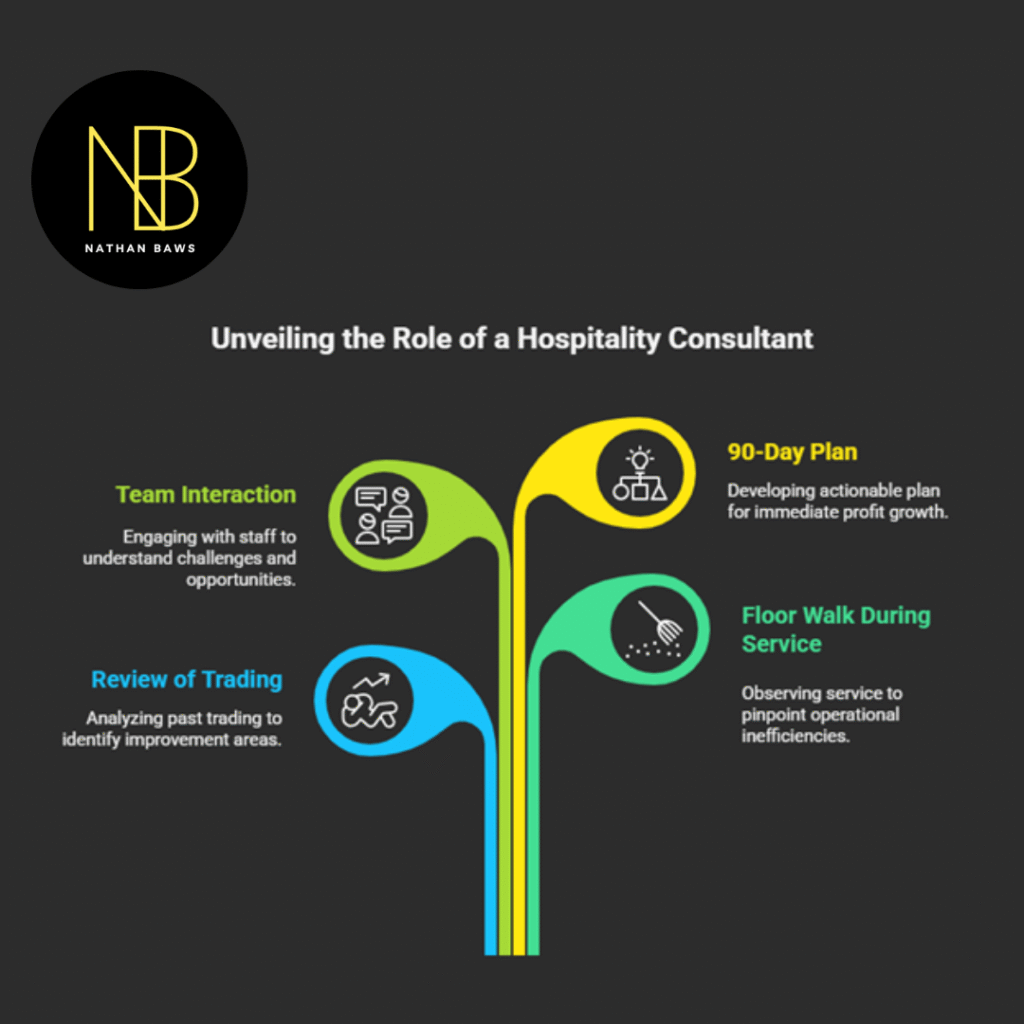
What is the primary role of a hospitality business consultant?
The primary role of a qualified hospitality business consultant is to thoroughly analyse a venue’s operational workflows and financial statements to maximise profitability. They design optimised menu structures, audit supply chains to eliminate waste, and implement data-driven staffing schedules. Their intervention transforms underperforming establishments into streamlined, highly scalable assets.
How does menu engineering improve a venue’s profit margins?
Menu engineering utilises algorithmic data analysis to position dishes based on profitability and popularity. By strategically placing high-margin items in primary focal zones, streamlining ingredient cross-utilisation, a hospitality business consultant can shift consumer choice. This scientific methodology increases gross margins without requiring an increase in menu pricing.
Why is labour optimisation critical in hospitality consulting?
Labour costs represent an exceptionally volatile variable expense in venue operations. A specialised hospitality business consultant replaces generic, static schedules with predictive templates backed by historical POS data trends. This process ensures front-of-house and back-of-house labour precisely matches consumer demand, eliminating costly overstaffing errors.
How can a venue successfully launch a high-margin catering arm?
Launching a successful catering stream requires leveraging existing kitchen infrastructure during underutilised morning hours. A hospitality business consultant designs specialised catering packages tailored for corporate clients, focusing entirely on high-yield menu items that transport well. This structural shift creates a predictable, pre-paid revenue stream independent of standard foot traffic.
What digital marketing strategies do hospitality consultants recommend?
Consultants prioritise hyper-local, high-conversion digital marketing frameworks rather than broad generic campaigns. This involves meticulous local search engine optimisation, targeted geographic social media ads aimed at nearby business professionals, and automated email nurturing campaigns sent directly to an internally owned VIP guest database to drive repeat business.
How often should a hospitality venue calculate its prime costs?
Prime costs must be calculated on a strict weekly basis rather than waiting for monthly accounting statements. A dedicated hospitality business consultant introduces real-time financial tracking dashboards. This immediate visibility allows management to rapidly modify labour allocation or address sudden supplier price creep before margins suffer.
What is the target prime cost percentage for a profitable venue?
While target metrics vary slightly depending on the specific operational model, a healthy, optimised venue should aim to keep total prime costs between fifty-five and sixty per cent of gross revenue. A hospitality business consultant systematically audits COGS and labour allocation models to safely guide an enterprise into this elite profitability bracket.
How do hospitality consultants address high kitchen waste?
Consultants eradicate kitchen waste by implementing standardised portion controls, precise daily prep sheets, and rigorous weekly inventory counts. Restructuring menus around cross-utilisable ingredients minimises spoilage, while posting visual plating guides ensures consistency across all kitchen shifts, effectively protecting ingredient cost models.
Why should tech stacks be integrated in modern venues?
Disjointed technology systems create major data blind spots and labour-intensive manual processing errors. A forward-thinking hospitality business consultant integrates the venue’s POS, scheduling, and accounting software into a unified ecosystem. This technological integration ensures seamless data transparency, giving operators instant clarity regarding daily profitability metrics.
How does an owner know when to hire a hospitality business consultant?
An owner should engage a hospitality business consultant when the venue is experiencing stagnant revenue growth, unexplainable cash flow shortages, high staff turnover, or severe margin compression. Bringing in objective, data-driven expertise allows owners to pinpoint hidden operational inefficiencies and rapidly implement proven strategic growth models.The first quarter – their stocktake time dropped from eight hours to ninety minutes a month.