Introduction
Finding the right business advisor in Perth shapes the future of your enterprise. This article explains how a professional advisor supports strategy, finance, operations and growth for businesses across Western Australia. It provides practical steps, structured frameworks and actionable advice to apply immediately. Whether you lead a startup, family enterprise or established firm, this guide shows how an advisor can deliver measurable results.
Key takeaways
- A business advisor provides strategic planning, financial insight and operational improvements tailored to Perth businesses.
- Engaging an advisor drives measurable growth through structured diagnostics, clear KPIs and ongoing coaching.
- Selecting the right advisor involves checking local experience, references, methodology and communication fit.
- Practical actions include a diagnostic audit, cash flow plan, customer segmentation, and a 90-day execution roadmap.
- Contact Nathan Baws for an initial consultation focused on outcomes, accountability, and local market knowledge.
Why hire a business advisor in Perth
Local market expertise from a business advisor
A business advisor with Perth experience understands Western Australia’s industry mix, regulatory environment and client expectations. Local knowledge helps tailor sales strategies, supply chain planning and workforce decisions to the Perth market.
Objective assessment from a business advisor
An advisor offers an independent, evidence-based assessment of your operations and finances. That objective perspective identifies blind spots and prioritises interventions that deliver return on investment.
Accountability and execution with a business advisor
Beyond advice, an advisor supports implementation with project management, performance tracking and coaching. Sustained follow-through transforms strategy into measurable business outcomes.
Core services offered by a business advisor
Strategic planning and market positioning
An advisor helps define competitive position, target segments and growth channels. This includes competitor analysis, value proposition development and a practical go-to-market plan.
Financial management and cashflow advisory
Effective financial controls, forecasting and cash flow forecasting are central services. A business advisor implements budgeting processes, scenario planning and KPI dashboards to improve financial resilience.
Operational improvement and systems
Improving processes, adopting technology, and enhancing supply chain resilience are typical engagements. A business advisor assesses current systems and recommends scalable, cost-effective solutions.
Selecting the right business advisor
Evaluating credentials and industry experience
Look for an advisor with relevant qualifications, case studies, and industry experience in sectors common to Perth, such as resources, professional services, and hospitality. Proven outcomes matter more than titles.
Assessing cultural and communication fit
Choose an advisor who communicates clearly, demonstrates respect for your team and aligns with your business culture. Effective collaboration accelerates implementation and results.
Reviewing fee structures and engagement models
An effective advisor outlines clear deliverables, timelines and fee models. Consider fixed-price diagnostics, retainer advisory or performance-linked arrangements depending on your needs.
How a business advisor diagnoses your business
Initial discovery and stakeholder interviews
An advisor begins with stakeholder interviews and document review to understand strategy, financials and operations. These conversations reveal priorities and constraints.
Data analysis and KPI benchmarking
Data-driven diagnostics compare your KPIs to industry benchmarks. A business advisor uses metrics such as gross margin, customer acquisition cost and employee productivity to identify gaps.
Delivering a prioritised action plan
The diagnostic concludes with a prioritised action plan, presented with milestones, owners, and expected impact. This ensures clarity and accountability for implementation.
Practical strategies from a business advisor to improve profit
Revenue growth through customer segmentation
An advisor helps segment customers by value, retention risk and acquisition cost. Tailored offerings and targeted marketing lift revenue per customer while reducing churn.
Margin improvement through cost-to-serve analysis
Analysing cost-to-serve by product or customer uncovers loss-making lines. A business advisor recommends rationalisation, pricing changes or process redesign to improve margins.
Efficiency gains via process automation
Automating repetitive tasks reduces errors and labour costs. A business advisor identifies automation opportunities in sales, invoicing and inventory management that deliver quick returns.
Scaling operations with a business advisor
Workforce planning and talent development
Scaling requires the right people and skills. A business advisor supports workforce planning, recruitment strategies and leadership development to sustain growth.
Systems and technology selection
A business advisor recommends scalable systems for CRM, accounting and operations. Proper selection reduces friction and supports multi-site expansion across Perth and beyond.
Franchising and expansion strategies
For businesses considering franchising or regional expansion, a business advisor evaluates model viability, operational manuals and compliance frameworks to reduce risk and accelerate rollout.
Risk Management: The Business Advisor’s Way
Financial risk and liquidity planning
A business advisor builds contingency plans and liquidity buffers. Scenario stress testing prepares businesses for downturns and supports lenders’ confidence during negotiations.
Regulatory and compliance risk
Compliance with Australian and Western Australian regulations is essential. A business advisor identifies obligations, implements controls and prepares documentation to avoid penalties.
Reputational and operational risk mitigation
Operational continuity plans, supplier diversification and customer communication strategies are central to reducing reputational and operational risks. A business advisor formalises these plans.
Engagement models: how a business advisor works with you
Project-based engagements
Project-based work suits discrete needs such as turnaround plans or system implementations. A business advisor defines scope, deliverables and exit criteria for clarity.
Ongoing advisory and retainer models
Retainer advisory provides continuous access to a business advisor for strategic oversight, monthly reporting and board-level support. This model supports long-term growth and accountability.
Performance-linked arrangements
When outcomes are clear, a business advisor may accept a performance-linked fee tied to defined milestones. This aligns incentives and focuses on measurable results.
Cost considerations for hiring a business advisor in Perth
Budgeting for advisory fees
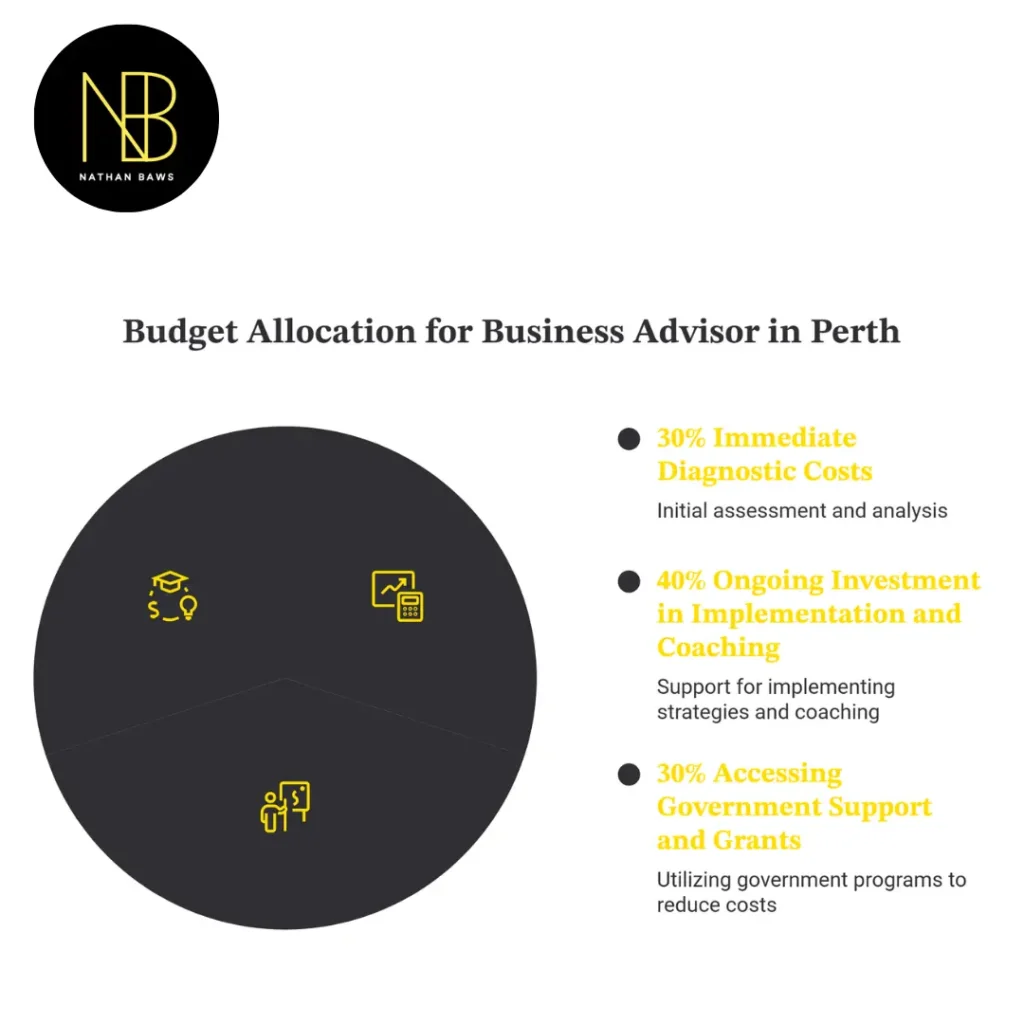
Advisory fees vary by scope and expertise. Budgeting for an advisor should consider immediate diagnostic costs and ongoing investment in implementation and coaching.
Return on investment expectations
A competent advisor presents conservative ROI estimates based on achievable improvements in revenue, margin and cash flow. Trackable KPIs confirm value over time.
Accessing government support and grants
There are local and federal programs in Australia that subsidise advisory services. An advisor can help identify applicable grants and prepare submissions to reduce net costs.
Actionable checklist from an advisor for the next 90 days
Days 1–30: Diagnostic and immediate wins
Engageana advisor to run a 30-day diagnostic: a financial health check, a customer profitability analysis, and a quick wins list. Implement easy actions such as overdue invoice recovery and pricing corrections.
Days 31–60: Implement systems and monitor KPIs
Adopt or refine CRM and accounting systems, set up KPI dashboards and start weekly performance reviews with owners. An advisor supports configuration and team training.
Days 61–90: Scale actions and lock in routines
Execute the 90-day roadmap: staff role clarity, process documentation and the first iteration of marketing campaigns. Review outcomes with your advisor and adjust priorities for the next quarter.
Measuring success with a business advisor
Define clear KPIs and success criteria
Success requires specific KPIs: revenue growth percentage, gross margin improvement, days sales outstanding and customer retention rates. An advisor sets targets based on current baselines.
Regular reporting and governance
Monthly reporting and governance meetings keep the leadership team accountable. A business advisor facilitates these sessions and ensures corrective actions are tracked.
Continuous improvement and learning
A culture of measurement and iteration ensures gains are sustainable. An advisor embeds review processes and continuous improvement routines within your business.
Case studies: outcomes delivered by a business advisor
Manufacturing SME: margin recovery
A Perth manufacturer engaged a business advisor to analyse product margins. By rationalising SKUs and renegotiating supplier terms, the business improved gross margin and freed working capital.
Professional services firm: scalable systems
A local consultancy adopted a CRM and billing automation based on advisor recommendations, reducing administrative time and improving client onboarding and retention.
Hospitality business: cashflow stabilisation
A restaurant group used an advisor to implement a rolling cash flow forecast and supplier consolidation. The intervention restored liquidity and supported expansion plans within six months.
Working with Nathan Baws as your business advisor
Local focus and practical outcomes
Nathan Baws brings Perth-focused advisory with emphasis on measurable outcomes. He combines strategic insight with hands-on execution to align teams and deliver results.
Tailored engagement and transparent fees
Nathan offers tailored engagement models including diagnostics, project work and ongoing advisory. Fees and deliverables are presented transparently to ensure mutual alignment.
Contact and next steps
To explore how an advisor can help your business, schedule an initial consultation with Nathan Baws. The conversation focuses on your objectives, constraints and a pragmatic roadmap for improvement.
Conclusion
Engaging an advisor in Perth strengthens strategy, improves financial resilience and accelerates growth. A skilled advisor brings objectivity, structured processes and accountability that turn plans into measurable outcomes. If you are ready to improve profitability, streamline operations and scale responsibly, contact Nathan Baws to discuss a tailored advisory engagement for your Perth business.
Contact Nathan Baws to arrange your initial business advisor consultation and begin a tailored roadmap to growth.
Frequently asked questions
What does a business advisor do?
An advisor diagnoses strategic, financial and operational issues, provides practical recommendations and supports implementation to improve business performance. They combine analysis with hands-on execution to deliver outcomes.
When should I hire a business advisor?
Engage an advisor when growth stalls, margins tighten, cash flow becomes unpredictable or when you require independent expertise for a strategic transition. Early intervention often yields better results.
How much does a business advisor cost in Perth?
Costs vary by scope and experience; options include fixed-price diagnostics, retainers or performance-linked fees. Discuss goals with the advisor to select the most appropriate model for value and risk.
Can a business advisor help with cash flow?
Yes. An advisor implements cash flow forecasting, working capital optimisation, and debtor management practices to improve liquidity and financial stability.
How long does it take to see results?
Initial improvements often occur within 30–90 days, yielding quick wins such as pricing adjustments or overdue invoice recovery. Sustained growth and system changes typically require ongoing work over several quarters.
Do business advisors work with small businesses?
Yes. advisors tailor their approach to a business’s size and maturity, delivering scalable solutions that align with resource constraints and growth ambitions.
What qualifications should a business advisor have?
Look for relevant industry experience, a strong commercial track record and evidence of successful client outcomes. Formal qualifications are useful, but demonstrated results matter most.
How does a business advisor measure success?
Success is measured through agreed KPIs such as revenue growth, margin improvement, reduced days sales outstanding and customer retention. Regular reporting confirms progress and guides adjustments.
Can a business advisor help with systems selection?
Yes. An advisor evaluates needs, compares solutions and supports implementation for CRM, accounting or operations systems to ensure they scale with the business.
How do I start working with a business advisor?
Begin with an initial consultation to define priorities, share key data and agree on a diagnostic scope. From there, an advisor will present a prioritised action plan with timelines and expected outcomes.