Introduction
Have you ever been in a room where the keynote address made people really listen? A talk that stayed in their minds long after they walked out the door? That is the ultimate goal of any speaker. I’m Nathan Baws. Over the years, I have helped countless individuals across Australia prepare for their address, and I have learned that a truly powerful speech isn’t about complex jargon or flashy theatrics. It’s about clear words, simple ideas, and meticulous preparation.
Whether this is your first keynote address or you have given hundreds before, the fundamental principles of engagement remain the same. The secret lies in understanding the psychology of your audience – what makes them lean in, what makes them remember, and what makes them change their behavior. In this guide, we will dive deep into the strategies that turn a standard speech into an unforgettable experience. We will explore how to build rapport instantly, how to structure your thoughts for maximum clarity, and how to leave a lasting impact that transcends the stage.
Key Takeaways
- The Hook: Begin your keynote address with a compelling element that demands immediate attention.
- The Blueprint: Keep the structure of your keynote address intuitive and easy to follow.
- The Value: Focus on providing practical, actionable ideas that people can implement immediately.
- The Foundation: Invest time in rigorous preparation to ensure you feel confident and composed.
- The Partnership: Expert guidance can help refine your delivery and amplify your message.
Start Your Keynote Address with Maximum Impact
The first few moments of your keynote address are undoubtedly the most critical. This brief window is when the audience subconsciously decides whether to invest their full attention or mentally “check out.” If you don’t capture them here, the rest of your address will be an uphill battle.
Why the Beginning Is So Important
I have observed numerous speakers lose their audience before they even finished their opening sentence. Starting with a standard, “Thanks for having me, I’m honored to be here,” is polite, but it’s also predictable and, quite frankly, boring. It doesn’t differentiate you from any other speaker they’ve heard. To truly command the room, you need to grab attention with surgical precision.
Effective openers often involve a provocative question or a startling statistic. For example, asking, “Have you ever left a professional conference feeling like you wasted eight hours of your life?” immediately validates a common audience frustration and signals that your talk will be different. Or, consider a fact: “Studies show that within 48 hours, most people forget 80% of what they hear in a lecture.” This creates a sense of urgency and shows that you understand the stakes. You are establishing yourself as a leader who values their time.
Master the “Hook” Technique
Think of your opening lines as a trailer for a blockbuster movie. You want to showcase the most exciting bits to ensure they stay for the whole show. During an event in Sydney, I experimented with an opening that was intentionally disruptive. I walked onto the stage, stood in silence for five seconds, and then asked, “Who here has mentally started writing their grocery list in the last five minutes?” The collective laughter broke the tension and instantly humanised me.
Your opening should always be about the audience. It’s not about your achievements; it’s about their needs. By addressing their potential scepticism or boredom head-on, you build a bridge of trust. Keep this introductory phase concise. Your goal is to provide a “north star” for the rest of your keynote address, showing them exactly where you are taking them and why the journey is worth it.
Common Pitfalls to Avoid
The most common mistake is the “biography trap.” Unless you are a global celebrity, the audience doesn’t need a five-minute rundown of your CV at the start. That information should be in the program or covered in the moderator’s introduction. Similarly, avoid “canned” jokes or forced icebreakers that don’t naturally lead into your topic. A clear, direct, and high-energy start is the best way to ensure the audience stays with you for the duration of the address.
Structure Your Keynote Address for Cognitive Ease
A powerful address requires a logical, transparent plan. If your thoughts are scattered, the audience’s attention will be too. A well-structured keynote address isn’t just easier for you to deliver; it’s significantly easier for the audience to digest and remember.
The Power of Simplicity
Human cognitive load is limited. When people are listening to a speech, they are processing your tone, body language, and content simultaneously. To help them, you must limit your core message to three to five key points. A popular and effective framework I often recommend is “Inspire, Teach, Act.”
- Inspire: Set the stage and create an emotional connection to the problem.
- Teach: Provide the new perspective or data that solves the problem.
- Act: Give them the specific steps to implement the solution.
Clearly signpost when you are moving from one section to another. Using phrases like “Now that we’ve seen the challenge, let’s move on to the solution” acts as mental checkpoints. This ensures that even if someone’s mind wanders for a moment, they can easily jump back in without feeling lost.
Building Your Narrative Arc
Every great keynote address follows a narrative arc. Start with an introduction that defines the current “status quo.” Then, introduce a “complication” or a challenge that the audience recognises. The middle of your address is where you provide the “resolution” – your unique insights or strategies. Finally, the conclusion provides the “new reality” – what life or business looks like once your advice is applied.
Within each point, follow a consistent sub-structure:
- State the Idea: Make it clear and punchy.
- Illustrate with an Example: Use a case study or personal anecdote.
- Provide a Takeaway: Tell them exactly how to use that information.
At the end of your talk, briefly summarise these points. Repetition is the mother of retention. By following this simple structure, you transform your address from a collection of words into a cohesive, persuasive argument.
A Proven Framework in Action
At a large-scale corporate event in Melbourne, we worked with a speaker who was struggling to condense twenty years of experience into a twenty-minute slot. By applying the “Rule of Three,” we stripped away the secondary details and focused on their three most impactful lessons. The result was a keynote address that was hailed as the highlight of the summit. People didn’t just walk away saying “that was good”; they walked away able to recite the three things they were going to change in their business the following Monday.
Maximising Audience Involvement and Engagement
If your keynote address feels like a one-way lecture, you are fighting a losing battle against the human attention span. A truly great address is a communal experience. When the audience feels like they are participating rather than just spectating, their engagement levels skyrocket.
Why Active Involvement Is Non-Negotiable
Research consistently shows that active participants retain information much better than passive listeners. This is true whether you are addressing university students, mid-level managers, or high-level business leaders. When you engage the audience, you aren’t just giving them information; you are giving them an experience. This creates an emotional anchor for your message.
Involvement doesn’t have to mean calling people up on stage – which can often cause anxiety for the audience. It can be as simple as changing the syntax of your speech to include “we” and “you” more frequently. It transforms the address from “Here is what I know” to “Here is what we can achieve together.”
Practical Engagement Strategies
There are several low-friction ways to involve your audience:
- Rhetorical and Direct Questions: “How many of you have felt overwhelmed this week?” vs. “Think about the one thing that would double your productivity.” Both keep the brain active.
- The “Turn and Talk”: Ask the audience to spend 60 seconds sharing a specific thought with the person sitting next to them. This creates a buzz in the room and resets the attention clock.
- Real-Time Polling: Use a simple show of hands or digital polling tools. “Raise your hand if you think AI will change your job in the next year.” This gives you immediate data and makes the audience feel heard.
- The “Call and Response”: In more high-energy settings, having the audience repeat a key phrase can be very powerful for memory.
Tailoring Engagement to the Demographic
Different groups respond to different types of engagement. A group of tech entrepreneurs might enjoy a fast-paced, data-driven poll, whereas a group of educators might appreciate a more reflective “turn and talk” exercise. At a recent event in Perth, we worked with a speaker addressing a room of senior executives. Instead of an icebreaker, they started with a “challenging fact” poll that required the execs to guess a industry statistic. It immediately engaged their competitive nature and focused them on the topic at hand.
Always observe the room. If you notice a “slump” in energy around the 15-minute mark, that’s your cue to introduce an interactive element. A good keynote address is a living, breathing thing that adapts to the energy of the people in the room.
The Art of Storytelling: Making Points Memorable
Facts tell, but stories sell. In the context of a keynote address, stories are the “glue” that makes your data and your advice stick in the minds of your audience. Without them, your talk is just a series of disconnected facts; with them, it becomes a journey.
The Science Behind the Story
Our brains are literally wired for narrative. When we hear a story, our brains release oxytocin, which helps us build trust and empathy with the speaker. Studies have shown that people are up to 22 times more likely to remember a fact when it is wrapped in a story. If your address is the “meal,” stories are the seasoning that makes it palatable and memorable.
A story provides context. It takes an abstract concept – like “resilience” – and shows it in action. Whether it’s a story about a team overcoming a major setback or a personal lesson you learned the hard way, these moments are what the audience will discuss during the coffee break.
How to Select and Craft Your Stories
Not all stories are created equal. To be effective in a keynote address, a story must meet three criteria:
- Relevance: It must directly support the point you are trying to make.
- Relatability: The audience must be able to see themselves or their challenges in the story.
- Brevity: It should be a “short story,” not an epic. Aim for 90 seconds to two minutes.
For a business-focused address, use stories of corporate turnarounds or innovation. For example, tell the story of a Brisbane-based company that was on the verge of bankruptcy but used a “customer-first” pivot to increase sales by 20% in six months. For an educational audience, share a story of a student who transformed their trajectory through a single shift in mindset. Always conclude the story by explicitly linking it back to your main point. “The reason I share this story is that…”
Finding the Right Balance
While stories are powerful, they shouldn’t overwhelm the substance of your address. A good rule of thumb is one impactful story for each of your main points. In a recent keynote, we helped a client balance a high-level statistical analysis of market trends with a single, moving story about an individual employee impacted by those trends. The data provided the “head” (credibility), while the story provided the “heart” (connection). This combination is what makes a keynote address truly influential.
Preparation: The Secret to Unshakeable Confidence
Confidence on stage is rarely a natural gift; it is a byproduct of preparation. If you want your keynote address to feel effortless, you have to put in the effort behind the scenes. When you are fully prepared, you are no longer worried about “what comes next,” which allows you to be fully present with your audience.
The Psychology of Preparation
The biggest source of “stage fright” is the fear of the unknown – forgetting a line, a technical glitch, or a difficult question. Preparation systematically removes these unknowns. When you know your content inside and out, your brain can focus on delivery, tone, and audience connection. You aren’t just reciting a script; you are sharing a message you truly own.
Preparation also gives you the flexibility to handle the unexpected. If a fire alarm goes off or a projector fails, a prepared speaker can continue without missing a beat because the message is in their head, not just on their slides. This level of composure is what separates amateur speakers from professionals.
A Step-by-Step Preparation Routine
- Internalise, Don’t Memorise: Don’t try to remember every single word. Instead, memorise the “milestones” – the opening, the transitions between points, and the closing. This makes your delivery sound more natural and conversational.
- The “Out Loud” Test: You must say your talk out loud. What looks good on paper often sounds clunky when spoken. Listen for awkward phrasing or sentences that are too long to say in one breath.
- Seek Objective Feedback: Record yourself or ask a trusted colleague to watch a rehearsal. Ask them specifically where they felt “bored” or “confused.”
- The “Dress Rehearsal”: Practice in the clothes you plan to wear. It sounds small, but it helps you feel comfortable and “in character” on the day.
- Technical Walkthrough: If possible, visit the venue beforehand. Check the acoustics, the stage layout, and the tech setup.
Managing Pre-Address Nerves
Even the most seasoned speakers feel a flutter of nerves. The key is to reframe that nervous energy as “excitement.” Physically, the two sensations are almost identical. Use “box breathing” – inhale for four, hold for four, exhale for four, hold for four – to calm your nervous system.
One speaker I coached used to get paralyzed by nerves before their annual keynote address. We implemented a ritual of “visualisation” where they would spend ten minutes before the talk picturing the audience nodding in agreement and the final round of applause. By the time they stepped on stage, their brain felt like the success had already happened. Being ready isn’t just about the words; it’s about the mindset.
Tailoring Your Message to the Audience’s Vibe
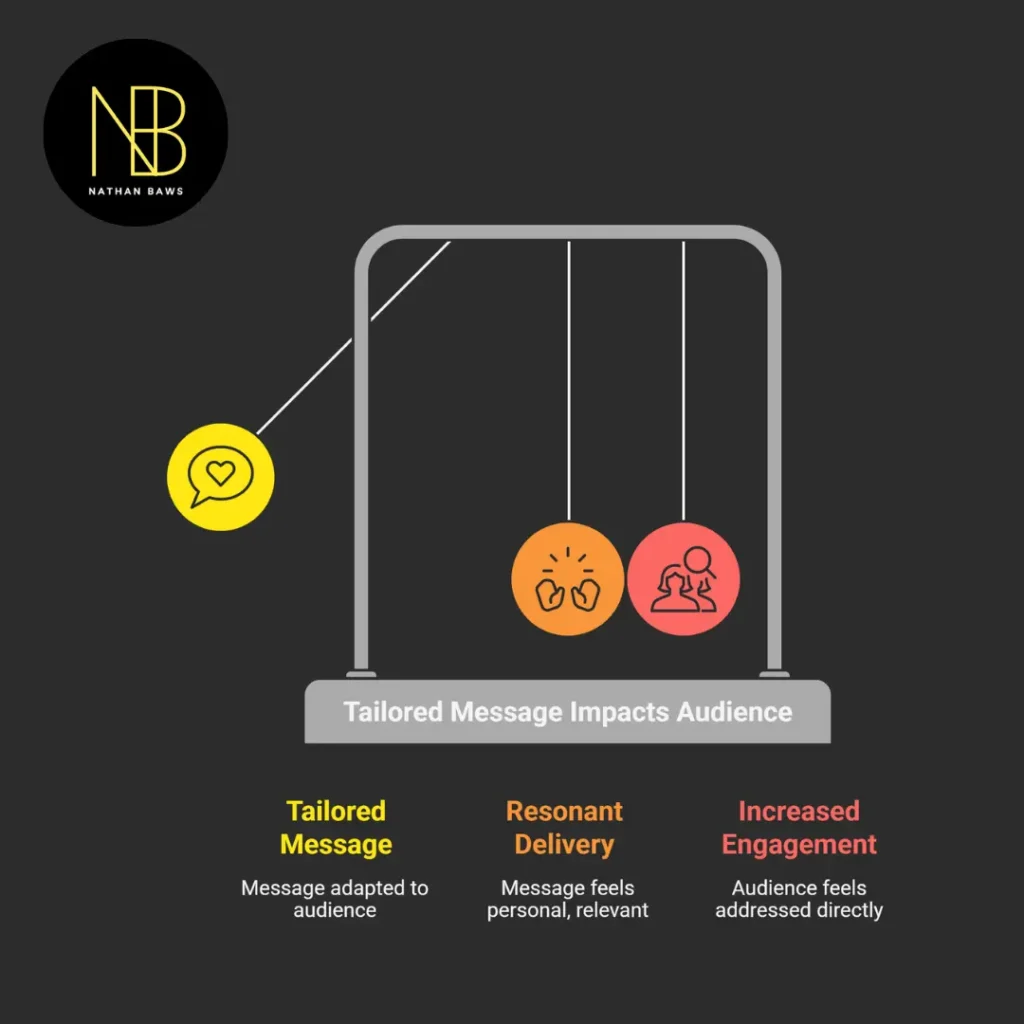
A “one-size-fits-all” approach is the fastest way to make a keynote address feel impersonal and irrelevant. Your message might be the same, but the delivery must change based on the specific people in the room. A talk that resonates in a boardroom might fall flat in a school gymnasium.
Understanding Your Demographic
Before you even start writing, you need to conduct “audience research.”
- Who are they? (Age, profession, industry)
- What is their current state? (Stressed, excited, sceptical, tired)
- What is their “Win”? (What do they hope to gain from this talk?)
A keynote address for high school students should be high-energy, visually driven, and focused on future possibilities. Conversely, an address for a group of veteran CEOs should be data-heavy, direct, and focused on strategic outcomes. By speaking their language and using examples that reflect their daily lives, you make them feel like the address was written specifically for them.
Reading the Room in Real-Time
Preparation gets you to the stage, but “presence” keeps you there. During your keynote address, you must be a student of the audience’s reactions.
- The “Nod” Factor: If people are nodding and making eye contact, you’re on the right track.
- The “Lean”: When people lean forward, they are deeply engaged. Lean into that point.
- The “Fidget”: If you see people checking watches or shifting in their seats, it’s time to speed up, tell a story, or introduce an interactive element.
I witnessed this beautifully handled at a Canberra event where the audience seemed particularly drained after a long morning session. The speaker noticed the low energy, paused their scripted address, and said, “I can see the coffee hasn’t kicked in yet. Let’s do a quick 30-second stretch before we get to the most important part of my talk.” It completely reset the room.
Flexible Delivery Techniques
If the group is highly interactive and chatty, use that energy! Ask more questions and let them contribute. If they are a more reserved or “academic” group, focus on providing high-value facts and clearly cited research. For a serious crowd, keep the humour minimal and the insights professional. For a creative crowd, feel free to use more metaphors and abstract concepts. The goal is always the same: to make the audience feel that your keynote address is a solution tailored to their specific needs.
Using Visuals to Amplify (Not Replace) Your Message
In the digital age, slides and visuals are often expected, but they are frequently misused. A good visual should be like a backup singer – there to support the lead performer (you), not to take over the show. When used correctly, visuals can significantly increase the retention and clarity of your keynote address.
The Psychology of Visual Learning
The “Picture Superiority Effect” suggests that people remember information far better when it is presented as an image rather than just words. A simple chart can communicate a complex market trend faster than a five-minute explanation. Visuals also provide a mental “rest” for the audience, giving them something else to focus on while they process your words.
However, the human brain cannot read and listen at the same time. If your slides are full of bullet points and long sentences, the audience will stop listening to you so they can read the slide. This is known as “cognitive interference” and it’s the fastest way to lose a room.
Designing High-Impact Visuals
- The “Six-Word” Rule: Aim for no more than six words per slide. Use the slide for the “headline,” and use your voice for the details.
- High-Quality Imagery: Use professional, high-resolution photos that evoke emotion or illustrate a point. Avoid generic clipart.
- Data Visualisation: Instead of a spreadsheet, use a simple, clean graph. Highlight the most important number in a contrasting colour.
- Consistency: Use a consistent colour palette and font style. This makes your address feel professional and polished.
During a Sydney event, we helped a speaker who had 50 slides for a 20-minute talk. We cut it down to 10 high-impact images. One slide was just a picture of a single, growing seedling to illustrate “potential.” That one image stayed with the audience more than fifty slides of data ever could.
Managing the Technical Side
Tech glitches are the enemy of momentum. Always check your visuals in the actual venue. Ensure your videos play with sound and that your fonts haven’t shifted.
- The “Blank Slide” Trick: If you want the audience’s absolute focus for a particularly important or emotional point, use a black slide. This “turns off” the screen and forces every eye in the room onto you.
- The Remote Clicker: Never say “next slide, please.” Use a wireless clicker so you can move around the stage freely. This maintains your status as the authority in the room. Your visuals should be a seamless part of your keynote address, helping you tell a more compelling story.
Closing with Impact: The “Call to Action”
The final minutes of your address are your last opportunity to seal your message. This is when you transition from being a “speaker” to being a “catalyst.” A weak ending can diminish a great talk, but a powerful ending can make a mediocre talk legendary.
Why the Conclusion Is Your “Final Impression”
The “Peak-End Rule” in psychology suggests that people judge an experience largely based on how they felt at its peak and at its end. If you trail off with a “So, yeah, that’s basically it,” or a rushed “Thanks for listening,” you are throwing away your most valuable real-time.
Your conclusion serves two purposes: to summarise the “what” and to emphasise the “why.” You want to leave the audience feeling energised, informed, and – most importantly – ready to do something. The end of your address should be the emotional high point of the entire experience.
How to Craft a Memorable Finish
- The Summary Recap: Briefly reiterate your three main points. “Today, we’ve looked at how to hook your audience, how to structure for clarity, and how to engage with authenticity.”
- The Emotional “Why”: Remind them of the stakes. Why does this matter? “Because every time you step on that stage, you have the chance to change a life.”
- The Call to Action (CTA): This is the most important part. Give them one specific, small thing they can do in the next 24 hours. “I want you to go home tonight and write down the one story that defines your business.”
- The “Bookend”: If you started with a specific story or question, refer back to it. This creates a sense of completion and “wholeness” for the audience.
Avoiding Common Closing Flops
Do not introduce new information in the conclusion. Do not apologise for going over time or for technical issues. And please, do not end with a Q&A session. While Q&A is important, it often ends on a “flat” note with a highly specific or technical question. Instead, take the questions before your final closing statement. This ensures that the very last words the audience hears from you are your most inspiring and powerful ones.
At a recent keynote address, we asked the audience to take out their phones and send themselves a one-sentence email starting with “I will…” followed by their main takeaway from the talk. The room was silent as 500 people committed to an action. That is how you end an address – not with a whimper, but with a spark.
Conclusion
There you have it – the comprehensive secrets to delivering a keynote address that captivates and inspires. From the surgical precision of your opening hook to the lingering impact of your final call to action, every element of your speech is an opportunity to connect and influence. Whether you are speaking to a small team in a boardroom or a massive crowd at a national conference, these principles will serve as your roadmap to success.
At Nathan Baws, we are passionate about the power of the spoken word. We believe that a great keynote address doesn’t just inform; it transforms. We’ve spent decades helping leaders across Australia find their voice and own their stage. If you’re ready to level up your skills, refine your message, or bring a new level of energy to your next talk, we’d love to help. Pop over to nathanbaws.com for a yarn – we’d love to help you nail your next address and leave your audience truly wowed.
Read Also: Unconventional Wisdom: 10 Growth Strategies from Leading Corporate Speakers Australia, Nathan Baws
FAQs
What is the single most important factor in a great keynote address?
While many factors contribute, the most important is “Audience Value.” Every word, story, and slide must be designed to serve the people sitting in the seats. If the audience doesn’t feel that the talk is relevant to their lives or challenges, they will disengage. A great address is built on a foundation of empathy and a genuine desire to provide a solution or a new perspective.
How can I effectively manage stage fright before a major keynote address?
The most effective way to combat nerves is through rigorous preparation and physical grounding. Knowing your material inside and out reduces the fear of the unknown. On the day, use “box breathing” or “power posing” (standing in a confident, open stance for two minutes) to lower your cortisol levels. Remember that the audience wants you to succeed; they are on your side!
How long should a standard keynote address be?
The “sweet spot” is typically between 20 and 45 minutes. Any shorter, and it’s hard to build enough depth; any longer, and you risk losing the audience’s attention. Even if you are given a 60-minute slot, aim for 40 minutes of content followed by 20 minutes of engagement or Q&A. Brevity is a sign of respect for your audience’s time.
Is it better to use a script or speak from notes?
Neither! The best delivery is “extemporaneous.” This means you have a deep understanding of your main points and stories (your milestones), but you choose the specific words in the moment. This makes you sound more human and allows you to react to the audience. If you use a full script, you often sound robotic; if you use no notes, you risk getting lost. Aim for a “bullet point” outline on a small tablet or cards.
How do I handle a “tough” or unengaged audience during an address?
First, don’t take it personally. They might just be tired or have other things on their mind. Increase your energy, shorten your points, and introduce a “pattern interrupt” – like a sudden question or a physical activity. If you acknowledge the energy in the room (“I know it’s been a long day, so let’s get straight to the point”), it often wins them over.
Should I include a Q&A session at the end of my keynote address?
Q&A is a great way to deepen the engagement, but it should not be the last thing you do. Take questions five to ten minutes before you are scheduled to finish. Answer them concisely, then transition back to your prepared closing statement. This ensures you maintain control of the final emotional “landing” of the talk.
How many slides should I have for a 30-minute keynote address?
There is no “perfect” number, but a common mistake is having too many. Focus on quality over quantity. Ten high-impact, visually stunning slides are better than thirty slides full of text. Remember, the slides are there to illustrate your points, not to act as your teleprompter.
How can I make my keynote address more inclusive for a diverse audience?
Inclusivity starts in the planning phase. Use diverse examples and stories that represent different backgrounds, genders, and industries. Avoid jargon or slang that might exclude certain groups. Ensure your visuals use high-contrast colours for readability. Most importantly, speak with a tone of respect and curiosity that welcomes everyone into the conversation.
What is the best way to practice a keynote address?
Practice out loud, standing up, and moving as if you were on stage. Record yourself and watch it back – though painful, it is the fastest way to spot repetitive gestures or “filler words” like “um” and “ah.” Practice in different environments with background noise to build your focus and resilience.
How can I ensure my message actually leads to action after the event?
You must give the audience a “low barrier to entry” first step. Instead of saying “Change your entire business model,” say “Identify one process you can automate tomorrow.” Providing a physical or digital takeaway, like a checklist or a summary sheet, also helps bridge the gap between inspiration and implementation. Follow up with the organiser to see if you can send a “check-in” email to the attendees a week later.